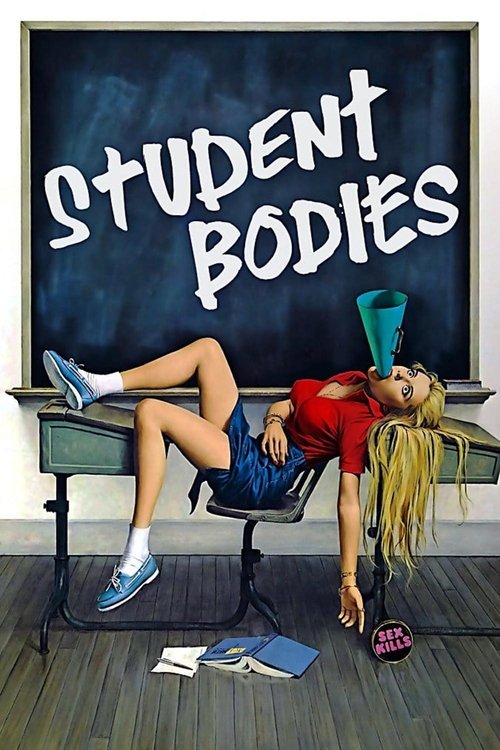
Student Bodies
This zany send-up of teen slasher flicks features a maniacal psycho known as the Breather, who stalks –and murders– promiscuous students at a suburban high school. The fanatical killer's unusual weapons include paper clips, blackboard erasers and eggplants.
The film earned $5.2M at the global box office.


Plot Structure
Story beats plotted across runtime


Narrative Arc
Emotional journey through the story's key moments
Story Circle
Blueprint 15-beat structure
Arcplot Score Breakdown
Weighted: Precision (70%) + Arc (15%) + Theme (15%)
Student Bodies (1981) exemplifies meticulously timed narrative architecture, characteristic of Mickey Rose's storytelling approach. This structural analysis examines how the film's 15-point plot structure maps to proven narrative frameworks across 1 hour and 26 minutes. With an Arcplot score of 7.5, the film showcases strong structural fundamentals.
Characters
Cast & narrative archetypes

Toby
The Breather
Principal Peters
Miss Mumsley
Malvert
Hardy
Patti
Main Cast & Characters
Toby
Played by Kristen Riter
The virginal heroine trying to survive a serial killer targeting sexually active teens at Lamab High School
The Breather
Played by Richard Brando
The mysterious heavy-breathing killer who targets promiscuous students with absurd weapons
Principal Peters
Played by Joe Flood
The stern and suspicious high school principal investigating the murders
Miss Mumsley
Played by Mimi Weddell
The eccentric school nurse with odd mannerisms and suspicious behavior
Malvert
Played by Joe Talarowski
The nerdy janitor with a bizarre fixation on garbage bags and unusual behavior
Hardy
Played by Matthew Goldsby
Toby's boyfriend who respects her virginity but becomes a suspect
Patti
Played by Lisa Welch
Toby's best friend, one of the promiscuous students targeted by the killer
Structural Analysis
The Status Quo at 1 minutes (1% through the runtime) establishes Opening establishes the slasher movie setup: a high school where students are being killed. On-screen text announces it's "Jamie Lee Curtis's birthday" and a "holiday," immediately signaling the film's parodic tone and the world of horror clichés we're entering.. Structural examination shows that this early placement immediately immerses viewers in the story world.
The inciting incident occurs at 10 minutes when Toby discovers she's connected to all the murder victims—each one was someone she knew or had just spoken with. The killer seems to be targeting people around her specifically, making her either a suspect or the ultimate target.. At 12% through the film, this Disruption aligns precisely with traditional story structure. This beat shifts the emotional landscape, launching the protagonist into the central conflict.
The First Threshold at 22 minutes marks the transition into Act II, occurring at 26% of the runtime. This illustrates the protagonist's commitment to Toby actively decides to investigate the murders herself rather than remain passive. She commits to uncovering the Breather's identity, crossing into the dangerous territory of amateur sleuthing while the body count continues to rise., moving from reaction to action.
At 43 minutes, the Midpoint arrives at 50% of the runtime—precisely centered, creating perfect narrative symmetry. Structural examination shows that this crucial beat The parade sequence and pep rally bring false security before a major kill. The stakes shift dramatically—this is no longer just about random victims. Toby realizes the killer is specifically toying with her, and suspects begin to narrow. The game becomes personal., fundamentally raising what's at risk. The emotional intensity shifts, dividing the narrative into clear before-and-after phases.
The Collapse moment at 64 minutes (74% through) represents the emotional nadir. Here, Toby is cornered, with evidence mounting against her and the true killer still unknown. Her allies are dead or missing, and she faces the classic final girl scenario alone. The comedic tone gives way to genuine tension as the endgame approaches., indicates the protagonist at their lowest point. This beat's placement in the final quarter sets up the climactic reversal.
The Second Threshold at 68 minutes initiates the final act resolution at 79% of the runtime. Toby discovers a crucial clue about the killer's identity, synthesizing all the absurd hints the film has dropped. She realizes the truth has been hiding in plain sight—and prepares to confront the Breather in the climactic showdown., demonstrating the transformation achieved throughout the journey.
Emotional Journey
Student Bodies's emotional architecture traces a deliberate progression across 15 carefully calibrated beats.
Narrative Framework
This structural analysis employs structural analysis methodology used to understand storytelling architecture. By mapping Student Bodies against these established plot points, we can identify how Mickey Rose utilizes or subverts traditional narrative conventions. The plot point approach reveals not only adherence to structural principles but also creative choices that distinguish Student Bodies within the comedy genre.
Comparative Analysis
Additional comedy films include The Bad Guys, Ella Enchanted and The Evening Star.
Plot Points by Act
Act I
SetupStatus Quo
Opening establishes the slasher movie setup: a high school where students are being killed. On-screen text announces it's "Jamie Lee Curtis's birthday" and a "holiday," immediately signaling the film's parodic tone and the world of horror clichés we're entering.
Theme
The on-screen body count ticker appears, with a character noting how predictable these situations are. The theme is stated through meta-commentary: in slasher films, certain behaviors (sex, isolation) guarantee death—a rule the film will mock relentlessly.
Worldbuilding
The world of Lamab High School is established through a series of murders targeting sexually active teenagers. We meet the cast of suspects and potential victims, including virginal protagonist Toby, the strange janitor Malvert, and various authority figures. The Breather's heavy breathing becomes the killer's signature.
Disruption
Toby discovers she's connected to all the murder victims—each one was someone she knew or had just spoken with. The killer seems to be targeting people around her specifically, making her either a suspect or the ultimate target.
Resistance
Toby debates whether to investigate or flee. She encounters various potential mentors and suspects, including the bizarre Malvert who speaks in horse-whinnies. School authorities are useless, parodying the incompetent adults of slasher films. Toby must decide whether to take matters into her own hands.
Act II
ConfrontationFirst Threshold
Toby actively decides to investigate the murders herself rather than remain passive. She commits to uncovering the Breather's identity, crossing into the dangerous territory of amateur sleuthing while the body count continues to rise.
Mirror World
Toby's relationship with Malvert the janitor deepens as he becomes an unlikely ally. Despite his creepy demeanor and being the obvious suspect, Malvert represents the film's thesis: appearances in horror movies are deceiving, and the weird outsider isn't always the killer.
Premise
The "fun and games" of the parody unfold: increasingly absurd murders using household objects (paper clips, garbage bags, eggplants), meta-humor about horror conventions, the running body count on screen, and elaborate sight gags. Toby investigates while the Breather racks up victims in ridiculous ways.
Midpoint
The parade sequence and pep rally bring false security before a major kill. The stakes shift dramatically—this is no longer just about random victims. Toby realizes the killer is specifically toying with her, and suspects begin to narrow. The game becomes personal.
Opposition
Pressure mounts as Toby becomes the prime suspect. Evidence seems to point to her, and she must evade both the killer and the authorities. Trust breaks down—anyone could be the Breather. The parody elements intensify with the infamous R-rating gag breaking the fourth wall.
Collapse
Toby is cornered, with evidence mounting against her and the true killer still unknown. Her allies are dead or missing, and she faces the classic final girl scenario alone. The comedic tone gives way to genuine tension as the endgame approaches.
Crisis
Toby processes her isolation and fear. In true slasher fashion, she's alone in the school at night, the Breather closing in. The dark night of the soul plays out through empty hallways and mounting dread, parodying while honoring the genre's conventions.
Act III
ResolutionSecond Threshold
Toby discovers a crucial clue about the killer's identity, synthesizing all the absurd hints the film has dropped. She realizes the truth has been hiding in plain sight—and prepares to confront the Breather in the climactic showdown.
Synthesis
The climactic confrontation unfolds as Toby faces the Breather. The killer's identity is revealed in a twist that parodies slasher conventions—multiple people were potentially the killer, subverting the genre's need for a single unmasking. Toby fights back and the chaos reaches peak absurdity.
Transformation
In the final twist, the film's meta-nature comes full circle. Toby survives—or does she? The ending questions reality itself, suggesting everything may have been a dream, a movie, or both. The final image subverts the "final girl survives" trope with one last gag.