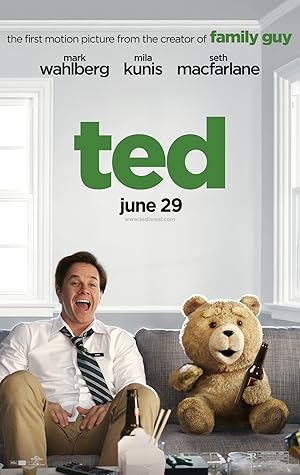
Ted
John makes a Christmas miracle happen by bringing his one and only friend to life, his teddy bear. The two grow up together and John must then choose to stay with his girlfriend or keep his friendship with his crude and extremely inappropriate teddy bear, Ted.
Despite a moderate budget of $50.0M, Ted became a box office phenomenon, earning $549.4M worldwide—a remarkable 999% return.
Nominated for 1 Oscar. 13 wins & 28 nominations


Plot Structure
Story beats plotted across runtime


Narrative Arc
Emotional journey through the story's key moments
Story Circle
Blueprint 15-beat structure
Arcplot Score Breakdown
Weighted: Precision (70%) + Arc (15%) + Theme (15%)
Ted (2012) exhibits precise plot construction, characteristic of Seth MacFarlane's storytelling approach. This structural analysis examines how the film's 15-point plot structure maps to proven narrative frameworks across 1 hour and 47 minutes. With an Arcplot score of 6.3, the film takes an unconventional approach to traditional narrative frameworks.
Characters
Cast & narrative archetypes

John Bennett
Ted
Lori Collins
Donny
Robert
Main Cast & Characters
John Bennett
Played by Mark Wahlberg
A 35-year-old man stuck in arrested development, unable to let go of his childhood teddy bear while trying to maintain his relationship with his girlfriend.
Ted
Played by Seth MacFarlane
John's living teddy bear and best friend since childhood, a crude party-loving bear who enables John's immaturity while hiding his own abandonment fears.
Lori Collins
Played by Mila Kunis
John's patient and supportive girlfriend who loves him deeply but grows frustrated with his inability to grow up and prioritize their relationship.
Donny
Played by Giovanni Ribisi
A creepy, obsessive fan of Ted from childhood who has developed an unhealthy fixation and wants to own Ted for his adult son.
Robert
Played by Aedin Mincks
Donny's overweight adult son who is emotionally stunted and shares his father's obsession with possessing Ted.
Structural Analysis
The Status Quo at 1 minutes (1% through the runtime) establishes Young John Bennett, a lonely outcast in 1985 Boston, receives a teddy bear for Christmas and wishes it could be his real friend. The wish comes true, establishing their magical bond.. Of particular interest, this early placement immediately immerses viewers in the story world.
The inciting incident occurs at 13 minutes when After four years together, Lori confronts John about their future. She needs him to grow up and asks if Ted could move out. John's comfortable status quo is directly challenged.. At 12% through the film, this Disruption aligns precisely with traditional story structure. This beat shifts the emotional landscape, launching the protagonist into the central conflict.
The First Threshold at 27 minutes marks the transition into Act II, occurring at 25% of the runtime. This indicates the protagonist's commitment to John commits to Lori and helps Ted move into his own apartment. He actively chooses to prioritize his adult relationship, seemingly ready to grow up. Ted gets a job at a grocery store., moving from reaction to action.
At 54 minutes, the Midpoint arrives at 50% of the runtime—precisely centered, creating perfect narrative symmetry. Significantly, this crucial beat John ditches Lori's important work party to hang out with Ted and Sam Jones. Lori discovers him at Ted's apartment, high and partying. She realizes John hasn't changed at all. False defeat: John's dual life collapses., fundamentally raising what's at risk. The emotional intensity shifts, dividing the narrative into clear before-and-after phases.
The Collapse moment at 80 minutes (75% through) represents the emotional nadir. Here, Lori breaks up with John definitively after discovering his lies. John blames Ted for all his problems and tells him to get out of his life. John has lost both Lori and his best friend. He's completely alone., demonstrates the protagonist at their lowest point. This beat's placement in the final quarter sets up the climactic reversal.
The Second Threshold at 86 minutes initiates the final act resolution at 80% of the runtime. John realizes he must save Ted and calls Lori for help. He chooses to act like an adult by taking responsibility while also honoring his friendship. He synthesizes maturity with loyalty., demonstrating the transformation achieved throughout the journey.
Emotional Journey
Ted's emotional architecture traces a deliberate progression across 15 carefully calibrated beats.
Narrative Framework
This structural analysis employs proven narrative structure principles that track dramatic progression. By mapping Ted against these established plot points, we can identify how Seth MacFarlane utilizes or subverts traditional narrative conventions. The plot point approach reveals not only adherence to structural principles but also creative choices that distinguish Ted within the comedy genre.
Seth MacFarlane's Structural Approach
Among the 3 Seth MacFarlane films analyzed on Arcplot, the average structural score is 7.0, demonstrating varied approaches to story architecture. Ted takes a more unconventional approach compared to the director's typical style. For comparative analysis, explore the complete Seth MacFarlane filmography.
Comparative Analysis
Additional comedy films include The Bad Guys, Ella Enchanted and The Evening Star. For more Seth MacFarlane analyses, see Ted 2, A Million Ways to Die in the West.
Plot Points by Act
Act I
SetupStatus Quo
Young John Bennett, a lonely outcast in 1985 Boston, receives a teddy bear for Christmas and wishes it could be his real friend. The wish comes true, establishing their magical bond.
Theme
The narrator states that no matter how big a splash you make, eventually nobody cares. Ted went from celebrity to obscurity. This foreshadows the theme: childhood magic fades, and growing up is inevitable.
Worldbuilding
We meet adult John as a slacker working at a rental car company, still living with Ted. His girlfriend Lori tolerates Ted but wants John to mature. Their Boston world of pot smoking, Flash Gordon worship, and arrested development is established.
Disruption
After four years together, Lori confronts John about their future. She needs him to grow up and asks if Ted could move out. John's comfortable status quo is directly challenged.
Resistance
John debates between his loyalty to Ted and his relationship with Lori. Ted reluctantly agrees to find his own apartment. John struggles with the idea of separation from his lifelong companion while trying to appease Lori.
Act II
ConfrontationFirst Threshold
John commits to Lori and helps Ted move into his own apartment. He actively chooses to prioritize his adult relationship, seemingly ready to grow up. Ted gets a job at a grocery store.
Mirror World
Lori and John's relationship deepens as she shows faith in his ability to change. Simultaneously, we're introduced to Donny and his son who are obsessed with owning Ted, establishing the external threat.
Premise
The fun and games of Ted living independently while John tries to balance both worlds. Ted's wild party with Sam Jones from Flash Gordon, workplace antics at the grocery store, and John repeatedly being pulled back into immature behavior with Ted.
Midpoint
John ditches Lori's important work party to hang out with Ted and Sam Jones. Lori discovers him at Ted's apartment, high and partying. She realizes John hasn't changed at all. False defeat: John's dual life collapses.
Opposition
John desperately tries to win Lori back. Rex, Lori's sleazy boss, makes his move on her. John's attempts at maturity backfire. Ted's advice proves counterproductive. Donny's stalking intensifies. John loses Lori when she discovers Ted helped cover his lie about the Tami-Lynn incident.
Collapse
Lori breaks up with John definitively after discovering his lies. John blames Ted for all his problems and tells him to get out of his life. John has lost both Lori and his best friend. He's completely alone.
Crisis
John wallows in misery, having pushed away everyone who matters. Ted is kidnapped by Donny and his son. John receives Ted's desperate call for help, forcing him to confront what truly matters.
Act III
ResolutionSecond Threshold
John realizes he must save Ted and calls Lori for help. He chooses to act like an adult by taking responsibility while also honoring his friendship. He synthesizes maturity with loyalty.
Synthesis
John and Lori team up to rescue Ted from Donny at Fenway Park. Ted is ripped apart in the chase and appears to die. Lori wishes on a falling star to bring Ted back. Ted is magically restored, and John proposes to Lori.
Transformation
John and Lori are now married, with Ted still in their lives but in healthy balance. John has grown up and committed to adult responsibility while maintaining his friendship. Ted also found love with Tami-Lynn. Everyone has matured.