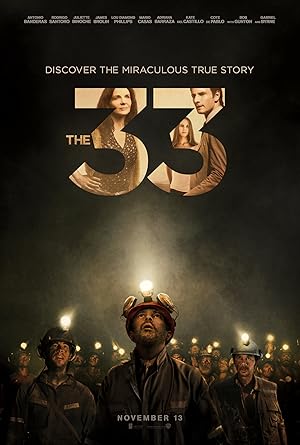
The 33
A docudramatic account of the 2010 Chilean mine disaster is presented, where the thirty-three miners who went into the San José Mine in Copiapó, Chile in the middle of the Atacama Desert on August 5 were trapped 700 meters underground for sixty-nine days, with all thirty-three eventually able to make it out of the mine alive. That day, mine foreman, Luis "Don Lucho" Urzúa, reported his concerns to mine owner, Carlos Castillo, about the unstable nature of the mountain under which the mine is located, those concerns which went unheeded. Don Lucho one of the thirty-three, went to work as usual into the mine, when that instability led to collapse in some of the underground shafts, the thirty-three who were able to make it to the refuge area, however with communication channels to the surface inoperable. Under normal circumstances, the refuge area had enough supplies to last thirty men three days. The miners also discovered that the company had failed to place the requisite ladders from the refuge area to the surface, and that the primary route out was now blocked by a shifted rock, its mass the equivalent of the Empire State Building. The thirty-three were ultimately led by Mario Sepúlveda, who was not going to let any of the thirty-three take priority over any of the others, especially in the initial panic and instinct for self-survival among some. On the surface, loved ones of the trapped miners held vigil at the mine, with María Segovia, elder sister of trapped miner Dario Segovia, arguably the most outspoken in condemnation of the powers that be not doing anything to search for the miners, not knowing if they were dead or alive, but who was also quick to give praise where praise was due. That praise largely went to the relatively new Minister of Mines, Laurence Golborne, who was determined both to do whatever he could on behalf of the government to look for the men and to provide accurate assessments to those holding vigil of the situation, especially in Castillo seeing miner deaths solely as an unfortunate nature of the business. The chief engineer assigned to drill toward the refuge area in the hopes that the miners were there was Andre Sougarret, who admitted that the process was not a scientific one as one would have hoped. Once the miners were discovered alive in the refuge area, the next phase of trying to extract them held its own new challenges for all concerned, both logistical and emotional.
Working with a mid-range budget of $25.0M, the film achieved a respectable showing with $28.0M in global revenue (+12% profit margin).
8 wins & 7 nominations


Plot Structure
Story beats plotted across runtime


Narrative Arc
Emotional journey through the story's key moments
Story Circle
Blueprint 15-beat structure
Arcplot Score Breakdown
Weighted: Precision (70%) + Arc (15%) + Theme (15%)
The 33 (2015) exemplifies precise narrative design, characteristic of Patricia Riggen's storytelling approach. This structural analysis examines how the film's 15-point plot structure maps to proven narrative frameworks across 2 hours. With an Arcplot score of 7.0, the film balances conventional beats with creative variation.
Characters
Cast & narrative archetypes

Mario Sepúlveda
Laurence Golborne
María Segovia
André Sougarret
Luis Urzúa
Darío Segovia
Yonni Barrios
Carlos Mamani
Main Cast & Characters
Mario Sepúlveda
Played by Antonio Banderas
Charismatic miner who becomes the emotional leader and spokesman for the trapped miners, maintaining morale underground.
Laurence Golborne
Played by Rodrigo Santoro
Chilean Minister of Mining who takes charge of the rescue operation and refuses to give up on the miners.
María Segovia
Played by Juliette Binoche
Sister of one of the trapped miners who leads the families' camp and refuses to let the government abandon the rescue.
André Sougarret
Played by Gabriel Byrne
Lead engineer who designs and oversees the technical aspects of the rescue drilling operation.
Luis Urzúa
Played by Lou Diamond Phillips
Shift foreman who maintains order and discipline among the trapped miners as their appointed leader.
Darío Segovia
Played by Juan Pablo Raba
Younger miner trapped underground who struggles with claustrophobia and despair.
Yonni Barrios
Played by Oscar Nuñez
Miner with medical training who serves as the group's medic, dealing with complications from his romantic life above.
Carlos Mamani
Played by Tenoch Huerta
Bolivian miner who faces discrimination from fellow miners while trapped underground.
Structural Analysis
The Status Quo at 1 minutes (1% through the runtime) establishes Mario Sepúlveda says goodbye to his family and heads to work at the San José mine. The miners' ordinary world of dangerous work, family obligations, and economic necessity is established.. Of particular interest, this early placement immediately immerses viewers in the story world.
The inciting incident occurs at 13 minutes when The mine collapses catastrophically. 700,000 tons of rock seal the 33 miners 2,300 feet underground in the refuge. Their world is literally shattered.. At 11% through the film, this Disruption aligns precisely with traditional story structure. This beat shifts the emotional landscape, launching the protagonist into the central conflict.
The First Threshold at 30 minutes marks the transition into Act II, occurring at 25% of the runtime. This shows the protagonist's commitment to Mario Sepúlveda takes leadership underground, organizing the men and instituting strict rationing (one spoonful of tuna every 48 hours). The miners make the active choice to fight for survival together rather than descend into chaos., moving from reaction to action.
At 60 minutes, the Midpoint arrives at 50% of the runtime—precisely centered, creating perfect narrative symmetry. The analysis reveals that this crucial beat Day 17: The drill breaks through and a note comes up: "Estamos bien en el refugio los 33" (We are well in the refuge, the 33 of us). False victory - they're alive, but extraction is still months away. Stakes raised: now the world knows they're alive, failure is not an option., fundamentally raising what's at risk. The emotional intensity shifts, dividing the narrative into clear before-and-after phases.
The Collapse moment at 90 minutes (75% through) represents the emotional nadir. Here, After two months underground, the miners hit their psychological breaking point. Drilling problems above threaten to delay rescue further. Hope dies as men face the possibility they may never get out. Mental and physical health at the lowest point., reveals the protagonist at their lowest point. This beat's placement in the final quarter sets up the climactic reversal.
The Second Threshold at 95 minutes initiates the final act resolution at 79% of the runtime. Day 69: The rescue shaft ("Plan B") finally breaks through to the refuge. The Phoenix capsule is ready. Engineers confirm the rescue can begin. Hope is reborn with concrete action., demonstrating the transformation achieved throughout the journey.
Emotional Journey
The 33's emotional architecture traces a deliberate progression across 15 carefully calibrated beats.
Narrative Framework
This structural analysis employs proven narrative structure principles that track dramatic progression. By mapping The 33 against these established plot points, we can identify how Patricia Riggen utilizes or subverts traditional narrative conventions. The plot point approach reveals not only adherence to structural principles but also creative choices that distinguish The 33 within the biography genre.
Patricia Riggen's Structural Approach
Among the 4 Patricia Riggen films analyzed on Arcplot, the average structural score is 6.9, demonstrating varied approaches to story architecture. The 33 represents one of the director's most structurally precise works. For comparative analysis, explore the complete Patricia Riggen filmography.
Comparative Analysis
Additional biography films include After Thomas, Taking Woodstock and The Fire Inside. For more Patricia Riggen analyses, see Girl in Progress, Miracles from Heaven and Under the Same Moon.
Plot Points by Act
Act I
SetupStatus Quo
Mario Sepúlveda says goodbye to his family and heads to work at the San José mine. The miners' ordinary world of dangerous work, family obligations, and economic necessity is established.
Theme
A miner comments on the dangerous conditions of the mine and the company's negligence. Theme stated: survival requires unity, hope, and refusing to be forgotten.
Worldbuilding
Introduction of the 33 miners, their families above ground, the unsafe mine conditions, and the economic pressures that keep men working in dangerous conditions. Establishes the ensemble cast and their relationships.
Disruption
The mine collapses catastrophically. 700,000 tons of rock seal the 33 miners 2,300 feet underground in the refuge. Their world is literally shattered.
Resistance
Underground: The miners debate survival strategies, ration food, and struggle with despair vs. hope. Above ground: Families arrive and demand rescue efforts. Mining engineer André Sougarret arrives to assess the situation. Dual narrative of debate below and above.
Act II
ConfrontationFirst Threshold
Mario Sepúlveda takes leadership underground, organizing the men and instituting strict rationing (one spoonful of tuna every 48 hours). The miners make the active choice to fight for survival together rather than descend into chaos.
Mirror World
María Segovia, sister of miner Darío, becomes the voice of the families, refusing to let the government abandon the rescue. She establishes "Camp Hope" and embodies the thematic determination that parallels the miners' underground struggle.
Premise
The promise of the premise: can they survive and be rescued? Dual narratives of survival underground (rationing, maintaining hope, dealing with tensions) and rescue efforts above (drilling attempts, political pressure, international attention). The world watches.
Midpoint
Day 17: The drill breaks through and a note comes up: "Estamos bien en el refugio los 33" (We are well in the refuge, the 33 of us). False victory - they're alive, but extraction is still months away. Stakes raised: now the world knows they're alive, failure is not an option.
Opposition
Pressure intensifies on both fronts. Underground: tensions rise, men struggle psychologically, health deteriorates. Above: technical problems plague the rescue shaft, government pressure mounts, time drags on. The novelty wears off and the grind of waiting takes its toll.
Collapse
After two months underground, the miners hit their psychological breaking point. Drilling problems above threaten to delay rescue further. Hope dies as men face the possibility they may never get out. Mental and physical health at the lowest point.
Crisis
The dark night where miners and families above process their darkest fears. Letters to loved ones are written as possible final goodbyes. The psychological toll of 69 days underground reaches its peak.
Act III
ResolutionSecond Threshold
Day 69: The rescue shaft ("Plan B") finally breaks through to the refuge. The Phoenix capsule is ready. Engineers confirm the rescue can begin. Hope is reborn with concrete action.
Synthesis
The finale: One by one, all 33 miners are brought to the surface in the Phoenix capsule. The rescue that captivated the world succeeds. Each man emerges to reunite with family, combining their underground unity with the above-ground determination of their families.
Transformation
Mario Sepúlveda, the last rescue worker and first miner up, emerges triumphant and embraces his family. The closing image mirrors the opening but shows transformed men - survivors who refused to be forgotten, united by their ordeal.