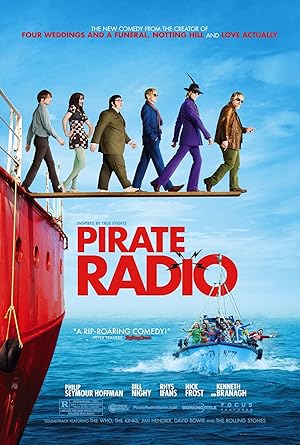
The Boat That Rocked
This movie is an ensemble comedy in which the romance takes place between the young people of the 1960s and pop music. It's about a band of rogue DJs that captivated Britain, playing the music that defined a generation and standing up to a government that wanted classical music, and nothing else, on the airwaves. The Count (Philip Seymour Hoffman), a big, brash, American god of the airwaves; Quentin (Bill Nighy), the boss of Radio Rock - a pirate radio station in the middle of the North Sea that's populated by an eclectic crew of rock and roll DJs; Gavin (Rhys Ifans), the greatest DJ in Britain who has just returned from his drug tour of America to reclaim his rightful position; Dave (Nick Frost), an ironic, intelligent, and cruelly funny co-broadcaster; and a fearsome British government official out for blood against the drug takers and lawbreakers of a once-great nation.
The film disappointed at the box office against its mid-range budget of $50.0M, earning $36.3M globally (-27% loss). While initial box office returns were modest, the film has gained appreciation for its fresh perspective within the comedy genre.
2 wins & 9 nominations


Plot Structure
Story beats plotted across runtime


Narrative Arc
Emotional journey through the story's key moments
Story Circle
Blueprint 15-beat structure
Arcplot Score Breakdown
Weighted: Precision (70%) + Arc (15%) + Theme (15%)
The Boat That Rocked (2009) exemplifies deliberately positioned narrative design, characteristic of Richard Curtis's storytelling approach. This structural analysis examines how the film's 15-point plot structure maps to proven narrative frameworks across 2 hours and 15 minutes. With an Arcplot score of 7.5, the film showcases strong structural fundamentals.
Characters
Cast & narrative archetypes

Carl
Young Carl
The Count
Dave
Quentin
Gavin
Sir Alistair Dormandy
Twatt
Felicity
Main Cast & Characters
Carl
Played by Philip Seymour Hoffman
The station's mysterious leader and star DJ, a cool American who keeps the pirate radio ship running with style and authority.
Young Carl
Played by Tom Sturridge
The innocent godson who arrives on the ship to find direction, becoming the audience's eyes into this wild world of rock and rebellion.
The Count
Played by Philip Glenister
A flamboyant, egotistical ladies' man and rival DJ who thrives on attention and competition with Dave.
Dave
Played by Nick Frost
A popular, smooth-talking DJ known as "Doctor Dave" who represents the more grounded romantic side of the crew.
Quentin
Played by Bill Nighy
The ship's owner and manager, an eccentric upper-class businessman who funds the operation and keeps the peace.
Gavin
Played by Rhys Ifans
A legendary DJ who returns to the ship, creating a power struggle and challenging The Count's supremacy.
Sir Alistair Dormandy
Played by Kenneth Branagh
A conservative government minister determined to shut down pirate radio stations and restore moral order to Britain.
Twatt
Played by Jack Davenport
An awkward, nervous government bureaucrat who assists Dormandy in his crusade against the pirates.
Felicity
Played by Katherine Parkinson
Quentin's free-spirited niece who arrives on the boat and becomes a romantic focus for several crew members.
Structural Analysis
The Status Quo at 2 minutes (1% through the runtime) establishes Carl arrives at Radio Rock ship in the North Sea. Montage establishes the vibrant, rebellious world of pirate radio DJs broadcasting rock and roll to millions of British listeners, defying government radio monopoly.. The analysis reveals that this early placement immediately immerses viewers in the story world.
The inciting incident occurs at 15 minutes when Dormandy announces in Parliament his intention to destroy pirate radio through legislation. The external threat to Radio Rock's existence is established, though the crew initially doesn't take it seriously.. At 11% through the film, this Disruption aligns precisely with traditional story structure. This beat shifts the emotional landscape, launching the protagonist into the central conflict.
The First Threshold at 33 minutes marks the transition into Act II, occurring at 24% of the runtime. This shows the protagonist's commitment to The crew collectively commits to continuing their broadcasts despite government pressure. Carl chooses to stay and embrace this life. They double down on their mission to bring rock and roll to the people., moving from reaction to action.
At 66 minutes, the Midpoint arrives at 49% of the runtime—precisely centered, creating perfect narrative symmetry. Significantly, this crucial beat Carl discovers Marianne has betrayed him with Dave. Personal heartbreak mirrors the false victory - just as relationships seem great, they crumble. Stakes raise as Dormandy finds a legal loophole to ban pirate radio., fundamentally raising what's at risk. The emotional intensity shifts, dividing the narrative into clear before-and-after phases.
The Collapse moment at 99 minutes (73% through) represents the emotional nadir. Here, The ship is sabotaged and begins sinking. Literal death threatens as the vessel takes on water. The dream of Radio Rock is dying. Everything they've built is going under, both metaphorically and literally., indicates the protagonist at their lowest point. This beat's placement in the final quarter sets up the climactic reversal.
The Second Threshold at 106 minutes initiates the final act resolution at 79% of the runtime. The Count returns to help. The crew realizes their mission transcends the ship - they've already changed British culture forever. Their listeners form a massive boat flotilla to rescue them. The synthesis: individual rebellion becomes collective movement., demonstrating the transformation achieved throughout the journey.
Emotional Journey
The Boat That Rocked's emotional architecture traces a deliberate progression across 15 carefully calibrated beats.
Narrative Framework
This structural analysis employs proven narrative structure principles that track dramatic progression. By mapping The Boat That Rocked against these established plot points, we can identify how Richard Curtis utilizes or subverts traditional narrative conventions. The plot point approach reveals not only adherence to structural principles but also creative choices that distinguish The Boat That Rocked within the comedy genre.
Richard Curtis's Structural Approach
Among the 3 Richard Curtis films analyzed on Arcplot, the average structural score is 7.3, reflecting strong command of classical structure. The Boat That Rocked represents one of the director's most structurally precise works. For comparative analysis, explore the complete Richard Curtis filmography.
Comparative Analysis
Additional comedy films include The Bad Guys, Ella Enchanted and The Evening Star. For more Richard Curtis analyses, see Love Actually, About Time.
Plot Points by Act
Act I
SetupStatus Quo
Carl arrives at Radio Rock ship in the North Sea. Montage establishes the vibrant, rebellious world of pirate radio DJs broadcasting rock and roll to millions of British listeners, defying government radio monopoly.
Theme
Quentin (Bill Nighy) tells Carl: "The government loathes us because we're the only thing standing between them and total control of the people." Theme of rebellion, freedom, and music's power to unite and liberate.
Worldbuilding
Carl integrates into ship life. Meet the DJ personalities: The Count (Philip Seymour Hoffman), Dave (Nick Frost), Simple Simon. Establish the station's massive popularity and the camaraderie among the crew. Government official Dormandy introduced plotting to eliminate pirate radio.
Disruption
Dormandy announces in Parliament his intention to destroy pirate radio through legislation. The external threat to Radio Rock's existence is established, though the crew initially doesn't take it seriously.
Resistance
Life continues on the ship despite the distant threat. Carl navigates romantic entanglements. Gavin arrives, creating rivalry with The Count. The crew debates their purpose and impact while Dormandy schemes in London.
Act II
ConfrontationFirst Threshold
The crew collectively commits to continuing their broadcasts despite government pressure. Carl chooses to stay and embrace this life. They double down on their mission to bring rock and roll to the people.
Mirror World
Carl's relationship with Marianne develops. She represents authentic connection versus the superficial encounters on the ship. This subplot carries the theme of finding genuine identity and love.
Premise
The promise of the premise: life aboard a floating radio station. Musical performances, parties, romantic escapades, DJ competitions between The Count and Gavin. The joy and freedom of the pirate radio lifestyle at its peak.
Midpoint
Carl discovers Marianne has betrayed him with Dave. Personal heartbreak mirrors the false victory - just as relationships seem great, they crumble. Stakes raise as Dormandy finds a legal loophole to ban pirate radio.
Opposition
Government pressure intensifies. The Marine Broadcasting Offences Act passes, making pirate radio illegal. Internal conflicts emerge - egos clash, relationships fracture. The Count leaves after losing to Gavin. The glory days are ending.
Collapse
The ship is sabotaged and begins sinking. Literal death threatens as the vessel takes on water. The dream of Radio Rock is dying. Everything they've built is going under, both metaphorically and literally.
Crisis
Darkness and chaos as the ship sinks. The crew faces mortality in freezing water. Carl processes what Radio Rock meant - not just rebellion, but community, identity, and freedom. Dark night before the dawn.
Act III
ResolutionSecond Threshold
The Count returns to help. The crew realizes their mission transcends the ship - they've already changed British culture forever. Their listeners form a massive boat flotilla to rescue them. The synthesis: individual rebellion becomes collective movement.
Synthesis
Hundreds of fans arrive in boats to save the DJs. The rescue becomes a celebration of what they achieved. Though Radio Rock dies, rock and roll won. Carl finds his identity. Dormandy loses despite his legal victory.
Transformation
Carl on the rescue boat, transformed from lost boy to confident young man. Closing montage shows rock music triumphant in Britain - pirate radio is gone but its spirit lives forever. The revolution succeeded.