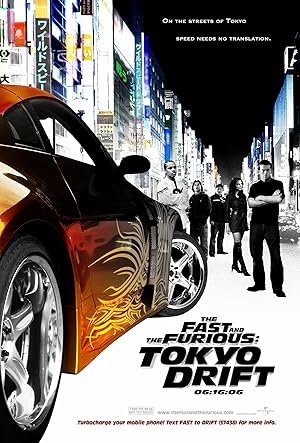
The Fast and the Furious: Tokyo Drift
An American teenager named Sean Boswell is a loner in school, however he challenges his rival for an illegal street racing, and he totals his car in the end of the race. To avoid time in prison he is sent to Tokyo to live with his father who is in the military. As soon as he arrives he discovers a new, fun but dangerous way of street racing in the underworld of the streets of Tokyo, Japan.
Working with a significant budget of $85.0M, the film achieved a modest success with $159.0M in global revenue (+87% profit margin).
1 win & 4 nominations


Plot Structure
Story beats plotted across runtime


Narrative Arc
Emotional journey through the story's key moments
Story Circle
Blueprint 15-beat structure
Arcplot Score Breakdown
Weighted: Precision (70%) + Arc (15%) + Theme (15%)
The Fast and the Furious: Tokyo Drift (2006) showcases deliberately positioned story structure, characteristic of Justin Lin's storytelling approach. This structural analysis examines how the film's 15-point plot structure maps to proven narrative frameworks across 1 hour and 44 minutes. With an Arcplot score of 7.4, the film balances conventional beats with creative variation.
Characters
Cast & narrative archetypes

Sean Boswell
Han Lue
Takashi (D.K.)
Neela
Twinkie
Kamata
Main Cast & Characters
Sean Boswell
Played by Lucas Black
A rebellious American teenager sent to Tokyo who discovers drift racing and finds his place in a new culture.
Han Lue
Played by Sung Kang
A cool, philosophical drift racer who becomes Sean's mentor and friend in the Tokyo underground racing scene.
Takashi (D.K.)
Played by Brian Tee
The Drift King of Tokyo, a skilled but arrogant racer with Yakuza connections who serves as Sean's rival.
Neela
Played by Nathalie Kelley
A beautiful Australian-Japanese woman caught between D.K. and Sean, seeking independence and genuine connection.
Twinkie
Played by Bow Wow
An American military brat and entrepreneur who introduces Sean to Tokyo's underground culture and becomes his friend.
Kamata
Played by Sonny Chiba
A dangerous Yakuza boss and D.K.'s uncle who controls the criminal underworld that intersects with the racing scene.
Structural Analysis
The Status Quo at 1 minutes (1% through the runtime) establishes Sean Boswell races his muscle car through Arizona suburb streets, showing his identity as a reckless outsider who expresses himself through illegal street racing despite consequences.. Significantly, this early placement immediately immerses viewers in the story world.
The inciting incident occurs at 12 minutes when Sean arrives in Tokyo, completely out of his element - can't speak Japanese, doesn't understand the culture, and his military father makes clear he's unwelcome and must follow strict rules or face juvenile hall.. At 11% through the film, this Disruption aligns precisely with traditional story structure. This beat shifts the emotional landscape, launching the protagonist into the central conflict.
The First Threshold at 25 minutes marks the transition into Act II, occurring at 24% of the runtime. This illustrates the protagonist's commitment to Sean accepts Han's challenge to race DK in the parking garage despite knowing nothing about drifting. He crashes Han's car spectacularly, losing the race and going into debt, but choosing to enter this new world of drift racing., moving from reaction to action.
At 53 minutes, the Midpoint arrives at 51% of the runtime—precisely centered, creating perfect narrative symmetry. Notably, this crucial beat Sean successfully completes his first drift race, beating DK's lieutenant Morimoto. False victory - he's proven himself as a drifter and won respect, but this publicly challenges DK and escalates the conflict with dangerous consequences., fundamentally raising what's at risk. The emotional intensity shifts, dividing the narrative into clear before-and-after phases.
The Collapse moment at 78 minutes (75% through) represents the emotional nadir. Here, Han is killed in a fiery car crash while fleeing DK and the Yakuza. Sean's mentor dies because of the conflict Sean helped escalate. Sean loses his guide, his friend, and the person who believed in him. Ultimate "whiff of death."., reveals the protagonist at their lowest point. This beat's placement in the final quarter sets up the climactic reversal.
The Second Threshold at 83 minutes initiates the final act resolution at 80% of the runtime. Sean challenges DK to a race down the mountain - winner takes all. Instead of running, Sean chooses to stand his ground using everything Han taught him. Synthesis of American courage and Japanese drift technique. Takes ownership of his choices., demonstrating the transformation achieved throughout the journey.
Emotional Journey
The Fast and the Furious: Tokyo Drift's emotional architecture traces a deliberate progression across 15 carefully calibrated beats.
Narrative Framework
This structural analysis employs proven narrative structure principles that track dramatic progression. By mapping The Fast and the Furious: Tokyo Drift against these established plot points, we can identify how Justin Lin utilizes or subverts traditional narrative conventions. The plot point approach reveals not only adherence to structural principles but also creative choices that distinguish The Fast and the Furious: Tokyo Drift within the action genre.
Justin Lin's Structural Approach
Among the 6 Justin Lin films analyzed on Arcplot, the average structural score is 7.2, reflecting strong command of classical structure. The Fast and the Furious: Tokyo Drift represents one of the director's most structurally precise works. For comparative analysis, explore the complete Justin Lin filmography.
Comparative Analysis
Additional action films include The Bad Guys, Puss in Boots and Venom: The Last Dance. For more Justin Lin analyses, see Fast Five, F9 and Star Trek Beyond.
Plot Points by Act
Act I
SetupStatus Quo
Sean Boswell races his muscle car through Arizona suburb streets, showing his identity as a reckless outsider who expresses himself through illegal street racing despite consequences.
Theme
Sean's mother tells him he's "going to Tokyo to live with your father" and warns "this is your last chance" - establishing the theme of second chances and finding where you belong.
Worldbuilding
Sean's life in Arizona: serial troublemaker, sent to multiple schools, lives with single mom. His reckless race with Clay destroys property and gets him arrested. Father in Tokyo offers only alternative to juvenile detention.
Disruption
Sean arrives in Tokyo, completely out of his element - can't speak Japanese, doesn't understand the culture, and his military father makes clear he's unwelcome and must follow strict rules or face juvenile hall.
Resistance
Sean navigates Japanese school as outsider. Twinkie becomes his guide to Tokyo's underground drift racing scene. Sean meets Neela and learns about DK (Drift King), the Yakuza-connected local racing champion. Sean is warned to stay away but is drawn to this new world.
Act II
ConfrontationFirst Threshold
Sean accepts Han's challenge to race DK in the parking garage despite knowing nothing about drifting. He crashes Han's car spectacularly, losing the race and going into debt, but choosing to enter this new world of drift racing.
Mirror World
Han offers Sean a deal: work for him to pay off the car debt while learning to drift. Han becomes the mentor/thematic character who teaches "life is simple - you make choices and don't look back." Represents the wisdom Sean needs.
Premise
Sean trains in drifting under Han's mentorship, working deliveries and practicing in the mountains. Develops skills and relationship with Neela. Explores Tokyo's drift culture, learning it's about finesse and control rather than brute force. Bond with Han deepens.
Midpoint
Sean successfully completes his first drift race, beating DK's lieutenant Morimoto. False victory - he's proven himself as a drifter and won respect, but this publicly challenges DK and escalates the conflict with dangerous consequences.
Opposition
DK's anger intensifies. Sean's relationship with Neela (DK's girlfriend) deepens, increasing danger. DK discovers Han has been skimming from Yakuza profits. Pressure from all sides: father threatens to send Sean home, DK threatens violence, Yakuza demands accountability.
Collapse
Han is killed in a fiery car crash while fleeing DK and the Yakuza. Sean's mentor dies because of the conflict Sean helped escalate. Sean loses his guide, his friend, and the person who believed in him. Ultimate "whiff of death."
Crisis
Sean mourns Han, faces his father's disappointment, and contemplates running away from his problems again. Processes the cost of his recklessness. Neela encourages him. Sean must decide whether to flee or face DK and his responsibility.
Act III
ResolutionSecond Threshold
Sean challenges DK to a race down the mountain - winner takes all. Instead of running, Sean chooses to stand his ground using everything Han taught him. Synthesis of American courage and Japanese drift technique. Takes ownership of his choices.
Synthesis
The final race down the mountain. Sean uses Han's lessons and his own adapted style. DK relies on aggression and power. Sean drifts with control and precision, barely winning as DK crashes. Sean earns respect, DK loses his crown. Yakuza allows Sean to take Han's place.
Transformation
Sean, now called DK (Drift King), races in the same spot where he first crashed. A challenger arrives - Dominic Toretto. Sean has transformed from reckless outsider to respected leader who found where he belongs, honoring Han's legacy.