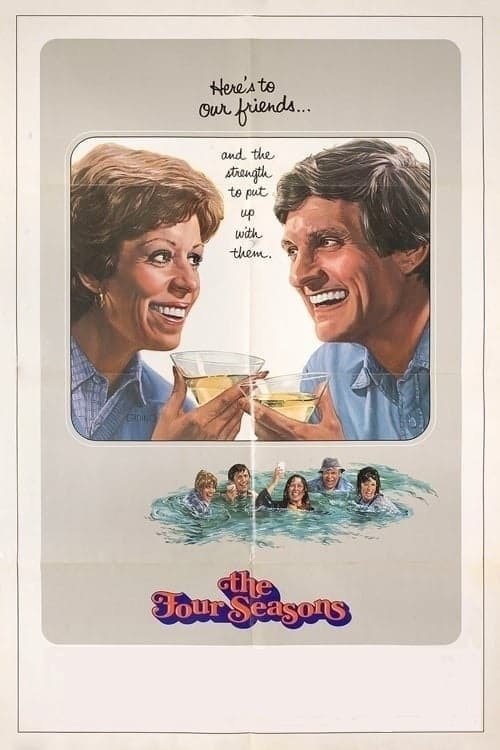
The Four Seasons
Three middle-aged wealthy couples take vacations together in Spring, Summer, Autumn and Winter. Along the way we are treated to mid-life, marital, parental and other crises.
The film earned $50.4M at the global box office.
1 win & 5 nominations


Plot Structure
Story beats plotted across runtime


Narrative Arc
Emotional journey through the story's key moments
Story Circle
Blueprint 15-beat structure
Arcplot Score Breakdown
Weighted: Precision (70%) + Arc (15%) + Theme (15%)
The Four Seasons (1981) reveals carefully calibrated dramatic framework, characteristic of Alan Alda's storytelling approach. This structural analysis examines how the film's 15-point plot structure maps to proven narrative frameworks across 1 hour and 47 minutes. With an Arcplot score of 7.8, the film showcases strong structural fundamentals.
Characters
Cast & narrative archetypes

Jack Burroughs
Kate Burroughs
Nick Callan
Claudia Callan
Danny Zimmer
Anne Zimmer
Ginny Newley
Main Cast & Characters
Jack Burroughs
Played by Alan Alda
A successful lawyer and the de facto leader of the friend group, struggling to maintain control as relationships shift around him.
Kate Burroughs
Played by Carol Burnett
Jack's wife, a warm and caring woman who tries to maintain peace and harmony within the group.
Nick Callan
Played by Len Cariou
An insecure insurance salesman who divorces his wife Claudia and begins dating a much younger woman.
Claudia Callan
Played by Sandy Dennis
Nick's ex-wife, a sharp-tongued and independent woman who must navigate life after her divorce.
Danny Zimmer
Played by Jack Weston
A dentist with a gentle demeanor who tries to mediate conflicts within the group.
Anne Zimmer
Played by Rita Moreno
Danny's wife, a practical and grounded woman who provides stability to the group dynamics.
Ginny Newley
Played by Bess Armstrong
Nick's much younger girlfriend, whose presence disrupts the established group dynamic and creates tension.
Structural Analysis
The Status Quo at 1 minutes (1% through the runtime) establishes Three couples - Jack and Kate, Nick and Anne, Danny and Claudia - enjoy a spring vacation together in the Caribbean, demonstrating their comfortable, long-standing friendships and established routines.. Significantly, this early placement immediately immerses viewers in the story world.
The inciting incident occurs at 13 minutes when Nick announces he's leaving his wife Anne for a much younger woman named Ginny, shocking the group and disrupting their comfortable equilibrium. The announcement shatters the assumption that their friendships are stable.. At 12% through the film, this Disruption aligns precisely with traditional story structure. This beat shifts the emotional landscape, launching the protagonist into the central conflict.
The First Threshold at 27 minutes marks the transition into Act II, occurring at 25% of the runtime. This illustrates the protagonist's commitment to The group decides to invite Nick and his new young girlfriend Ginny to their summer vacation, actively choosing to navigate this new reality rather than ending the tradition or excluding Nick., moving from reaction to action.
At 54 minutes, the Midpoint arrives at 50% of the runtime—precisely centered, creating perfect narrative symmetry. Significantly, this crucial beat A major confrontation erupts during the fall vacation when Jack's criticism of Nick and Ginny's relationship boils over, exposing Jack's fear of change and his need to control everything, raising the stakes for all relationships., fundamentally raising what's at risk. The emotional intensity shifts, dividing the narrative into clear before-and-after phases.
The Collapse moment at 80 minutes (75% through) represents the emotional nadir. Here, The group fractures completely - the winter vacation is cancelled, friendships are broken, and Jack faces the "death" of the comfortable world he tried so hard to preserve. His marriage with Kate is also strained to the breaking point., demonstrates the protagonist at their lowest point. This beat's placement in the final quarter sets up the climactic reversal.
The Second Threshold at 86 minutes initiates the final act resolution at 80% of the runtime. Jack has a breakthrough moment of self-awareness, recognizing that trying to control life and resist change only destroys relationships. He realizes he must accept that people and relationships evolve through seasons., demonstrating the transformation achieved throughout the journey.
Emotional Journey
The Four Seasons's emotional architecture traces a deliberate progression across 15 carefully calibrated beats.
Narrative Framework
This structural analysis employs systematic plot point analysis that identifies crucial turning points. By mapping The Four Seasons against these established plot points, we can identify how Alan Alda utilizes or subverts traditional narrative conventions. The plot point approach reveals not only adherence to structural principles but also creative choices that distinguish The Four Seasons within the comedy genre.
Comparative Analysis
Additional comedy films include The Bad Guys, Ella Enchanted and The Evening Star.
Plot Points by Act
Act I
SetupStatus Quo
Three couples - Jack and Kate, Nick and Anne, Danny and Claudia - enjoy a spring vacation together in the Caribbean, demonstrating their comfortable, long-standing friendships and established routines.
Theme
During vacation conversation, someone remarks about how relationships and friendships change over time, foreshadowing the group's upcoming upheaval and the theme of adapting to life's seasons.
Worldbuilding
Establishing the three couples' dynamics, their seasonal vacation tradition, their different personalities (Nick the lawyer, Jack the emotionally guarded one, Danny the fun-loving one), and their interdependent friendships spanning decades.
Disruption
Nick announces he's leaving his wife Anne for a much younger woman named Ginny, shocking the group and disrupting their comfortable equilibrium. The announcement shatters the assumption that their friendships are stable.
Resistance
The group struggles with how to handle Nick's divorce and new relationship. Jack and Kate debate whether to maintain the friendship, how to treat Anne, and whether to accept Ginny into the group during their summer vacation.
Act II
ConfrontationFirst Threshold
The group decides to invite Nick and his new young girlfriend Ginny to their summer vacation, actively choosing to navigate this new reality rather than ending the tradition or excluding Nick.
Mirror World
Ginny's presence during the summer vacation creates tension and awkwardness, forcing everyone (especially Jack and Kate) to confront their own marriages and assumptions about aging, commitment, and change.
Premise
The summer vacation with Ginny reveals generational conflicts, jealousies, and insecurities. Jack becomes increasingly judgmental and controlling, Kate tries to keep peace, and the group dynamic fractures under the strain of change.
Midpoint
A major confrontation erupts during the fall vacation when Jack's criticism of Nick and Ginny's relationship boils over, exposing Jack's fear of change and his need to control everything, raising the stakes for all relationships.
Opposition
Jack's rigidity and judgmental nature alienates everyone. Kate confronts him about his controlling behavior. The friendships deteriorate as everyone takes sides, and Jack faces consequences for his inability to accept change.
Collapse
The group fractures completely - the winter vacation is cancelled, friendships are broken, and Jack faces the "death" of the comfortable world he tried so hard to preserve. His marriage with Kate is also strained to the breaking point.
Crisis
Jack reflects on his failures, confronting his fear of aging, irrelevance, and change. Kate considers leaving him. He must process the loss of his friendships and recognize his role in destroying what he valued most.
Act III
ResolutionSecond Threshold
Jack has a breakthrough moment of self-awareness, recognizing that trying to control life and resist change only destroys relationships. He realizes he must accept that people and relationships evolve through seasons.
Synthesis
Jack reaches out to repair relationships, apologizes for his rigidity, and accepts Nick and Ginny's relationship. The group reunites for a spring vacation, with Jack demonstrating newfound flexibility and acceptance of life's changes.
Transformation
The friends together again on vacation, but transformed - Jack is more open and accepting, the group dynamic has matured to include change, and everyone has learned to adapt to life's seasons while maintaining core connections.