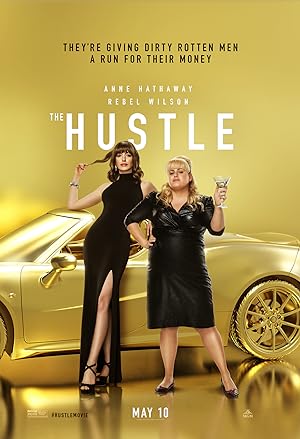
The Hustle
In this remake of 1988's "Dirty Rotten Scoundrels," 2 con-women hustle in a small French Riviera town - one for small amounts from average men, and one for higher amounts wealthier men. They bet on what looks like an easy target. Winner gets $500K from him, and the loser leaves town forever.
Despite a mid-range budget of $21.0M, The Hustle became a financial success, earning $97.4M worldwide—a 364% return.
3 wins & 4 nominations








Plot Structure
Story beats plotted across runtime


Narrative Arc
Emotional journey through the story's key moments
Story Circle
Blueprint 15-beat structure
Arcplot Score Breakdown
Weighted: Precision (70%) + Arc (15%) + Theme (15%)
The Hustle (2019) demonstrates meticulously timed story structure, characteristic of Chris Addison's storytelling approach. This structural analysis examines how the film's 15-point plot structure maps to proven narrative frameworks across 1 hour and 34 minutes. With an Arcplot score of 6.9, the film balances conventional beats with creative variation.
Structural Analysis
The Status Quo at 1 minutes (1% through the runtime) establishes Penny Rust cons a tech billionaire on a dating app in New York, establishing her as a small-time grifter living meal-to-meal through amateur schemes.. The analysis reveals that this early placement immediately immerses viewers in the story world.
The inciting incident occurs at 10 minutes when Josephine Chesterfield (Thomas's real partner) confronts Penny at a restaurant, revealing Thomas is actually her apprentice, and Josephine runs the Riviera con scene - threatening Penny's newfound paradise.. At 11% through the film, this Disruption aligns precisely with traditional story structure. This beat shifts the emotional landscape, launching the protagonist into the central conflict.
The First Threshold at 21 minutes marks the transition into Act II, occurring at 22% of the runtime. This illustrates the protagonist's commitment to Penny actively chooses to become Josephine's apprentice, entering a training montage where she learns accents, seduction techniques, and the psychology of high-end marks - committing to the world of sophisticated cons., moving from reaction to action.
At 45 minutes, the Midpoint arrives at 48% of the runtime—precisely centered, creating perfect narrative symmetry. Structural examination shows that this crucial beat Penny (as "blind" heiress Raph) successfully seduces Thomas Westerburg and has him falling in love with her, appearing to gain the upper hand in the competition - a false victory as we later learn she's being out-conned., fundamentally raising what's at risk. The emotional intensity shifts, dividing the narrative into clear before-and-after phases.
The Collapse moment at 67 minutes (71% through) represents the emotional nadir. Here, Penny "reveals" her con to Thomas, admitting she's not blind and was trying to steal from him. He appears devastated and heartbroken - the death of Penny's con, her partnership with Josephine, and potentially her whole identity as a grifter., demonstrates the protagonist at their lowest point. This beat's placement in the final quarter sets up the climactic reversal.
The Second Threshold at 73 minutes initiates the final act resolution at 78% of the runtime. Josephine finds Penny and reveals the truth: Thomas was actually legendary con artist "Medusa," and both women were marks in his elaborate scheme. Penny realizes she was out-conned by a master, synthesizing everything she's learned., demonstrating the transformation achieved throughout the journey.
Emotional Journey
The Hustle's emotional architecture traces a deliberate progression across 15 carefully calibrated beats.
Narrative Framework
This structural analysis employs proven narrative structure principles that track dramatic progression. By mapping The Hustle against these established plot points, we can identify how Chris Addison utilizes or subverts traditional narrative conventions. The plot point approach reveals not only adherence to structural principles but also creative choices that distinguish The Hustle within the comedy genre.
Comparative Analysis
Additional comedy films include The Ministry of Ungentlemanly Warfare, The Bad Guys and Lake Placid.
Plot Points by Act
Act I
SetupStatus Quo
Penny Rust cons a tech billionaire on a dating app in New York, establishing her as a small-time grifter living meal-to-meal through amateur schemes.
Theme
A mark on the train tells Penny "You can't con an honest man" - foreshadowing the film's exploration of morality, deception, and whether there are truly victims in the con game.
Worldbuilding
Penny meets "Doctor" Thomas on a train to the French Riviera, witnesses his sophisticated long-con on a wealthy woman, and follows him to Beaumont-sur-Mer, discovering a world of high-stakes grifting far beyond her street-level schemes.
Disruption
Josephine Chesterfield (Thomas's real partner) confronts Penny at a restaurant, revealing Thomas is actually her apprentice, and Josephine runs the Riviera con scene - threatening Penny's newfound paradise.
Resistance
Penny refuses to leave, attempts her own amateur cons in Josephine's territory, and negotiates for training. Josephine initially rejects her but eventually agrees to teach her the art of the sophisticated con in exchange for partnership.
Act II
ConfrontationFirst Threshold
Penny actively chooses to become Josephine's apprentice, entering a training montage where she learns accents, seduction techniques, and the psychology of high-end marks - committing to the world of sophisticated cons.
Mirror World
Josephine and Penny execute their first successful con together on a sexist businessman, with Penny playing the ingenue. Their partnership represents the film's thematic exploration: can women succeed by exploiting the system that exploits them?
Premise
Josephine and Penny run increasingly elaborate cons together, but tension builds as Penny wants equal partnership while Josephine maintains control. They agree to a competition: whoever cons Thomas Westerburg (a tech billionaire) out of $500,000 first wins, loser leaves town.
Midpoint
Penny (as "blind" heiress Raph) successfully seduces Thomas Westerburg and has him falling in love with her, appearing to gain the upper hand in the competition - a false victory as we later learn she's being out-conned.
Opposition
Josephine escalates with increasingly desperate schemes to sabotage Penny's relationship with Thomas. Thomas appears genuinely in love with Penny, offering her the money freely. Penny begins to feel genuine guilt and connection, complicating her ability to complete the con.
Collapse
Penny "reveals" her con to Thomas, admitting she's not blind and was trying to steal from him. He appears devastated and heartbroken - the death of Penny's con, her partnership with Josephine, and potentially her whole identity as a grifter.
Crisis
Penny leaves town defeated, processing her guilt over hurting someone innocent. She sits alone with the weight of having failed at the con game while possibly becoming the very mark she despised - someone with genuine feelings.
Act III
ResolutionSecond Threshold
Josephine finds Penny and reveals the truth: Thomas was actually legendary con artist "Medusa," and both women were marks in his elaborate scheme. Penny realizes she was out-conned by a master, synthesizing everything she's learned.
Synthesis
Penny and Josephine team up for real, tracking down Thomas to con him back. They execute an elaborate revenge scheme, using their combined skills and their new authentic partnership to turn the tables and reclaim their money plus his fortune.
Transformation
Penny and Josephine celebrate their victory as true equal partners on a yacht, transformed from competitors into genuine friends and collaborators - mirroring the opening but now Penny operates at the highest level with authentic connection.