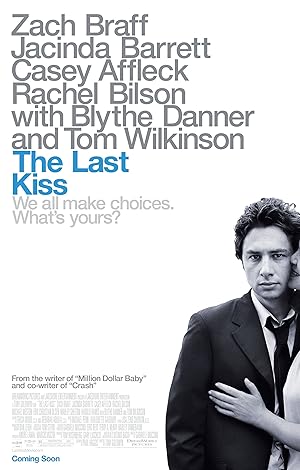
The Last Kiss
Michael and Jenna, having been a couple for three years, want to get married and start a family. These plans seem to be well on their way when Jenna announces that she's pregnant. But Michael is worried that his life and his youth will be over for good. At a wedding of a friend, he meets a free-spirited college co-ed, Kim, who opens his eyes and leads him on a dangerous path away from Jenna. Meanwhile, none of the relationships of the people surrounding Michael and Jenna are happy and stable. Michael's friend Izzy is unwilling to let go of his childhood sweetheart Arianna; Kenny is a handsome stud who fears commitment to his latest conquest Danielle; and Chris is a co-worker who is dominated by his neurotic and overbearing wife over raising their newborn son. Even Jenna's parents, Stephen and Anna, are experiencing problems in their long-suffering marriage.
The film disappointed at the box office against its respectable budget of $20.0M, earning $15.9M globally (-21% loss).
1 win & 4 nominations


Plot Structure
Story beats plotted across runtime


Narrative Arc
Emotional journey through the story's key moments
Story Circle
Blueprint 15-beat structure
Arcplot Score Breakdown
Weighted: Precision (70%) + Arc (15%) + Theme (15%)
The Last Kiss (2006) reveals strategically placed narrative architecture, characteristic of Tony Goldwyn's storytelling approach. This structural analysis examines how the film's 15-point plot structure maps to proven narrative frameworks across 1 hour and 55 minutes. With an Arcplot score of 7.7, the film showcases strong structural fundamentals.
Structural Analysis
The Status Quo at 1 minutes (1% through the runtime) establishes Michael and Jenna's comfortable life together. They're expecting a baby, surrounded by friends, seemingly happy but something feels incomplete.. Notably, this early placement immediately immerses viewers in the story world.
The inciting incident occurs at 14 minutes when Michael meets Kim, a college-aged woman at a wedding. She represents freedom and the life he's about to lose forever.. At 12% through the film, this Disruption aligns precisely with traditional story structure. This beat shifts the emotional landscape, launching the protagonist into the central conflict.
The First Threshold at 29 minutes marks the transition into Act II, occurring at 25% of the runtime. This shows the protagonist's commitment to Michael actively chooses to pursue Kim. He seeks her out and begins an emotional (and later physical) affair, crossing into infidelity., moving from reaction to action.
At 58 minutes, the Midpoint arrives at 51% of the runtime—precisely centered, creating perfect narrative symmetry. Structural examination shows that this crucial beat Michael sleeps with Kim (false victory of getting what he wants), but the stakes raise as Jenna's parents' marriage collapses, showing Michael the consequences of betrayal., fundamentally raising what's at risk. The emotional intensity shifts, dividing the narrative into clear before-and-after phases.
The Collapse moment at 87 minutes (76% through) represents the emotional nadir. Here, Jenna discovers the affair. She throws Michael out. The relationship dies. Michael loses everything - Jenna, the baby, his home, his future., reveals the protagonist at their lowest point. This beat's placement in the final quarter sets up the climactic reversal.
The Second Threshold at 92 minutes initiates the final act resolution at 80% of the runtime. Michael realizes love isn't about excitement but about choice and commitment. He synthesizes the Mirror World lesson: freedom without love is empty., demonstrating the transformation achieved throughout the journey.
Emotional Journey
The Last Kiss's emotional architecture traces a deliberate progression across 15 carefully calibrated beats.
Narrative Framework
This structural analysis employs structural analysis methodology used to understand storytelling architecture. By mapping The Last Kiss against these established plot points, we can identify how Tony Goldwyn utilizes or subverts traditional narrative conventions. The plot point approach reveals not only adherence to structural principles but also creative choices that distinguish The Last Kiss within the comedy genre.
Tony Goldwyn's Structural Approach
Among the 3 Tony Goldwyn films analyzed on Arcplot, the average structural score is 7.6, reflecting strong command of classical structure. The Last Kiss represents one of the director's most structurally precise works. For comparative analysis, explore the complete Tony Goldwyn filmography.
Comparative Analysis
Additional comedy films include The Bad Guys, Ella Enchanted and The Evening Star. For more Tony Goldwyn analyses, see Someone Like You..., Conviction.
Plot Points by Act
Act I
SetupStatus Quo
Michael and Jenna's comfortable life together. They're expecting a baby, surrounded by friends, seemingly happy but something feels incomplete.
Theme
Michael's father figure at the wedding discusses fear of commitment and whether happiness is enough. Theme: "Is this all there is?"
Worldbuilding
Establishing Michael's world at 29: his pregnant girlfriend Jenna, his anxious friends dealing with marriage and parenthood, his growing sense of being trapped.
Disruption
Michael meets Kim, a college-aged woman at a wedding. She represents freedom and the life he's about to lose forever.
Resistance
Michael wrestles with temptation while observing his friends' failed relationships. He debates whether to pursue Kim or commit to Jenna and their future child.
Act II
ConfrontationFirst Threshold
Michael actively chooses to pursue Kim. He seeks her out and begins an emotional (and later physical) affair, crossing into infidelity.
Mirror World
Kim represents the mirror world - youthful freedom vs. adult commitment. She embodies what Michael thinks he wants but challenges what he needs.
Premise
Michael explores his affair with Kim while maintaining his relationship with Jenna. The premise: can you have both freedom and commitment? The fun of escape.
Midpoint
Michael sleeps with Kim (false victory of getting what he wants), but the stakes raise as Jenna's parents' marriage collapses, showing Michael the consequences of betrayal.
Opposition
Reality closes in. Kim becomes clingy, wanting more. Jenna grows suspicious. Michael's friends' relationships deteriorate further. His double life becomes unsustainable.
Collapse
Jenna discovers the affair. She throws Michael out. The relationship dies. Michael loses everything - Jenna, the baby, his home, his future.
Crisis
Michael's dark night. He faces what he's destroyed and why. He seeks counsel from Jenna's father, who models what it means to fight for love.
Act III
ResolutionSecond Threshold
Michael realizes love isn't about excitement but about choice and commitment. He synthesizes the Mirror World lesson: freedom without love is empty.
Synthesis
Michael camps on Jenna's porch for days, refusing to leave, demonstrating his commitment through action rather than words. He waits for her choice.
Transformation
Jenna opens the door. Michael has transformed from a boy seeking escape to a man willing to fight for commitment. The question "Is this all there is?" is answered: yes, and it's enough.