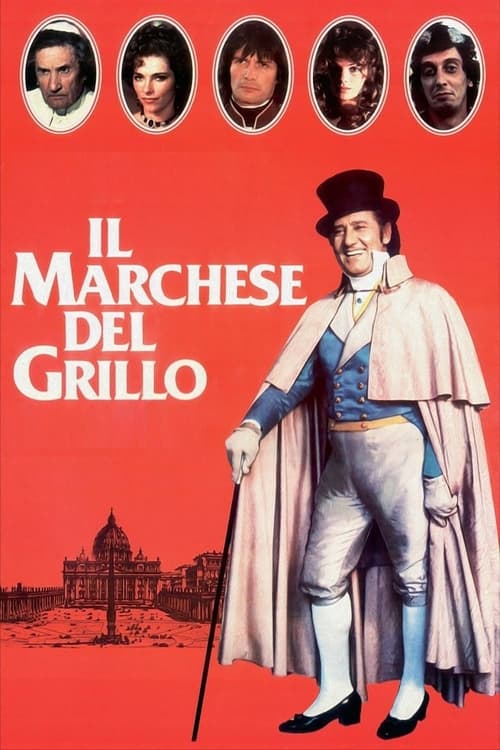
The Marquis of Grillo
In 18th-century Rome, impish aristocrat Onofrio del Grillo amuses himself by playing pranks on all sorts of people — his reactionary family and fellow nobles, the poors, the French occupiers trying to modernize society, and even the Pope himself.
The film earned $7.3M at the global box office.

Plot Structure
Story beats plotted across runtime


Narrative Arc
Emotional journey through the story's key moments
Story Circle
Blueprint 15-beat structure
Arcplot Score Breakdown
Weighted: Precision (70%) + Arc (15%) + Theme (15%)
The Marquis of Grillo (1981) showcases meticulously timed narrative design, characteristic of Mario Monicelli's storytelling approach. This structural analysis examines how the film's 15-point plot structure maps to proven narrative frameworks across 2 hours and 19 minutes. With an Arcplot score of 6.8, the film balances conventional beats with creative variation.
Structural Analysis
The Status Quo at 2 minutes (1% through the runtime) establishes The Marquis del Grillo rides through Rome in his carriage, embodying aristocratic privilege and arrogance. He declares his famous line "Io so' io, e voi non siete un cazzo" (I am me, and you are nothing), establishing his world of unchallenged power and casual cruelty toward the lower classes.. The analysis reveals that this early placement immediately immerses viewers in the story world.
The inciting incident occurs at 16 minutes when The Marquis encounters Gasperino, a coal merchant who is his exact physical double. This discovery disrupts the Marquis's sense of uniqueness and absolute superiority, planting the seed for his most elaborate and cruel prank.. At 12% through the film, this Disruption aligns precisely with traditional story structure. This beat shifts the emotional landscape, launching the protagonist into the central conflict.
The First Threshold at 34 minutes marks the transition into Act II, occurring at 24% of the runtime. This demonstrates the protagonist's commitment to The Marquis makes the active decision to kidnap Gasperino and switch places with him, forcing the coal merchant to live as the Marquis while he observes the chaos. This is his choice to cross into a dangerous game of identity., moving from reaction to action.
At 70 minutes, the Midpoint arrives at 50% of the runtime—precisely centered, creating perfect narrative symmetry. Significantly, this crucial beat Gasperino, desperate and terrified, manages to convince some people of his true identity, but no one believes him because of the Marquis's machinations. The Marquis realizes his prank has taken on a life of its own—false victory for him, false defeat for Gasperino. The stakes raise as the deception deepens., fundamentally raising what's at risk. The emotional intensity shifts, dividing the narrative into clear before-and-after phases.
The Collapse moment at 102 minutes (73% through) represents the emotional nadir. Here, Gasperino, broken by the ordeal, attempts suicide or experiences complete psychological collapse. The Marquis witnesses the real human cost of his game—a symbolic death of innocence and his own humanity. His amusement turns to hollow emptiness., indicates the protagonist at their lowest point. This beat's placement in the final quarter sets up the climactic reversal.
The Second Threshold at 110 minutes initiates the final act resolution at 79% of the runtime. The Marquis makes his final choice: he decides to end the game and restore Gasperino, but in doing so, reveals his true nature—he has learned nothing. He will return Gasperino to poverty and resume his privileged life, unchanged. This is a negative arc threshold., demonstrating the transformation achieved throughout the journey.
Emotional Journey
The Marquis of Grillo's emotional architecture traces a deliberate progression across 15 carefully calibrated beats.
Narrative Framework
This structural analysis employs structural analysis methodology used to understand storytelling architecture. By mapping The Marquis of Grillo against these established plot points, we can identify how Mario Monicelli utilizes or subverts traditional narrative conventions. The plot point approach reveals not only adherence to structural principles but also creative choices that distinguish The Marquis of Grillo within the comedy genre.
Comparative Analysis
Additional comedy films include The Bad Guys, Ella Enchanted and The Evening Star.
Plot Points by Act
Act I
SetupStatus Quo
The Marquis del Grillo rides through Rome in his carriage, embodying aristocratic privilege and arrogance. He declares his famous line "Io so' io, e voi non siete un cazzo" (I am me, and you are nothing), establishing his world of unchallenged power and casual cruelty toward the lower classes.
Theme
A commoner or servant remarks on the injustice of the class system and how the nobles do as they please without consequences, planting the thematic question: What happens when privilege meets its mirror image?
Worldbuilding
Introduction to early 19th-century papal Rome, the Marquis's world of pranks, gambling, womanizing, and complete disregard for consequences. We meet his circle of aristocrats, his long-suffering servants, and the rigid class hierarchy that enables his behavior.
Disruption
The Marquis encounters Gasperino, a coal merchant who is his exact physical double. This discovery disrupts the Marquis's sense of uniqueness and absolute superiority, planting the seed for his most elaborate and cruel prank.
Resistance
The Marquis becomes obsessed with the possibilities presented by his double. He debates with himself and tests small deceptions, considering how far he can take this situation. His servants and friends express concern, but he dismisses them.
Act II
ConfrontationFirst Threshold
The Marquis makes the active decision to kidnap Gasperino and switch places with him, forcing the coal merchant to live as the Marquis while he observes the chaos. This is his choice to cross into a dangerous game of identity.
Mirror World
Gasperino's innocent wife and humble family are introduced, representing the genuine human connections and simple dignity that the Marquis lacks. They embody the thematic counterpoint: authentic relationships versus aristocratic emptiness.
Premise
The fun and games of the switched identity. Gasperino struggles to navigate aristocratic society while the Marquis enjoys watching the confusion. Elaborate set pieces show the comedy of class contrast, mistaken identity, and the Marquis's cruel amusement at others' suffering.
Midpoint
Gasperino, desperate and terrified, manages to convince some people of his true identity, but no one believes him because of the Marquis's machinations. The Marquis realizes his prank has taken on a life of its own—false victory for him, false defeat for Gasperino. The stakes raise as the deception deepens.
Opposition
The situation spirals beyond the Marquis's control. Gasperino's family suffers, authorities get involved, and the Marquis's own circle begins to question what's happening. The cruel joke reveals the Marquis's fundamental emptiness and inability to truly connect with others. Opposition intensifies from multiple directions.
Collapse
Gasperino, broken by the ordeal, attempts suicide or experiences complete psychological collapse. The Marquis witnesses the real human cost of his game—a symbolic death of innocence and his own humanity. His amusement turns to hollow emptiness.
Crisis
The Marquis confronts the darkness of his own nature. He processes what his privilege has allowed him to do and the emptiness of his existence. For a moment, the possibility of change or redemption flickers.
Act III
ResolutionSecond Threshold
The Marquis makes his final choice: he decides to end the game and restore Gasperino, but in doing so, reveals his true nature—he has learned nothing. He will return Gasperino to poverty and resume his privileged life, unchanged. This is a negative arc threshold.
Synthesis
The Marquis orchestrates the return to status quo, dismissing Gasperino back to his coal merchant life with casual cruelty. He resumes his aristocratic existence, perhaps with a brief flicker of melancholy, but fundamentally unchanged. The system reasserts itself.
Transformation
The final image mirrors the opening: the Marquis rides through Rome in his carriage, once again declaring "Io so' io, e voi non siete un cazzo." Nothing has changed—a tragic transformation showing that privilege and class structure are immutable. The Marquis remains exactly who he was, proving the film's cynical thesis about power.