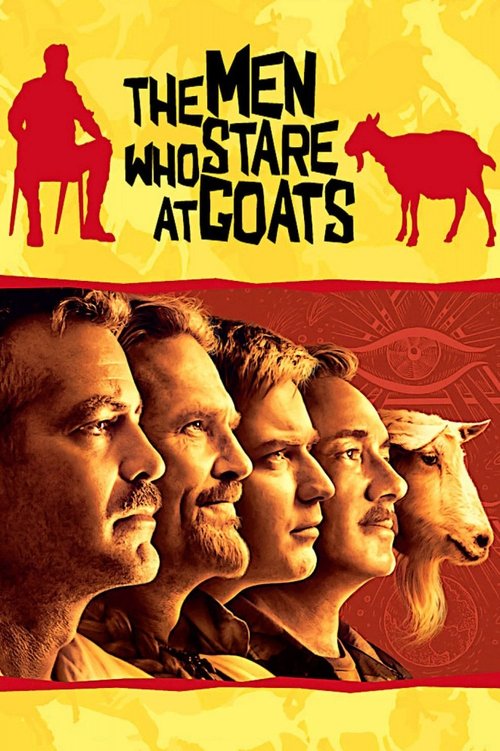
The Men Who Stare at Goats
A reporter in Iraq might just have the story of a lifetime when he meets Lyn Cassady, a guy who claims to be a former member of the U.S. Army's New Earth Army, a unit that employs paranormal powers in their missions.
Despite a mid-range budget of $24.0M, The Men Who Stare at Goats became a financial success, earning $68.7M worldwide—a 186% return.
1 win & 1 nomination


Plot Structure
Story beats plotted across runtime


Narrative Arc
Emotional journey through the story's key moments
Story Circle
Blueprint 15-beat structure
Arcplot Score Breakdown
Weighted: Precision (70%) + Arc (15%) + Theme (15%)
The Men Who Stare at Goats (2009) showcases strategically placed narrative design, characteristic of Grant Heslov's storytelling approach. This structural analysis examines how the film's 15-point plot structure maps to proven narrative frameworks across 1 hour and 34 minutes. With an Arcplot score of 7.3, the film balances conventional beats with creative variation.
Structural Analysis
The Status Quo at 1 minutes (1% through the runtime) establishes Bob Wilton is a small-time reporter in Ann Arbor, Michigan, interviewing a man who claims to have psychic powers. His ordinary world is mundane journalism and a stable marriage.. Notably, this early placement immediately immerses viewers in the story world.
The inciting incident occurs at 10 minutes when Bob decides to prove himself by going to Iraq as a journalist to cover the war, hoping to find purpose and show his ex-wife he's more than she thought.. At 11% through the film, this Disruption aligns precisely with traditional story structure. This beat shifts the emotional landscape, launching the protagonist into the central conflict.
The First Threshold at 23 minutes marks the transition into Act II, occurring at 24% of the runtime. This illustrates the protagonist's commitment to Bob chooses to accompany Lyn into Iraq, actively committing to this bizarre journey. They cross the border together, entering the mirror world of psychic soldiers and New Age military operations., moving from reaction to action.
At 47 minutes, the Midpoint arrives at 50% of the runtime—precisely centered, creating perfect narrative symmetry. Structural examination shows that this crucial beat Bob and Lyn are captured by a private military contractor - Larry Hoagland, Lyn's former colleague who corrupted the New Earth Army's ideals. The stakes raise as they discover Larry is running a psychic interrogation program at a secret base., fundamentally raising what's at risk. The emotional intensity shifts, dividing the narrative into clear before-and-after phases.
The Collapse moment at 68 minutes (72% through) represents the emotional nadir. Here, Lyn and Bob discover the goat from Lyn's past experiment - the one he tried to kill - confined and suffering. Lyn is confronted with the cost of his actions and the corruption of everything Bill Django built. The whiff of death: the dying goats and Lyn's broken idealism., shows the protagonist at their lowest point. This beat's placement in the final quarter sets up the climactic reversal.
The Second Threshold at 74 minutes initiates the final act resolution at 79% of the runtime. Bob chooses to believe - to act with purpose rather than cynicism. He helps Lyn recover and they decide to free the goats, synthesizing the New Earth Army's ideals with practical action. Bob becomes an active participant rather than a passive observer., demonstrating the transformation achieved throughout the journey.
Emotional Journey
The Men Who Stare at Goats's emotional architecture traces a deliberate progression across 15 carefully calibrated beats.
Narrative Framework
This structural analysis employs structural analysis methodology used to understand storytelling architecture. By mapping The Men Who Stare at Goats against these established plot points, we can identify how Grant Heslov utilizes or subverts traditional narrative conventions. The plot point approach reveals not only adherence to structural principles but also creative choices that distinguish The Men Who Stare at Goats within the comedy genre.
Comparative Analysis
Additional comedy films include The Bad Guys, Ella Enchanted and The Evening Star.
Plot Points by Act
Act I
SetupStatus Quo
Bob Wilton is a small-time reporter in Ann Arbor, Michigan, interviewing a man who claims to have psychic powers. His ordinary world is mundane journalism and a stable marriage.
Theme
The psychic subject tells Bob, "More of this is real than you think" - suggesting the central theme about belief, perception, and the line between reality and delusion.
Worldbuilding
Bob's wife leaves him for his one-armed editor. We see Bob's mundane life as a journalist, his broken marriage, and his search for meaning. The film intercuts with Lyn Cassady's voiceover establishing the New Earth Army's history.
Disruption
Bob decides to prove himself by going to Iraq as a journalist to cover the war, hoping to find purpose and show his ex-wife he's more than she thought.
Resistance
In Kuwait, Bob struggles to get into Iraq. He meets Lyn Cassady in a hotel, who claims to be a psychic spy. Bob is skeptical but intrigued, debating whether to follow this strange man or return home.
Act II
ConfrontationFirst Threshold
Bob chooses to accompany Lyn into Iraq, actively committing to this bizarre journey. They cross the border together, entering the mirror world of psychic soldiers and New Age military operations.
Mirror World
Lyn begins telling Bob about Bill Django and the New Earth Army - a thematic counterpoint showing idealistic soldiers trying to achieve peace through psychic powers and positivity, contrasting with Bob's cynical worldview.
Premise
The promise of the premise: Bob travels through Iraq with Lyn, hearing stories of psychic warriors, remote viewing, cloudbursting, and the legendary Jedi warriors. Flashbacks show the New Earth Army's heyday. Bob is both skeptical and captivated.
Midpoint
Bob and Lyn are captured by a private military contractor - Larry Hoagland, Lyn's former colleague who corrupted the New Earth Army's ideals. The stakes raise as they discover Larry is running a psychic interrogation program at a secret base.
Opposition
At the military base, Bob witnesses the dark side of the psychic soldier program. Larry has weaponized the New Earth Army's peaceful techniques. Lyn's past failures haunt him, particularly his inability to kill a goat by staring at it and his role in Bill Django's downfall.
Collapse
Lyn and Bob discover the goat from Lyn's past experiment - the one he tried to kill - confined and suffering. Lyn is confronted with the cost of his actions and the corruption of everything Bill Django built. The whiff of death: the dying goats and Lyn's broken idealism.
Crisis
Lyn falls into despair, drugged by Larry. Bob must process what he's learned about belief, truth, and the cost of idealism. Both men face their darkest moment, questioning whether any of it meant anything.
Act III
ResolutionSecond Threshold
Bob chooses to believe - to act with purpose rather than cynicism. He helps Lyn recover and they decide to free the goats, synthesizing the New Earth Army's ideals with practical action. Bob becomes an active participant rather than a passive observer.
Synthesis
Bob and Lyn liberate the goats and escape the base. They execute their plan, confronting Larry and rejecting the weaponized version of the New Earth Army. The finale shows them successfully releasing the goats into the desert, redeeming Lyn's past failure.
Transformation
Bob, now back home, types his story with newfound purpose and belief. He has transformed from a cynical, defeated journalist into someone who believes in something bigger. The final image mirrors the opening but shows Bob's changed perspective - he's no longer the skeptical interviewer but a believer.