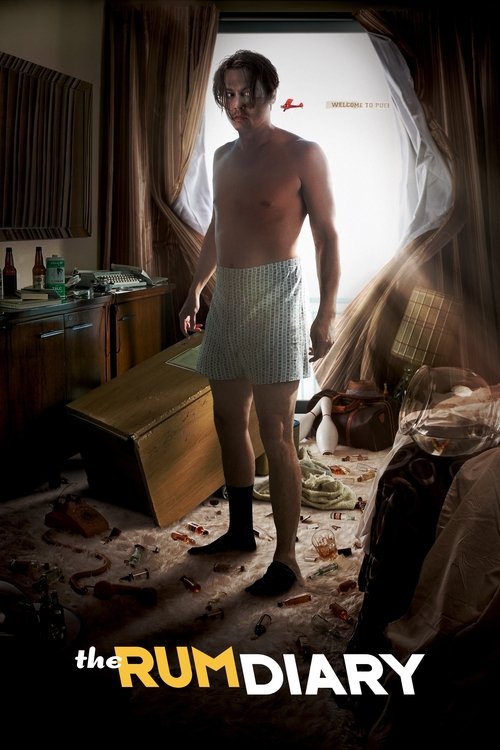
The Rum Diary
Tired of the noise and madness of New York and the crushing conventions of late Eisenhower-era America, itinerant journalist Paul Kemp travels to the pristine island of Puerto Rico to write for a local San Juan newspaper run by the downtrodden editor Lotterman. Adopting the rum-soaked lifestyle of the late ‘50s version of Hemingway’s 'The Lost Generation', Paul soon becomes entangled with a very attractive American woman and her fiancée, a businessman involved in shady property development deals. It is within this world that Kemp ultimately discovers his true voice as a writer and integrity as a man.
The film underperformed commercially against its respectable budget of $45.0M, earning $24.0M globally (-47% loss). While initial box office returns were modest, the film has gained appreciation for its unique voice within the comedy genre.
2 wins & 4 nominations


Plot Structure
Story beats plotted across runtime


Narrative Arc
Emotional journey through the story's key moments
Story Circle
Blueprint 15-beat structure
Arcplot Score Breakdown
Weighted: Precision (70%) + Arc (15%) + Theme (15%)
The Rum Diary (2011) demonstrates deliberately positioned plot construction, characteristic of Bruce Robinson's storytelling approach. This structural analysis examines how the film's 15-point plot structure maps to proven narrative frameworks across 2 hours. With an Arcplot score of 7.3, the film balances conventional beats with creative variation.
Structural Analysis
The Status Quo at 1 minutes (1% through the runtime) establishes Paul Kemp arrives hungover in 1960s Puerto Rico, a struggling journalist fleeing New York, representing his directionless life and dependency on alcohol.. Structural examination shows that this early placement immediately immerses viewers in the story world.
The inciting incident occurs at 14 minutes when Paul meets Sanderson, a wealthy businessman, and his stunning girlfriend Chenault at a party, opening the door to a world of money and temptation beyond journalism.. At 12% through the film, this Disruption aligns precisely with traditional story structure. This beat shifts the emotional landscape, launching the protagonist into the central conflict.
The First Threshold at 31 minutes marks the transition into Act II, occurring at 26% of the runtime. This demonstrates the protagonist's commitment to Paul agrees to work for Sanderson, accepting money to write propaganda for the development project that will displace locals, crossing his ethical line., moving from reaction to action.
At 61 minutes, the Midpoint arrives at 50% of the runtime—precisely centered, creating perfect narrative symmetry. Of particular interest, this crucial beat At a local carnival, Chenault dances provocatively with locals and a riot breaks out; Paul realizes he's losing control of everything—Chenault, his ethics, and his identity. False defeat., fundamentally raising what's at risk. The emotional intensity shifts, dividing the narrative into clear before-and-after phases.
The Collapse moment at 89 minutes (74% through) represents the emotional nadir. Here, The newspaper shuts down completely—Paul loses his job, his purpose, and his cover for being in Puerto Rico. The dream of being a real journalist dies., demonstrates the protagonist at their lowest point. This beat's placement in the final quarter sets up the climactic reversal.
The Second Threshold at 95 minutes initiates the final act resolution at 79% of the runtime. Paul discovers evidence of Sanderson's illegal scheme and decides to write the truth—to expose the corruption rather than profit from it, reclaiming his integrity as a journalist., demonstrating the transformation achieved throughout the journey.
Emotional Journey
The Rum Diary's emotional architecture traces a deliberate progression across 15 carefully calibrated beats.
Narrative Framework
This structural analysis employs systematic plot point analysis that identifies crucial turning points. By mapping The Rum Diary against these established plot points, we can identify how Bruce Robinson utilizes or subverts traditional narrative conventions. The plot point approach reveals not only adherence to structural principles but also creative choices that distinguish The Rum Diary within the comedy genre.
Bruce Robinson's Structural Approach
Among the 2 Bruce Robinson films analyzed on Arcplot, the average structural score is 6.8, demonstrating varied approaches to story architecture. The Rum Diary represents one of the director's most structurally precise works. For comparative analysis, explore the complete Bruce Robinson filmography.
Comparative Analysis
Additional comedy films include The Bad Guys, Ella Enchanted and The Evening Star. For more Bruce Robinson analyses, see Jennifer Eight.
Plot Points by Act
Act I
SetupStatus Quo
Paul Kemp arrives hungover in 1960s Puerto Rico, a struggling journalist fleeing New York, representing his directionless life and dependency on alcohol.
Theme
Sala tells Paul about the newspaper: "We're dying... but not dead yet." Theme of corruption vs. integrity, selling out vs. staying true.
Worldbuilding
Paul meets the eccentric staff of the San Juan Star, encounters the bizarre photographer Moberg, experiences the chaotic newsroom, and sees the poverty and excess of Puerto Rico.
Disruption
Paul meets Sanderson, a wealthy businessman, and his stunning girlfriend Chenault at a party, opening the door to a world of money and temptation beyond journalism.
Resistance
Paul debates whether to accept Sanderson's offer to write promotional materials for his real estate scheme, while growing closer to Chenault and experiencing wild nights with Sala and Moberg.
Act II
ConfrontationFirst Threshold
Paul agrees to work for Sanderson, accepting money to write propaganda for the development project that will displace locals, crossing his ethical line.
Mirror World
Paul and Chenault connect meaningfully, and she represents the thematic mirror—someone also trapped by a corrupt relationship, showing Paul what he might become if he continues selling out.
Premise
Paul enjoys the money and access from Sanderson while pursuing Chenault, living the high life between two worlds, investigating stories while compromising his integrity, escalating drinking and debauchery.
Midpoint
At a local carnival, Chenault dances provocatively with locals and a riot breaks out; Paul realizes he's losing control of everything—Chenault, his ethics, and his identity. False defeat.
Opposition
Sanderson's corruption becomes undeniable, Chenault pulls away, the newspaper faces closure, Moberg's behavior spirals, and Paul's complicity in the real estate scam weighs on him as locals suffer.
Collapse
The newspaper shuts down completely—Paul loses his job, his purpose, and his cover for being in Puerto Rico. The dream of being a real journalist dies.
Crisis
Paul drowns his sorrows, contemplates leaving Puerto Rico defeated, reflects on how far he's fallen from his ideals, and faces the emptiness of the corrupt path he chose.
Act III
ResolutionSecond Threshold
Paul discovers evidence of Sanderson's illegal scheme and decides to write the truth—to expose the corruption rather than profit from it, reclaiming his integrity as a journalist.
Synthesis
Paul writes an exposé of the real estate scam, breaks free from Sanderson, says goodbye to Chenault and his friends, and prepares to leave Puerto Rico transformed—broke but with his soul intact.
Transformation
Paul leaves Puerto Rico as a true writer who chose truth over money, mirroring the opening but transformed—still drinking, but now with purpose and integrity instead of emptiness.