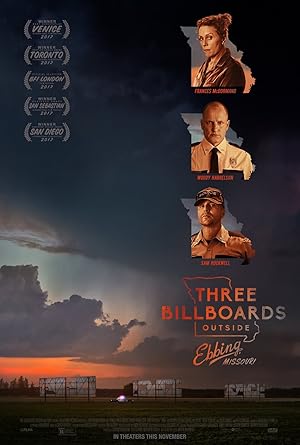
Three Billboards Outside Ebbing, Missouri
THREE BILLBOARDS OUTSIDE EBBING, MISSOURI is a darkly comic drama from Academy Award nominee Martin McDonagh (In Bruges). After months have passed without a culprit in her daughter's murder case, Mildred Hayes (Academy Award winner Frances McDormand) makes a bold move, painting three signs leading into her town with a controversial message directed at William Willoughby (Academy Award nominee Woody Harrelson), the town's revered chief of police. When his second-in-command Officer Dixon (Academy Award winner Sam Rockwell), an immature mother's boy with a penchant for violence, gets involved, the battle between Mildred and Ebbing's law enforcement is only exacerbated.
Despite a respectable budget of $15.0M, Three Billboards Outside Ebbing, Missouri became a box office phenomenon, earning $162.7M worldwide—a remarkable 985% return.
2 Oscars. 132 wins & 233 nominations
Plot Structure
Story beats plotted across runtime


Narrative Arc
Emotional journey through the story's key moments
Story Circle
Blueprint 15-beat structure
Arcplot Score Breakdown
Weighted: Precision (70%) + Arc (15%) + Theme (15%)
Three Billboards Outside Ebbing, Missouri (2017) exhibits strategically placed plot construction, characteristic of Martin McDonagh's storytelling approach. This structural analysis examines how the film's 14-point plot structure maps to proven narrative frameworks across 1 hour and 55 minutes. With an Arcplot score of 3.4, the film takes an unconventional approach to traditional narrative frameworks.
Structural Analysis
The Status Quo at 1 minutes (1% through the runtime) establishes Mildred Hayes drives past three dilapidated billboards on a lonely road, her face marked by grief and determination. Her daughter Angela was raped and murdered seven months ago, and the case remains unsolved.. Of particular interest, this early placement immediately immerses viewers in the story world.
The inciting incident occurs at 12 minutes when The three billboards are revealed with their accusatory messages: "RAPED WHILE DYING," "AND STILL NO ARRESTS?" "HOW COME, CHIEF WILLOUGHBY?" The town erupts in shock and outrage, dividing the community.. At 11% through the film, this Disruption aligns precisely with traditional story structure. This beat shifts the emotional landscape, launching the protagonist into the central conflict.
The First Threshold at 26 minutes marks the transition into Act II, occurring at 22% of the runtime. This demonstrates the protagonist's commitment to After the priest visits to pressure her, Mildred delivers a devastating monologue about the Church's complicity in child abuse, burning every bridge. She fully commits to her war against the establishment, accepting complete isolation., moving from reaction to action.
At 50 minutes, the Midpoint arrives at 44% of the runtime—arriving early, accelerating into Act IIb complications. Significantly, this crucial beat Chief Willoughby shoots himself. This false defeat devastates everyone. He leaves behind letters for Mildred, Dixon, and his wife. His death removes the film's moral center and unleashes chaos., fundamentally raising what's at risk. The emotional intensity shifts, dividing the narrative into clear before-and-after phases.
The Collapse moment at 75 minutes (65% through) represents the emotional nadir. Here, Mildred, believing Dixon set the fire, firebombs the police station in retaliation. She learns afterward that Dixon was NOT responsible—he was actually the one person who saved Angela's file. Her rage has made her no better than those she condemns. Charlie tells her, "The town's sympathies are with you... Until today."., reveals the protagonist at their lowest point. This beat's placement in the final quarter sets up the climactic reversal.
The Second Threshold at 82 minutes initiates the final act resolution at 71% of the runtime. Dixon calls Mildred with the potential lead—the DNA from the man in the bar. It's not a match for Angela's killer, but it doesn't matter. They both realize they've found something more important: a path forward together, and a choice about who they want to become., demonstrating the transformation achieved throughout the journey.
Emotional Journey
Three Billboards Outside Ebbing, Missouri's emotional architecture traces a deliberate progression across 14 carefully calibrated beats.
Narrative Framework
This structural analysis employs structural analysis methodology used to understand storytelling architecture. By mapping Three Billboards Outside Ebbing, Missouri against these established plot points, we can identify how Martin McDonagh utilizes or subverts traditional narrative conventions. The plot point approach reveals not only adherence to structural principles but also creative choices that distinguish Three Billboards Outside Ebbing, Missouri within the comedy genre.
Martin McDonagh's Structural Approach
Among the 3 Martin McDonagh films analyzed on Arcplot, the average structural score is 5.6, showcasing experimental approaches to narrative form. Three Billboards Outside Ebbing, Missouri takes a more unconventional approach compared to the director's typical style. For comparative analysis, explore the complete Martin McDonagh filmography.
Comparative Analysis
Additional comedy films include The Ministry of Ungentlemanly Warfare, The Bad Guys and Lake Placid. For more Martin McDonagh analyses, see Seven Psychopaths, The Banshees of Inisherin.
Plot Points by Act
Act I
SetupStatus Quo
Mildred Hayes drives past three dilapidated billboards on a lonely road, her face marked by grief and determination. Her daughter Angela was raped and murdered seven months ago, and the case remains unsolved.
Theme
Red Welby, the advertising agent, tells Mildred: "Hard to catch a criminal when you're committing a crime yourself." The theme of vengeance versus justice, and whether fighting fire with fire is justified, is established.
Worldbuilding
Mildred rents the three billboards with inflammatory messages directed at Chief Willoughby about her daughter's unsolved murder. We meet the key players: Chief Willoughby (a respected, dying lawman), Officer Dixon (racist, violent, living with his mother), Mildred's son Robbie, and ex-husband Charlie. The town's dynamics and Mildred's isolation are established.
Disruption
The three billboards are revealed with their accusatory messages: "RAPED WHILE DYING," "AND STILL NO ARRESTS?" "HOW COME, CHIEF WILLOUGHBY?" The town erupts in shock and outrage, dividing the community.
Resistance
Mildred faces intense pressure from the community, the church, and even her own son to take down the billboards. Willoughby visits her privately, explaining with dignity why the case is unsolvable. Despite threats, harassment, and social ostracism, Mildred refuses to back down. Her rage is immovable.
Act II
ConfrontationFirst Threshold
After the priest visits to pressure her, Mildred delivers a devastating monologue about the Church's complicity in child abuse, burning every bridge. She fully commits to her war against the establishment, accepting complete isolation.
Mirror World
James, a gentle dwarf who works at the gift shop, asks Mildred on a date. He represents kindness, acceptance, and the possibility of connection—everything Mildred's rage prevents her from accessing. He becomes the film's moral conscience.
Premise
The premise delivers: a town at war with itself. Mildred endures increasing harassment (her billboards are vandalized, her son is bullied, Charlie attacks her). Dixon investigates Red Welby illegally. Willoughby tries to maintain peace while dying of cancer. Tensions escalate with violent confrontations, including Dixon throwing Red out a window.
Midpoint
Chief Willoughby shoots himself. This false defeat devastates everyone. He leaves behind letters for Mildred, Dixon, and his wife. His death removes the film's moral center and unleashes chaos.
Opposition
The town blames Mildred for Willoughby's suicide. Dixon, reading his letter from Willoughby urging him to lead with love, is fired for his brutality. In revenge, someone firebombs the billboards while Mildred is inside; she barely escapes. Dixon, in the police station during the fire, risks his life to save Angela's case file. Both are burned—literally and metaphorically.
Collapse
Mildred, believing Dixon set the fire, firebombs the police station in retaliation. She learns afterward that Dixon was NOT responsible—he was actually the one person who saved Angela's file. Her rage has made her no better than those she condemns. Charlie tells her, "The town's sympathies are with you... until today."
Crisis
Mildred sits in darkness, processing the consequences of her actions. Dixon, bandaged and burned, overhears a man in a bar bragging about raping and burning a girl. Despite his injuries, he provokes a fight to get the man's DNA. Both are at their lowest, forced to confront who they've become.
Act III
ResolutionSecond Threshold
Dixon calls Mildred with the potential lead—the DNA from the man in the bar. It's not a match for Angela's killer, but it doesn't matter. They both realize they've found something more important: a path forward together, and a choice about who they want to become.
Synthesis
Mildred and Dixon drive toward Idaho to possibly kill the man from the bar. In the car, they discuss their plan. Dixon admits he's not sure the man is guilty. Mildred admits she's not sure either. They agree to "decide on the way" whether to go through with it. The finale resolves nothing—except their transformation.


