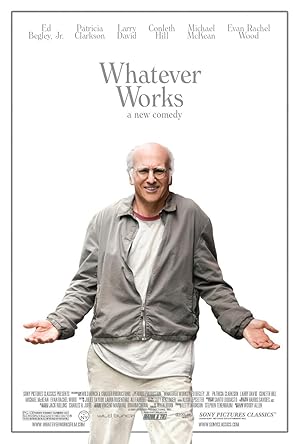
Whatever Works
Attempting to impress his ideologies on religion, relationships, and the randomness (and worthlessness) of existence, lifelong New York resident Boris Yellnikoff rants to anyone who will listen, including the audience. But when he begrudgingly allows naive Mississippi runaway Melodie St. Ann Celestine to live in his apartment, his reclusive rages give way to an unlikely friendship and Boris begins to mold the impressionable young girl's worldly views to match his own. When it comes to love, "whatever works" is his motto, but his already perplexed life complicates itself further when Melodie's parents eventually track her down.
Despite a respectable budget of $15.0M, Whatever Works became a financial success, earning $36.0M worldwide—a 140% return.
2 wins & 1 nomination


Plot Structure
Story beats plotted across runtime


Narrative Arc
Emotional journey through the story's key moments
Story Circle
Blueprint 15-beat structure
Arcplot Score Breakdown
Weighted: Precision (70%) + Arc (15%) + Theme (15%)
Whatever Works (2009) exemplifies meticulously timed narrative architecture, characteristic of Woody Allen's storytelling approach. This structural analysis examines how the film's 15-point plot structure maps to proven narrative frameworks across 1 hour and 32 minutes. With an Arcplot score of 6.7, the film balances conventional beats with creative variation.
Structural Analysis
The Status Quo at 1 minutes (1% through the runtime) establishes Boris Yellnikoff addresses the camera directly, establishing his misanthropic worldview and intellectual superiority complex while dining with friends who are exhausted by his negativity.. The analysis reveals that this early placement immediately immerses viewers in the story world.
The inciting incident occurs at 12 minutes when Melodie St. Ann Celestine, a young runaway from Mississippi, appears on Boris's doorstep begging for food. Despite his protests, her persistent innocence disrupts his carefully constructed isolation.. At 13% through the film, this Disruption is delayed, allowing extended setup of the story world. This beat shifts the emotional landscape, launching the protagonist into the central conflict.
The First Threshold at 23 minutes marks the transition into Act II, occurring at 25% of the runtime. This illustrates the protagonist's commitment to Boris agrees to let Melodie stay permanently and begins teaching her about philosophy, science, and culture. He actively chooses to engage with another human being despite his professed misanthropy., moving from reaction to action.
At 46 minutes, the Midpoint arrives at 50% of the runtime—precisely centered, creating perfect narrative symmetry. The analysis reveals that this crucial beat Melodie's mother Marietta arrives unexpectedly in New York, having left her husband. Her arrival threatens the equilibrium Boris and Melodie have established and introduces new chaos into their lives., fundamentally raising what's at risk. The emotional intensity shifts, dividing the narrative into clear before-and-after phases.
The Collapse moment at 69 minutes (75% through) represents the emotional nadir. Here, Melodie confesses her feelings for Randy and leaves Boris. His carefully constructed life collapses. Alone again, Boris faces the failure of his one attempt at human connection, confirming his worst fears about relationships., indicates the protagonist at their lowest point. This beat's placement in the final quarter sets up the climactic reversal.
The Second Threshold at 74 minutes initiates the final act resolution at 81% of the runtime. Boris attempts suicide again by jumping out a window, but lands on a woman passing below. This absurd survival forces him to confront that he cannot escape life - he must find a way to live it., demonstrating the transformation achieved throughout the journey.
Emotional Journey
Whatever Works's emotional architecture traces a deliberate progression across 15 carefully calibrated beats.
Narrative Framework
This structural analysis employs systematic plot point analysis that identifies crucial turning points. By mapping Whatever Works against these established plot points, we can identify how Woody Allen utilizes or subverts traditional narrative conventions. The plot point approach reveals not only adherence to structural principles but also creative choices that distinguish Whatever Works within the comedy genre.
Woody Allen's Structural Approach
Among the 42 Woody Allen films analyzed on Arcplot, the average structural score is 7.0, demonstrating varied approaches to story architecture. Whatever Works takes a more unconventional approach compared to the director's typical style. For comparative analysis, explore the complete Woody Allen filmography.
Comparative Analysis
Additional comedy films include The Bad Guys, Ella Enchanted and The Evening Star. For more Woody Allen analyses, see Everyone Says I Love You, Celebrity and Interiors.
Plot Points by Act
Act I
SetupStatus Quo
Boris Yellnikoff addresses the camera directly, establishing his misanthropic worldview and intellectual superiority complex while dining with friends who are exhausted by his negativity.
Theme
Boris explains his philosophy to his friends: life is meaningless, happiness is an illusion, and you should grab "whatever works" to get through the cosmic joke of existence.
Worldbuilding
We learn Boris is a former Columbia professor who had a breakdown, attempted suicide, divorced his wife, and now teaches chess to children he considers idiots. His bitter, isolated New York existence is established.
Disruption
Melodie St. Ann Celestine, a young runaway from Mississippi, appears on Boris's doorstep begging for food. Despite his protests, her persistent innocence disrupts his carefully constructed isolation.
Resistance
Boris reluctantly allows Melodie to stay temporarily. He debates with himself and his friends about this intrusion, while Melodie's naive optimism clashes with his cynicism. She becomes fascinated by his intelligence.
Act II
ConfrontationFirst Threshold
Boris agrees to let Melodie stay permanently and begins teaching her about philosophy, science, and culture. He actively chooses to engage with another human being despite his professed misanthropy.
Mirror World
Melodie declares her love for Boris and proposes marriage. This relationship embodies the film's theme - an unlikely pairing that "works" despite making no conventional sense.
Premise
Boris and Melodie's unconventional marriage unfolds. She absorbs his pessimistic worldview while bringing unexpected warmth to his life. Their mismatched relationship delivers the comedic promise of the premise.
Midpoint
Melodie's mother Marietta arrives unexpectedly in New York, having left her husband. Her arrival threatens the equilibrium Boris and Melodie have established and introduces new chaos into their lives.
Opposition
Marietta transforms from a conservative Southern Christian into a bohemian artist with two lovers. Melodie meets Randy, a young attractive actor. John arrives and discovers his homosexuality. The family chaos intensifies around Boris.
Collapse
Melodie confesses her feelings for Randy and leaves Boris. His carefully constructed life collapses. Alone again, Boris faces the failure of his one attempt at human connection, confirming his worst fears about relationships.
Crisis
Boris spirals into despair. Without Melodie, his nihilistic philosophy offers no comfort. He wanders the city alone, contemplating the meaninglessness he always preached but now painfully feels.
Act III
ResolutionSecond Threshold
Boris attempts suicide again by jumping out a window, but lands on a woman passing below. This absurd survival forces him to confront that he cannot escape life - he must find a way to live it.
Synthesis
Boris recovers and meets Helena, the psychic he landed on. Everyone finds their unconventional happiness: Melodie with Randy, Marietta with her two lovers, John with his male partner. Boris tentatively opens to Helena.
Transformation
Boris addresses the audience one final time, now with Helena beside him. He admits that despite the absurdity of existence, you grab whatever works. His transformation from isolated cynic to reluctant participant in life is complete.