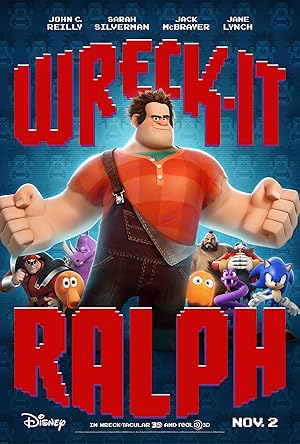
Wreck-It Ralph
Wreck-It Ralph longs to be as beloved as his game's perfect Good Guy, Fix-It Felix. Problem is, nobody loves a Bad Guy. But they do love heroes... so when a modern, first-person shooter game arrives featuring tough-as-nails Sergeant Calhoun, Ralph sees it as his ticket to heroism and happiness. He sneaks into the game with a simple plan -- win a medal -- but soon wrecks everything, and accidentally unleashes a deadly enemy that threatens every game in the arcade. Ralph's only hope? Vanellope von Schweetz, a young troublemaking "glitch" from a candy-coated cart racing game who might just be the one to teach Ralph what it means to be a Good Guy. But will he realize he is good enough to become a hero before it's "Game Over" for the entire arcade?
Despite a major studio investment of $165.0M, Wreck-It Ralph became a box office success, earning $471.2M worldwide—a 186% return. This commercial performance validated the ambitious narrative scope, proving that audiences embrace bold vision even at blockbuster scale.
Nominated for 1 Oscar. 33 wins & 42 nominations


Plot Structure
Story beats plotted across runtime


Narrative Arc
Emotional journey through the story's key moments
Story Circle
Blueprint 15-beat structure
Arcplot Score Breakdown
Weighted: Precision (70%) + Arc (15%) + Theme (15%)
Wreck-It Ralph (2012) showcases precise plot construction, characteristic of Rich Moore's storytelling approach. This structural analysis examines how the film's 15-point plot structure maps to proven narrative frameworks across 1 hour and 41 minutes. With an Arcplot score of 6.7, the film balances conventional beats with creative variation.
Structural Analysis
The Status Quo at 1 minutes (1% through the runtime) establishes Ralph sits alone in the dump made of bricks, narrating his 30 years as the villain in Fix-It Felix Jr. He's isolated, unloved, and sleeps in the garbage while Felix lives in the penthouse. The "before" state: a bad guy who desperately wants to be good.. Of particular interest, this early placement immediately immerses viewers in the story world.
The inciting incident occurs at 12 minutes when Gene tells Ralph he'll never be a hero and can never earn a medal. Ralph, enraged, smashes the cake and declares he WILL win a medal. This public humiliation and challenge disrupts his acceptance of his role and sets him on his dangerous quest.. At 12% through the film, this Disruption aligns precisely with traditional story structure. This beat shifts the emotional landscape, launching the protagonist into the central conflict.
The First Threshold at 24 minutes marks the transition into Act II, occurring at 24% of the runtime. This demonstrates the protagonist's commitment to Ralph grabs the Medal of Heroes at the top of the tower, making the active choice to take it and flee. However, he accidentally launches an escape pod containing a Cy-Bug into Sugar Rush. This irreversible decision catapults him into the new world and sets catastrophe in motion., moving from reaction to action.
At 50 minutes, the Midpoint arrives at 49% of the runtime—precisely centered, creating perfect narrative symmetry. The analysis reveals that this crucial beat False victory: Vanellope successfully completes the practice track, proving she can race despite her glitch. Ralph and Vanellope share a genuine moment of friendship as she gives him her homemade "Hero" cookie medal. Ralph finally feels like a hero through connection, not recognition., fundamentally raising what's at risk. The emotional intensity shifts, dividing the narrative into clear before-and-after phases.
The Collapse moment at 73 minutes (73% through) represents the emotional nadir. Here, Ralph returns to Fix-It Felix Jr. To find it abandoned and scheduled for unplugging—everyone evacuated when he left. Gene reveals that without Ralph, there is no game. Ralph realizes his quest for validation has destroyed his home and betrayed the only person who believed in him., demonstrates the protagonist at their lowest point. This beat's placement in the final quarter sets up the climactic reversal.
The Second Threshold at 79 minutes initiates the final act resolution at 78% of the runtime. Ralph smashes the Sugar Rush cabinet from outside, sees Vanellope's image as a legitimate racer, and realizes King Candy lied. He breaks Felix out of prison with the revelation that Vanellope was always supposed to be in the game. They must get her across the finish line to reset everything., demonstrating the transformation achieved throughout the journey.
Emotional Journey
Wreck-It Ralph's emotional architecture traces a deliberate progression across 15 carefully calibrated beats.
Narrative Framework
This structural analysis employs proven narrative structure principles that track dramatic progression. By mapping Wreck-It Ralph against these established plot points, we can identify how Rich Moore utilizes or subverts traditional narrative conventions. The plot point approach reveals not only adherence to structural principles but also creative choices that distinguish Wreck-It Ralph within the animation genre.
Comparative Analysis
Additional animation films include The Bad Guys, Puss in Boots and Violet Evergarden: Eternity and the Auto Memory Doll.
Plot Points by Act
Act I
SetupStatus Quo
Ralph sits alone in the dump made of bricks, narrating his 30 years as the villain in Fix-It Felix Jr. He's isolated, unloved, and sleeps in the garbage while Felix lives in the penthouse. The "before" state: a bad guy who desperately wants to be good.
Theme
At the Bad-Anon support group, the zombie states the mantra: "One game at a time, Ralph." Clyde the ghost delivers the key thematic line: "Just because you are bad guy doesn't mean you are bad guy." This establishes that identity is not defined by your role.
Worldbuilding
We learn the rules of the arcade world: characters can travel between games via Game Central Station, dying outside your game means permanent death, and going "Turbo" (abandoning your game) is the ultimate taboo. Ralph attends the 30th anniversary party uninvited and is rejected by the Nicelanders.
Disruption
Gene tells Ralph he'll never be a hero and can never earn a medal. Ralph, enraged, smashes the cake and declares he WILL win a medal. This public humiliation and challenge disrupts his acceptance of his role and sets him on his dangerous quest.
Resistance
Ralph debates his options at Tapper's bar, where a soldier from Hero's Duty tells him about the Medal of Heroes. Ralph learns how to game-jump, sneaks into Hero's Duty, and endures the terrifying first-person shooter to reach the medal. His guide is desperation and the soldier's offhand comment.
Act II
ConfrontationFirst Threshold
Ralph grabs the Medal of Heroes at the top of the tower, making the active choice to take it and flee. However, he accidentally launches an escape pod containing a Cy-Bug into Sugar Rush. This irreversible decision catapults him into the new world and sets catastrophe in motion.
Mirror World
Ralph meets Vanellope von Schweetz, a "glitch" who steals his medal to enter the Random Roster Race. She's an outcast like him—rejected, mocked, and denied her place in the game. Their parallel journeys intertwine as she becomes his thematic mirror and eventual found family.
Premise
The "fun and games" of Sugar Rush unfold: Ralph chases Vanellope, destroys her cart, then reluctantly helps her build a new one in the kart bakery. They bond during racing practice in Diet Cola Mountain. Meanwhile, Felix and Calhoun search for Ralph and the Cy-Bug.
Midpoint
False victory: Vanellope successfully completes the practice track, proving she can race despite her glitch. Ralph and Vanellope share a genuine moment of friendship as she gives him her homemade "Hero" cookie medal. Ralph finally feels like a hero through connection, not recognition.
Opposition
King Candy manipulates Ralph, showing him the "truth" that if Vanellope races and the players see her glitch, the game will be unplugged and she'll die. Ralph, believing he's protecting her, destroys her kart and breaks her heart. Felix is imprisoned. The Cy-Bug threat grows underground.
Collapse
Ralph returns to Fix-It Felix Jr. to find it abandoned and scheduled for unplugging—everyone evacuated when he left. Gene reveals that without Ralph, there is no game. Ralph realizes his quest for validation has destroyed his home and betrayed the only person who believed in him.
Crisis
Ralph's dark night: staring at Vanellope's medal on the side of the Sugar Rush cabinet, he sees her image and realizes she was always meant to be in the game. King Candy manipulated him. He didn't protect Vanellope—he abandoned her, just like everyone abandoned him.
Act III
ResolutionSecond Threshold
Ralph smashes the Sugar Rush cabinet from outside, sees Vanellope's image as a legitimate racer, and realizes King Candy lied. He breaks Felix out of prison with the revelation that Vanellope was always supposed to be in the game. They must get her across the finish line to reset everything.
Synthesis
The finale: Ralph and Felix retrieve Vanellope, repair her kart, and she enters the race. King Candy is revealed as Turbo. Cy-Bugs swarm. Ralph launches himself into the Mentos volcano to create a beacon, reciting the Bad Guy Affirmation as his sacrifice—becoming a true hero through selfless action.
Transformation
Vanellope crosses the finish line, resetting the game and revealing herself as Princess Vanellope. Ralph returns to Fix-It Felix Jr., now celebrated by the Nicelanders and content in his role. He watches Vanellope race from his building, finally at peace: "If that little kid likes me, how bad can I be?"