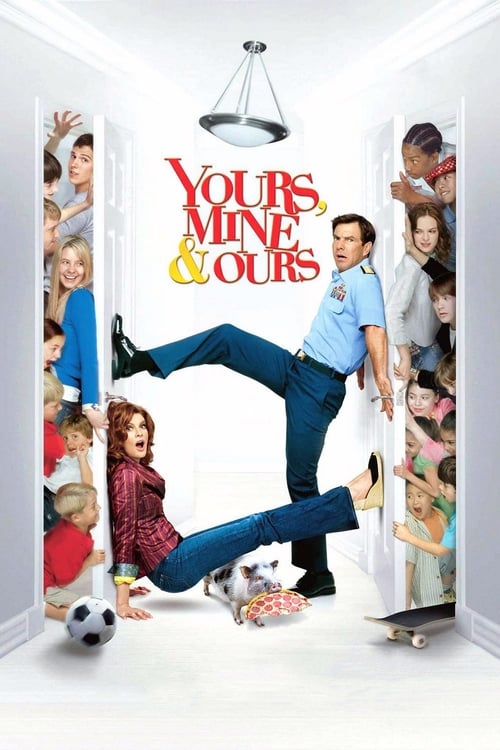
Yours, Mine & Ours
Admiral Frank Beardsley returns to New London to run the Coast Guard Academy, his last stop before a probable promotion to head the Guard. A widower with eight children, he runs a loving but tight ship, with charts and salutes. The kids long for a permanent home. Helen North is a free spirit, a designer whose ten children live in loving chaos, with occasional group hugs. Helen and Frank, high school sweethearts, reconnect at a reunion, and it's love at first re-sighting. They marry on the spot. Then the problems start as two sets of kids, the free spirits and the disciplined preppies, must live together. The warring factions agree to work together to end the marriage.
Working with a moderate budget of $45.0M, the film achieved a modest success with $72.0M in global revenue (+60% profit margin).
2 wins & 5 nominations


Plot Structure
Story beats plotted across runtime


Narrative Arc
Emotional journey through the story's key moments
Story Circle
Blueprint 15-beat structure
Arcplot Score Breakdown
Weighted: Precision (70%) + Arc (15%) + Theme (15%)
Yours, Mine & Ours (2005) showcases carefully calibrated story structure, characteristic of Raja Gosnell's storytelling approach. This structural analysis examines how the film's 15-point plot structure maps to proven narrative frameworks across 1 hour and 30 minutes. With an Arcplot score of 7.4, the film balances conventional beats with creative variation.
Structural Analysis
The Status Quo at 1 minutes (1% through the runtime) establishes Frank Beardsley runs his household of 8 children with military precision while Helen North manages her 10 children with artistic chaos. Two separate, functional but incomplete families.. Of particular interest, this early placement immediately immerses viewers in the story world.
The inciting incident occurs at 11 minutes when Frank proposes to Helen after their whirlwind reunion. The decision to marry brings joy but introduces the impending challenge of merging 18 children into one household.. At 12% through the film, this Disruption aligns precisely with traditional story structure. This beat shifts the emotional landscape, launching the protagonist into the central conflict.
The First Threshold at 22 minutes marks the transition into Act II, occurring at 25% of the runtime. This reveals the protagonist's commitment to Frank and Helen get married and actively choose to merge their families into one household. They move into a lighthouse home together, committing to making the blended family work., moving from reaction to action.
At 44 minutes, the Midpoint arrives at 49% of the runtime—precisely centered, creating perfect narrative symmetry. Of particular interest, this crucial beat False defeat: The children from both sides unite against their parents, staging coordinated sabotage to break up the marriage. Stakes raise as Frank and Helen realize their children are working together to destroy the family., fundamentally raising what's at risk. The emotional intensity shifts, dividing the narrative into clear before-and-after phases.
The Collapse moment at 67 minutes (74% through) represents the emotional nadir. Here, All Is Lost: Frank and Helen have a major fight about their incompatible parenting styles. They decide to separate, with the dream of a united family dying. The children realize their plan worked but feel guilty., demonstrates the protagonist at their lowest point. This beat's placement in the final quarter sets up the climactic reversal.
The Second Threshold at 72 minutes initiates the final act resolution at 80% of the runtime. Breakthrough: The children realize they actually became friends and miss each other. They devise a plan to reunite their parents. Frank and Helen separately realize they need to blend their styles, not choose one over the other., demonstrating the transformation achieved throughout the journey.
Emotional Journey
Yours, Mine & Ours's emotional architecture traces a deliberate progression across 15 carefully calibrated beats.
Narrative Framework
This structural analysis employs a 15-point narrative structure framework that maps key story moments. By mapping Yours, Mine & Ours against these established plot points, we can identify how Raja Gosnell utilizes or subverts traditional narrative conventions. The plot point approach reveals not only adherence to structural principles but also creative choices that distinguish Yours, Mine & Ours within the comedy genre.
Raja Gosnell's Structural Approach
Among the 9 Raja Gosnell films analyzed on Arcplot, the average structural score is 7.3, reflecting strong command of classical structure. Yours, Mine & Ours represents one of the director's most structurally precise works. For comparative analysis, explore the complete Raja Gosnell filmography.
Comparative Analysis
Additional comedy films include The Bad Guys, Ella Enchanted and The Evening Star. For more Raja Gosnell analyses, see The Smurfs, Never Been Kissed and Show Dogs.
Plot Points by Act
Act I
SetupStatus Quo
Frank Beardsley runs his household of 8 children with military precision while Helen North manages her 10 children with artistic chaos. Two separate, functional but incomplete families.
Theme
A character mentions that love means compromise and families have to find common ground - foreshadowing the central challenge of merging two different family styles.
Worldbuilding
Establishment of Frank's structured military-style household and Helen's free-spirited artistic family. Frank and Helen reconnect after 30 years, reigniting their high school romance.
Disruption
Frank proposes to Helen after their whirlwind reunion. The decision to marry brings joy but introduces the impending challenge of merging 18 children into one household.
Resistance
Frank and Helen debate how to break the news to their children. They plan the wedding while the children from both families begin to meet and clash over their different lifestyles and values.
Act II
ConfrontationFirst Threshold
Frank and Helen get married and actively choose to merge their families into one household. They move into a lighthouse home together, committing to making the blended family work.
Mirror World
The relationship between Frank and Helen represents the thematic mirror - if they can bridge their differences through love and respect, so can their children.
Premise
The "promise of the premise" - chaos and comedy as 18 children clash in one house. Bathroom wars, food fights, competing family traditions. Frank imposes military rules while Helen tries to maintain creativity and freedom.
Midpoint
False defeat: The children from both sides unite against their parents, staging coordinated sabotage to break up the marriage. Stakes raise as Frank and Helen realize their children are working together to destroy the family.
Opposition
The children's sabotage intensifies - embarrassing their parents publicly, creating disasters at home. Frank becomes more authoritarian while Helen withdraws. The parents' different approaches create friction in their marriage.
Collapse
All Is Lost: Frank and Helen have a major fight about their incompatible parenting styles. They decide to separate, with the dream of a united family dying. The children realize their plan worked but feel guilty.
Crisis
Dark night: Both families separately grieve the loss of their blended family. The children reflect on what they've done. Frank and Helen each realize they were trying to change the other instead of compromising.
Act III
ResolutionSecond Threshold
Breakthrough: The children realize they actually became friends and miss each other. They devise a plan to reunite their parents. Frank and Helen separately realize they need to blend their styles, not choose one over the other.
Synthesis
The finale: Children orchestrate a reunion. Frank and Helen reconcile, committing to a true partnership that honors both structure and freedom. The family works together for the first time, combining military efficiency with artistic creativity.
Transformation
Final image mirrors the opening but transformed: the blended family functioning as one unit with both order and chaos in harmony. 18 children now genuinely united, Frank and Helen leading together with balanced parenting.