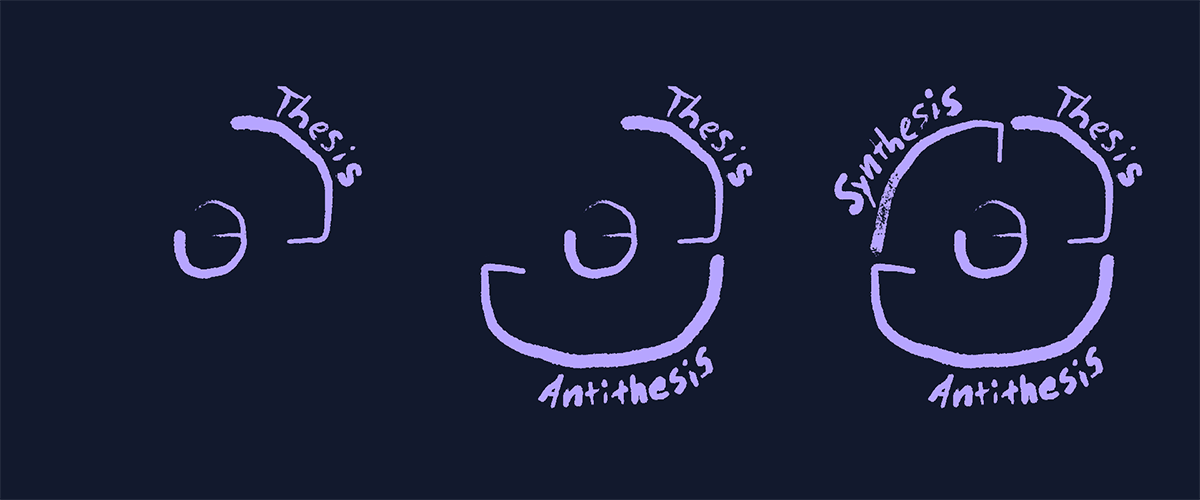
Thesis, Antithesis, Synthesis: A Rhythm of Transformation
Curiosity opens the door. Sacrifice pays the toll. Synthesis is the prize. And the prize, in time, becomes the new beginning.
Every story that involves change follows the same underlying pattern, a structure of transformation. The pattern is is classic: thesis, antithesis, synthesis. A state of being, its negation, and the integration of both into a new, third thing.
Thesis: The Rulebook of Act One
The thesis is your starting condition. It's the world as it exists before the story begins, complete with its own internal logic, values, and rules. In The Matrix, the thesis is the simulated reality where Neo works his corporate job and follows the rules of a world he doesn't yet know is false. In The Wizard of Oz, it's Kansas: flat, gray, and governed by the adult logic of responsibility and restraint.
The thesis isn't necessarily bad. It's simply what is. It contains everything the protagonist currently knows about how the world works and who they are within it. This is sometimes called the "status quo,". The thesis is a complete worldview, a coherent set of principles that has, until now, been sufficient.
The key characteristic of the thesis is that it feels stable. It has rules, and those rules create predictability. You know what's expected, you know what's possible, you know your place. This is very often where the key elements of the story's set up occur, its setting, world-building, and key characters.
But stability isn't the same as truth and eventually, something challenges the coherence of the thesis. A counterintuitive anomaly to the status quo brings you to the first threshold.
The First Threshold: Curiosity
The transition from thesis to antithesis requires a specific emotional state: curiosity. And even though fear can get you to the threshold it won't necessarily get you across. Desperation might push you, but it won't sustain you through what comes next.
In The Matrix, Morpheus offers Neo a choice: the blue pill or the red pill. This is the threshold. What gets Neo to take the red pill is curiosity about what the Matrix is and about what "the truth" might mean. He wants to know and that wanting is what makes the crossing possible.
In The Wizard of Oz, Dorothy opens the door of the fallen house and steps into Oz. The world shifts from sepia to technicolor. The threshold here is literal and visual, but the emotional mechanism is the same: desire for what lies beyond the known world (over the rainbow).
Antithesis: The Inverted World
The antithesis is a negation of the thesis. Everything that was true in Act One is inverted, questioned, or dismantled in Act Two.
If the thesis operated under one set of rules, the antithesis operates under a completely different set. In The Matrix, the digital world follows the laws of physics and social hierarchy. The real world (Zion, the Nebuchadnezzar) follows different laws: reality can be bent, authority is earned through skill rather than position, and the stakes are existential rather than commercial.
In The Wizard of Oz, Kansas operates under adult logic: chores must be done, problems are mundane, wishes don't come true. Oz operates under dream logic: shoes have power, witches are real, and getting home requires a journey rather than just clicking your heels. (Until it doesn't, but we'll get to that.)
The antithesis has its own integrity, but it feels chaotic compared to what you knew. This is where a mirror of the set up can occur, otherwise known as the B-story. This can often achieved by introducing more characters and word-building, guides that illustrate and instruct on the way the Antithesis rulebook works and how to navigate this world. This is the work of Act Two: operating in a world where your previous knowledge doesn't help you and you must learn these new rules, adapt to them, and assimilate them.
The antithesis reveals what the thesis obscured. In The Matrix, the comfortable illusion hid human enslavement. In The Wizard of Oz, the gray mundanity of Kansas hid Dorothy's capacity for courage, compassion, and leadership. The antithesis doesn't just contradict the thesis. It exposes what the thesis required you not to see.
The Second Threshold: Sacrifice
The transition from antithesis to synthesis requires a different emotion: sacrifice. You cannot return to the thesis unchanged. You cannot bring the antithesis back with you intact. Something must be given up. This is the price of integration.
In a classic example for this threshold in the Prose Edda, Odin sacrifices his eye to Mimir (who operates as the sort of gatekeeper of the threshold). Mimir's name calls Odin to "remember", a symbol for wisdom. When the trade is made, Odin gains a different way of seeing, on of internal vision, or insight, which equips him be creative in his third act.
In The Matrix, Neo must sacrifice his attachment to the idea of himself as someone who survives by avoiding risk. He must let himself die (or appear to die) in order to be resurrected as something new. The sacrifice isn't just physical. It's the death of the person who took the red pill. That version of Neo, the one still learning the rules of the Matrix, must end.
In The Wizard of Oz, Dorothy must sacrifice her fantasy of escape. Oz cannot be her permanent home. The Wizard cannot actually give her what she wants. She must give up the idea that the answer lies somewhere else, in some other world with different rules. The power was always hers, but accepting that power means giving up the comforting fiction that someone else could have solved her problem.
Sacrifice is required because synthesis isn't addition. You don't get to keep everything from the thesis and everything from the antithesis and just combine them. Synthesis is a new creation that requires something from both worlds to be left behind.
This threshold is harder to cross than the first. Curiosity asks you to risk not knowing, but sacrifice asks you to risk not being.
Synthesis: The New Rulebook
Synthesis is the integration of thesis and antithesis into something that didn't exist before. It's not a return to Act One. It's not staying in Act Two. It's a third thing.
In The Matrix, Neo returns to the Matrix in the final act, but he's no longer bound by its rules. He can see the code. He can stop bullets. He can fly. He's integrated the knowledge of the real world (the antithesis) with his presence in the digital world (the thesis), and the synthesis is a person who can operate in both, bound by neither.
In The Wizard of Oz, Dorothy returns to Kansas, but she's not the same person who left. She's integrated Oz's lessons about her own capabilities with Kansas's reality that home is where you're loved. The synthesis is a Dorothy who knows she has power and knows where she belongs.
The synthesis creates a new rulebook. Not the thesis's rules and not quite the antithesis's rules, but a third set of rules derived from understanding both and created from a source of deep creativity. This is what transformation looks like structurally: the creation of a new operating system that incorporates what was learned.
But here's what makes the model recursive rather than linear: the synthesis becomes the new thesis.
The Loop: Synthesis Becomes Thesis
Act Three doesn't exactly end the story... The synthesis you achieve becomes the starting condition for the next cycle. This is achieved by mirroring key elements in story for the sake of juxtaposition (in movies, often the connected bookends of the opening image and the closing image)
This is why the Story Circle is drawn as a circle rather than a line. The descent into chaos and the return to order aren't endpoints. They're movements in an ongoing rhythm. You return changed, and that change becomes the new baseline. Until something challenges it.
This recursive quality is built into transformation itself. Every answer generates new questions. Every solution reveals new problems. Every synthesis, given enough time and pressure, calcifies into a new thesis waiting to be disrupted, assumptions waiting to be questioned.
Why This Pattern Persists
Its worth exploring the ways Hegel was describing consciousness. There is a sort of story architecture even in the simplest explanations of how something becomes different from what it was.
Curiosity opens the door. Sacrifice pays the toll. Synthesis is the prize. And the prize, in time, becomes the new beginning.
Explore how films structure transformation on our movie database, or read more about story structures.