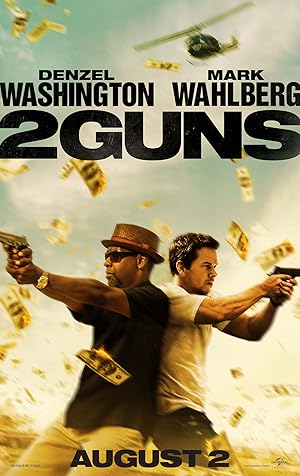
2 Guns
Robert Trench, an undercover DEA agent, takes advantage of gunman Michael Stigman's idea to rob a bank to bust him and a mob boss. However, it proves too successful with much more money seized than anticipated with Trench's forces not stopping the getaway. Complicating things still more, Stigman turns out to be a Naval Intelligence agent who shoots Trench and takes the money. The interservice debacle suddenly finds Trench and Stigman in a bloody web of corrupt clandestine rivalries as they are hunted, blackmailed and isolated for the money on both sides of the law. Now, the fugitives must work together to find a way out of this situation with no one to turn to but themselves.
Despite a mid-range budget of $61.0M, 2 Guns became a box office success, earning $131.9M worldwide—a 116% return.


Plot Structure
Story beats plotted across runtime


Narrative Arc
Emotional journey through the story's key moments
Story Circle
Blueprint 15-beat structure
Arcplot Score Breakdown
Weighted: Precision (70%) + Arc (15%) + Theme (15%)
2 Guns (2013) reveals precise plot construction, characteristic of Baltasar Kormákur's storytelling approach. This structural analysis examines how the film's 15-point plot structure maps to proven narrative frameworks across 1 hour and 49 minutes. With an Arcplot score of 7.2, the film balances conventional beats with creative variation.
Characters
Cast & narrative archetypes

Robert "Bobby" Trench
Michael "Stig" Stigman
Deb Rees
Earl
Papi Greco
Commander Quince
Main Cast & Characters
Robert "Bobby" Trench
Played by Denzel Washington
DEA agent working undercover who discovers his partner is actually a Naval Intelligence officer.
Michael "Stig" Stigman
Played by Mark Wahlberg
Naval Intelligence officer posing as a criminal who partners with Bobby on an unauthorized mission.
Deb Rees
Played by Paula Patton
DEA supervisor and Bobby's former romantic interest who may have her own agenda.
Earl
Played by Bill Paxton
Mysterious CIA operative who orchestrates events from the shadows and controls the stolen money.
Papi Greco
Played by Edward James Olmos
Mexican drug lord whose money becomes the target of the heist operation.
Commander Quince
Played by James Marsden
Corrupt Naval Intelligence commander who manipulates Stig and orchestrates the bank robbery.
Structural Analysis
The Status Quo at 1 minutes (1% through the runtime) establishes Bobby and Stig sit in a diner across from a bank, planning their next move. They appear to be small-time criminals working together, with easy banter masking their mutual distrust. The opening establishes them as partners in crime in a seemingly straightforward heist setup.. Structural examination shows that this early placement immediately immerses viewers in the story world.
The inciting incident occurs at 12 minutes when Bobby's DEA superior refuses to authorize the bust of Papi Greco despite Bobby's years undercover. Bobby is told to stay in place indefinitely. His mission appears to be going nowhere, forcing him to consider Stig's plan to rob Papi's money from the bank - an unauthorized, illegal action.. At 11% through the film, this Disruption aligns precisely with traditional story structure. This beat shifts the emotional landscape, launching the protagonist into the central conflict.
The First Threshold at 27 minutes marks the transition into Act II, occurring at 25% of the runtime. This illustrates the protagonist's commitment to Bobby and Stig actively choose to rob the bank together. They execute the heist, expecting to find $3 million of cartel money. This irreversible criminal act launches them into Act 2 - there's no going back now., moving from reaction to action.
At 54 minutes, the Midpoint arrives at 50% of the runtime—precisely centered, creating perfect narrative symmetry. Significantly, this crucial beat Bobby and Stig are captured by Papi Greco's men. Papi tortures them for information about the money. The stakes are raised - it's not just about the money anymore, it's life and death. They realize they're pawns in a much bigger game involving the CIA. False defeat: they seem completely trapped and powerless., fundamentally raising what's at risk. The emotional intensity shifts, dividing the narrative into clear before-and-after phases.
The Collapse moment at 81 minutes (74% through) represents the emotional nadir. Here, Stig chooses to follow orders and turns on Bobby, taking him captive to hand over to Admiral Tuwey. Bobby is alone, betrayed again by the one person he was beginning to trust. The partnership appears completely dead. Metaphorical death: the death of trust and hope for alliance., indicates the protagonist at their lowest point. This beat's placement in the final quarter sets up the climactic reversal.
The Second Threshold at 88 minutes initiates the final act resolution at 81% of the runtime. Stig chooses trust over orders and rescues Bobby from Tuwey. Bobby reciprocates by choosing to trust Stig despite the betrayals. They synthesize their skills: Bobby's street smarts and DEA experience + Stig's military precision. They form a real partnership based on actual trust for the first time. They devise a plan to take down all three antagonists at once., demonstrating the transformation achieved throughout the journey.
Emotional Journey
2 Guns's emotional architecture traces a deliberate progression across 15 carefully calibrated beats.
Narrative Framework
This structural analysis employs proven narrative structure principles that track dramatic progression. By mapping 2 Guns against these established plot points, we can identify how Baltasar Kormákur utilizes or subverts traditional narrative conventions. The plot point approach reveals not only adherence to structural principles but also creative choices that distinguish 2 Guns within the action genre.
Baltasar Kormákur's Structural Approach
Among the 3 Baltasar Kormákur films analyzed on Arcplot, the average structural score is 7.2, reflecting strong command of classical structure. 2 Guns represents one of the director's most structurally precise works. For comparative analysis, explore the complete Baltasar Kormákur filmography.
Comparative Analysis
Additional action films include The Bad Guys, Puss in Boots and Venom: The Last Dance. For more Baltasar Kormákur analyses, see Beast, Contraband.
Plot Points by Act
Act I
SetupStatus Quo
Bobby and Stig sit in a diner across from a bank, planning their next move. They appear to be small-time criminals working together, with easy banter masking their mutual distrust. The opening establishes them as partners in crime in a seemingly straightforward heist setup.
Theme
Stig tells Bobby his philosophy: "Never trust anybody." This line captures the film's central theme - both men are lying to each other, everyone will betray everyone, and trust is the ultimate currency in their world.
Worldbuilding
Bobby and Stig burn down Papi Greco's restaurant to prove themselves. We meet DEA agent Deb, Bobby's handler and lover. Established: Bobby is deep undercover trying to infiltrate Papi's cartel, Stig is his criminal partner, and Bobby is waiting for authorization to make his case. The world of cartel operations, undercover work, and criminal partnerships is set up.
Disruption
Bobby's DEA superior refuses to authorize the bust of Papi Greco despite Bobby's years undercover. Bobby is told to stay in place indefinitely. His mission appears to be going nowhere, forcing him to consider Stig's plan to rob Papi's money from the bank - an unauthorized, illegal action.
Resistance
Bobby debates whether to go through with the bank robbery. Stig pushes the plan. Bobby meets with Papi, who is suspicious and dangerous. Bobby reconnects with Deb, who warns him against going rogue. Bobby wrestles with the decision to break the law to accomplish his mission, setting up his choice to cross the line.
Act II
ConfrontationFirst Threshold
Bobby and Stig actively choose to rob the bank together. They execute the heist, expecting to find $3 million of cartel money. This irreversible criminal act launches them into Act 2 - there's no going back now.
Mirror World
After the robbery, both men's true identities are revealed in the betrayal. Stig reveals he's Naval Intelligence and shoots Bobby, leaving him for dead. Bobby discovers Stig isn't who he claimed. The "partnership" was a lie on both sides - this revelation of mutual deception becomes the thematic core they must overcome.
Premise
The fun and games: Bobby and Stig are on the run, hunted by everyone. They discover they stole $43 million (not $3 million) of CIA black ops money. The DEA disavows Bobby. The Navy disavows Stig. Papi wants his money. They're forced to work together despite mutual distrust, leading to action sequences, shootouts, and reluctant partnership comedy. Each tries to use the other while staying alive.
Midpoint
Bobby and Stig are captured by Papi Greco's men. Papi tortures them for information about the money. The stakes are raised - it's not just about the money anymore, it's life and death. They realize they're pawns in a much bigger game involving the CIA. False defeat: they seem completely trapped and powerless.
Opposition
Bobby and Stig escape from Papi but now face attacks from all sides: Quince (CIA) threatens everyone Bobby loves to get the money back; Admiral Tuwey (Navy) orders Stig to eliminate Bobby and recover the cash; Papi continues hunting them; Deb is revealed to be compromised. Trust is shattered completely. The noose tightens as every authority figure proves corrupt.
Collapse
Stig chooses to follow orders and turns on Bobby, taking him captive to hand over to Admiral Tuwey. Bobby is alone, betrayed again by the one person he was beginning to trust. The partnership appears completely dead. Metaphorical death: the death of trust and hope for alliance.
Crisis
Bobby is held by Tuwey while Stig grapples with his conscience. The dark night: both men face their internal crisis about trust. Can either of them trust anyone? Bobby confronts his isolation. Stig confronts his blind military loyalty. Both process their lowest moment.
Act III
ResolutionSecond Threshold
Stig chooses trust over orders and rescues Bobby from Tuwey. Bobby reciprocates by choosing to trust Stig despite the betrayals. They synthesize their skills: Bobby's street smarts and DEA experience + Stig's military precision. They form a real partnership based on actual trust for the first time. They devise a plan to take down all three antagonists at once.
Synthesis
The finale showdown at Papi's ranch. Bobby and Stig execute their plan, playing all three villains against each other. They orchestrate a meeting between Papi, Quince, and Tuwey with the money as bait. In the climactic gunfight, they eliminate the corrupt players: Papi is killed, Quince is killed, Tuwey is arrested. They recover the $43 million and return it. Their genuine partnership defeats the corrupt institutions.
Transformation
Bobby and Stig sit together, mirroring the opening diner scene, but transformed. Where they began as fake partners lying to each other, they end as real partners who trust each other. They joke about their next move together. The final image shows two men who learned that trust - real trust - is possible, even in their world. Theme resolved: you CAN trust somebody - if they earn it.