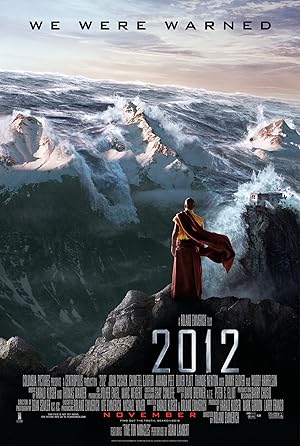
2012
Dr. Adrian Helmsley, part of a worldwide geophysical team investigating the effect on the earth of radiation from unprecedented solar storms, learns that the earth's core is heating up. He warns U.S. President Thomas Wilson that the crust of the earth is becoming unstable and that without proper preparations for saving a fraction of the world's population, the entire race is doomed. Meanwhile, writer Jackson Curtis stumbles on the same information. While the world's leaders race to build "arks" to escape the impending cataclysm, Curtis struggles to find a way to save his family. Meanwhile, volcanic eruptions and earthquakes of unprecedented strength wreak havoc around the world.
Despite a blockbuster budget of $200.0M, 2012 became a financial success, earning $791.2M worldwide—a 296% return. This commercial performance validated the ambitious narrative scope, showing that audiences embrace fresh perspective even at blockbuster scale.
5 wins & 21 nominations


Plot Structure
Story beats plotted across runtime


Narrative Arc
Emotional journey through the story's key moments
Story Circle
Blueprint 15-beat structure
Arcplot Score Breakdown
Weighted: Precision (70%) + Arc (15%) + Theme (15%)
2012 (2009) reveals carefully calibrated narrative architecture, characteristic of Roland Emmerich's storytelling approach. This structural analysis examines how the film's 15-point plot structure maps to proven narrative frameworks across 2 hours and 38 minutes. With an Arcplot score of 7.0, the film balances conventional beats with creative variation.
Characters
Cast & narrative archetypes

Jackson Curtis
Adrian Helmsley
Kate Curtis
Gordon Silberman
Charlie Frost
Carl Anheuser
President Thomas Wilson
Yuri Karpov
Laura Wilson
Main Cast & Characters
Jackson Curtis
Played by John Cusack
A struggling science fiction writer and limo driver who must save his family during the apocalypse.
Adrian Helmsley
Played by Chiwetel Ejiofor
A geologist who discovers the impending global catastrophe and works to warn world leaders.
Kate Curtis
Played by Amanda Peet
Jackson's ex-wife who has moved on with a new partner but must reunite with Jackson to survive.
Gordon Silberman
Played by Thomas McCarthy
Kate's boyfriend, a plastic surgeon who initially clashes with Jackson but proves resourceful.
Charlie Frost
Played by Woody Harrelson
An eccentric conspiracy theorist radio host who knows about the arks and the government cover-up.
Carl Anheuser
Played by Oliver Platt
The ruthless White House Chief of Staff who prioritizes pragmatic survival over humanitarian ideals.
President Thomas Wilson
Played by Danny Glover
The U.S. President who faces impossible decisions as the world collapses around him.
Yuri Karpov
Played by Zlatko Burić
A Russian billionaire who purchased tickets for himself and his family on the survival arks.
Laura Wilson
Played by Thandiwe Newton
The First Daughter who forms a connection with Adrian during the crisis.
Structural Analysis
The Status Quo at 2 minutes (1% through the runtime) establishes In 2009, geologist Adrian Helmsley discovers unprecedented solar activity is heating Earth's core during a visit to an Indian copper mine, establishing the scientific threat that will doom civilization while the world remains oblivious.. Significantly, this early placement immediately immerses viewers in the story world.
The inciting incident occurs at 19 minutes when At Yellowstone, Jackson encounters conspiracy theorist Charlie Frost who reveals the government is hiding the truth about the coming apocalypse and has built massive ships to save select humans. Jackson dismisses him as crazy, but the seed of doubt is planted as he witnesses the dried-up lake and military presence.. At 12% through the film, this Disruption aligns precisely with traditional story structure. This beat shifts the emotional landscape, launching the protagonist into the central conflict.
The First Threshold at 40 minutes marks the transition into Act II, occurring at 25% of the runtime. This indicates the protagonist's commitment to A massive earthquake destroys Los Angeles as Jackson races through collapsing streets in a limousine to rescue his family. He makes the active choice to take control, commandeering a plane with Gordon as pilot, and they escape as California literally falls into the ocean behind them. There is no going back to normal life., moving from reaction to action.
At 79 minutes, the Midpoint arrives at 50% of the runtime—precisely centered, creating perfect narrative symmetry. Significantly, this crucial beat The Yellowstone supervolcano fully erupts, killing Charlie Frost mid-broadcast and sending an apocalyptic ash cloud across North America. This false defeat raises the stakes impossibly high - the extinction-level event is now fully underway. Jackson's group barely escapes aboard Yuri's Antonov plane, but fuel is running low and they're racing against global destruction., fundamentally raising what's at risk. The emotional intensity shifts, dividing the narrative into clear before-and-after phases.
The Collapse moment at 119 minutes (75% through) represents the emotional nadir. Here, Gordon is killed when the cargo plane's ramp crushes him during their desperate boarding attempt. Tamara and Yuri also perish. The death of Gordon - Kate's boyfriend who had become part of the family - delivers the whiff of death. Jackson realizes he could lose everyone if he doesn't act. The ark doors are sealed with thousands left outside to die., shows the protagonist at their lowest point. This beat's placement in the final quarter sets up the climactic reversal.
The Second Threshold at 126 minutes initiates the final act resolution at 80% of the runtime. Adrian convinces the world leaders to open the gates and save the people stranded outside, delivering an impassioned speech about what makes humanity worth saving. This synthesis of compassion over survival-at-all-costs gives Jackson the moral framework to risk his life. He volunteers to dive into the flooding mechanics to free the jammed gears, combining his determination to save his family with a larger act of heroism., demonstrating the transformation achieved throughout the journey.
Emotional Journey
2012's emotional architecture traces a deliberate progression across 15 carefully calibrated beats.
Narrative Framework
This structural analysis employs a 15-point narrative structure framework that maps key story moments. By mapping 2012 against these established plot points, we can identify how Roland Emmerich utilizes or subverts traditional narrative conventions. The plot point approach reveals not only adherence to structural principles but also creative choices that distinguish 2012 within the action genre.
Roland Emmerich's Structural Approach
Among the 12 Roland Emmerich films analyzed on Arcplot, the average structural score is 7.0, demonstrating varied approaches to story architecture. 2012 represents one of the director's most structurally precise works. For comparative analysis, explore the complete Roland Emmerich filmography.
Comparative Analysis
Additional action films include The Bad Guys, Puss in Boots and Venom: The Last Dance. For more Roland Emmerich analyses, see The Day After Tomorrow, White House Down and 10,000 BC.
Plot Points by Act
Act I
SetupStatus Quo
In 2009, geologist Adrian Helmsley discovers unprecedented solar activity is heating Earth's core during a visit to an Indian copper mine, establishing the scientific threat that will doom civilization while the world remains oblivious.
Theme
Adrian tells the President's Chief of Staff that they must warn people and give them a chance to say goodbye to their loved ones, stating "Everybody deserves a chance to fight for their lives" - articulating the theme that human connection and dignity matter even in the face of extinction.
Worldbuilding
The setup establishes parallel storylines: Adrian's discovery of the impending disaster and secret government preparations, while Jackson Curtis struggles as a divorced father whose ex-wife Kate has moved on with plastic surgeon Gordon. Jackson takes his kids camping at Yellowstone, unaware of the dormant supervolcano and government conspiracy.
Disruption
At Yellowstone, Jackson encounters conspiracy theorist Charlie Frost who reveals the government is hiding the truth about the coming apocalypse and has built massive ships to save select humans. Jackson dismisses him as crazy, but the seed of doubt is planted as he witnesses the dried-up lake and military presence.
Resistance
Jackson returns his children to Kate and Gordon while earthquakes begin in Los Angeles. Charlie Frost acts as an unlikely mentor, broadcasting warnings about the end times. Jackson debates whether to believe the conspiracy while Adrian pressures the government to warn the public. The world begins showing signs of catastrophic geological instability.
Act II
ConfrontationFirst Threshold
A massive earthquake destroys Los Angeles as Jackson races through collapsing streets in a limousine to rescue his family. He makes the active choice to take control, commandeering a plane with Gordon as pilot, and they escape as California literally falls into the ocean behind them. There is no going back to normal life.
Mirror World
Adrian Helmsley's storyline deepens as he struggles with the moral weight of the government's secret - who gets saved and who doesn't. His relationship with First Daughter Laura Wilson begins, representing hope and love even as the world ends. Adrian embodies the thematic question of what humanity is worth saving.
Premise
The promise of the premise delivers spectacular destruction sequences: the family flies through crumbling Los Angeles skyscrapers, lands in Yellowstone as the supervolcano erupts, and narrowly escapes in an RV. They encounter Russian billionaire Yuri Karpov who offers passage on his plane to China. Meanwhile, famous landmarks are destroyed and millions die as tsunamis and earthquakes devastate the globe.
Midpoint
The Yellowstone supervolcano fully erupts, killing Charlie Frost mid-broadcast and sending an apocalyptic ash cloud across North America. This false defeat raises the stakes impossibly high - the extinction-level event is now fully underway. Jackson's group barely escapes aboard Yuri's Antonov plane, but fuel is running low and they're racing against global destruction.
Opposition
Everything goes wrong as the group races toward the arks in China. The Earth's crust shifts earlier than predicted. Their plane crashes in the Himalayas. The President chooses to stay behind and dies with his people. Carl Anheuser reveals his corrupt priorities about who deserves to survive. Yuri sacrifices his chance to get his sons aboard. The opposition isn't just nature - it's human selfishness and the clock running out.
Collapse
Gordon is killed when the cargo plane's ramp crushes him during their desperate boarding attempt. Tamara and Yuri also perish. The death of Gordon - Kate's boyfriend who had become part of the family - delivers the whiff of death. Jackson realizes he could lose everyone if he doesn't act. The ark doors are sealed with thousands left outside to die.
Crisis
The family makes it inside an ark, but a piece of debris jams the hydraulic system preventing the door from closing. As a mega-tsunami approaches Tibet, the ark cannot start its engines. Jackson's son Noah blames himself for letting go during the chaos. The surviving family clings together in the darkness of the ark's maintenance area, facing what appears to be certain death.
Act III
ResolutionSecond Threshold
Adrian convinces the world leaders to open the gates and save the people stranded outside, delivering an impassioned speech about what makes humanity worth saving. This synthesis of compassion over survival-at-all-costs gives Jackson the moral framework to risk his life. He volunteers to dive into the flooding mechanics to free the jammed gears, combining his determination to save his family with a larger act of heroism.
Synthesis
Jackson dives into the flooded hydraulic chamber to dislodge the debris while the tsunami hits. His son Noah follows to help, and together they free the mechanism just as Jackson nearly drowns. The door seals, the engines start, and the ark narrowly avoids crashing into Mount Everest. The synthesis brings together Jackson's journey as a father - his son now trusts and follows him, and the family is reunited in purpose.
Transformation
27 days later, the waters recede revealing that Africa has risen and become the new habitable continent. Jackson and Kate embrace as a reunited family, their children beside them, looking out at the new world. The failed writer who couldn't connect with his family has become the hero who saved them. Adrian and Laura stand together representing hope. Humanity will rebuild.