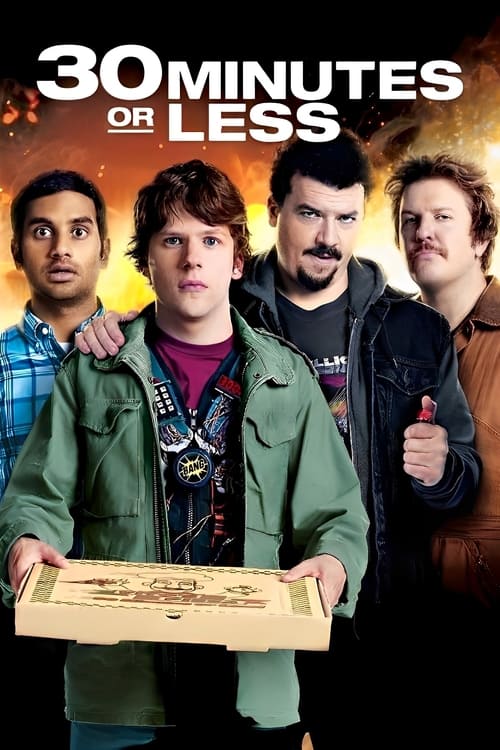
30 Minutes or Less
Two fledgling criminals kidnap a pizza delivery guy, strap a bomb to his chest, and advise him that he has mere hours to rob a bank or else...
Working with a moderate budget of $28.0M, the film achieved a respectable showing with $40.5M in global revenue (+45% profit margin).


Plot Structure
Story beats plotted across runtime


Narrative Arc
Emotional journey through the story's key moments
Story Circle
Blueprint 15-beat structure
Arcplot Score Breakdown
Weighted: Precision (70%) + Arc (15%) + Theme (15%)
30 Minutes or Less (2011) reveals strategically placed dramatic framework, characteristic of Ruben Fleischer's storytelling approach. This structural analysis examines how the film's 15-point plot structure maps to proven narrative frameworks across 1 hour and 23 minutes. With an Arcplot score of 7.7, the film showcases strong structural fundamentals.
Characters
Cast & narrative archetypes

Nick
Chet
Dwayne
Travis
Kate
Chango
Main Cast & Characters
Nick
Played by Jesse Eisenberg
A pizza delivery driver forced to rob a bank with a bomb strapped to his chest.
Chet
Played by Aziz Ansari
Nick's best friend and elementary school teacher who reluctantly helps with the heist.
Dwayne
Played by Danny McBride
A delusional wannabe criminal mastermind who orchestrates the bomb plot to fund his father's murder.
Travis
Played by Nick Swardson
Dwayne's dim-witted best friend and accomplice in the kidnapping scheme.
Kate
Played by Dilshad Vadsaria
Chet's twin sister and Nick's love interest, caught in the middle of the chaos.
Chango
Played by Michael Peña
A dangerous hitman hired by Dwayne and Travis to kill Dwayne's father.
Structural Analysis
The Status Quo at 1 minutes (1% through the runtime) establishes Nick delivers pizza in his beaten-down car, living a directionless slacker life. He's stuck in a rut, avoiding responsibility and commitment.. Notably, this early placement immediately immerses viewers in the story world.
The inciting incident occurs at 11 minutes when Dwayne and Travis kidnap Nick during a fake pizza delivery. They knock him unconscious, and he wakes up with a bomb strapped to his chest. They give him 10 hours to rob a bank or the bomb explodes.. At 13% through the film, this Disruption is delayed, allowing extended setup of the story world. This beat shifts the emotional landscape, launching the protagonist into the central conflict.
The First Threshold at 21 minutes marks the transition into Act II, occurring at 26% of the runtime. This shows the protagonist's commitment to Nick convinces Chet to help him rob a bank. Chet reluctantly agrees when he sees the bomb is real. They actively choose to become criminals and cross the point of no return., moving from reaction to action.
At 42 minutes, the Midpoint arrives at 50% of the runtime—precisely centered, creating perfect narrative symmetry. Structural examination shows that this crucial beat Nick and Chet execute the bank robbery wearing ridiculous disguises. The robbery succeeds—they get the money—but it's a false victory. The stakes raise when they realize Dwayne and Travis might kill them anyway to eliminate witnesses. The clock is still ticking on the bomb., fundamentally raising what's at risk. The emotional intensity shifts, dividing the narrative into clear before-and-after phases.
The Collapse moment at 62 minutes (74% through) represents the emotional nadir. Here, Chet abandons Nick, leaving him alone with the bomb still strapped to his chest and running out of time. Nick hits rock bottom—friendless, facing death, with no way out. The "whiff of death" is literal: the bomb's timer is counting down and Nick believes he will die alone., indicates the protagonist at their lowest point. This beat's placement in the final quarter sets up the climactic reversal.
The Second Threshold at 66 minutes initiates the final act resolution at 79% of the runtime. Chet returns to help Nick. They realize they must confront Dwayne, Travis, and Chango directly to get the bomb deactivated. Nick synthesizes his new action-oriented self with help from his friend. They choose to fight back rather than run., demonstrating the transformation achieved throughout the journey.
Emotional Journey
30 Minutes or Less's emotional architecture traces a deliberate progression across 15 carefully calibrated beats.
Narrative Framework
This structural analysis employs proven narrative structure principles that track dramatic progression. By mapping 30 Minutes or Less against these established plot points, we can identify how Ruben Fleischer utilizes or subverts traditional narrative conventions. The plot point approach reveals not only adherence to structural principles but also creative choices that distinguish 30 Minutes or Less within the action genre.
Ruben Fleischer's Structural Approach
Among the 6 Ruben Fleischer films analyzed on Arcplot, the average structural score is 7.1, reflecting strong command of classical structure. 30 Minutes or Less represents one of the director's most structurally precise works. For comparative analysis, explore the complete Ruben Fleischer filmography.
Comparative Analysis
Additional action films include The Bad Guys, Puss in Boots and Venom: The Last Dance. For more Ruben Fleischer analyses, see Uncharted, Gangster Squad and Venom.
Plot Points by Act
Act I
SetupStatus Quo
Nick delivers pizza in his beaten-down car, living a directionless slacker life. He's stuck in a rut, avoiding responsibility and commitment.
Theme
Chet (Nick's roommate and best friend) confronts Nick about wasting his life and not taking action: "You need to actually do something with your life." The theme of passivity vs. action is established.
Worldbuilding
Establishment of Nick's dead-end job as a pizza driver, his strained friendship with teacher Chet, and his inability to commit. Parallel introduction of Dwayne and Travis, two incompetent criminals plotting to hire a hitman to kill Dwayne's wealthy father. They need $100,000.
Disruption
Dwayne and Travis kidnap Nick during a fake pizza delivery. They knock him unconscious, and he wakes up with a bomb strapped to his chest. They give him 10 hours to rob a bank or the bomb explodes.
Resistance
Nick debates what to do, initially trying to go to the police but realizing the bomb is real and will explode if tampered with. He considers his options and realizes he needs help. Despite their falling out, he knows only Chet can help him pull off a bank robbery.
Act II
ConfrontationFirst Threshold
Nick convinces Chet to help him rob a bank. Chet reluctantly agrees when he sees the bomb is real. They actively choose to become criminals and cross the point of no return.
Mirror World
Nick and Chet's friendship is reestablished as they work together. Their partnership represents the thematic counterpoint—taking action together vs. being passive and alone. Chet becomes the relationship that will test Nick's growth.
Premise
The "fun and games" of two idiots planning a bank heist. Nick and Chet acquire guns from criminals, create disguises, and attempt to plan the robbery. Dark comedy ensues as they bungle their way through preparation, including a hilarious scene buying supplies and practicing their approach.
Midpoint
Nick and Chet execute the bank robbery wearing ridiculous disguises. The robbery succeeds—they get the money—but it's a false victory. The stakes raise when they realize Dwayne and Travis might kill them anyway to eliminate witnesses. The clock is still ticking on the bomb.
Opposition
Things spiral out of control. Dwayne and Travis's plan unravels; the hitman they hired (Chango) turns on them. Nick and Chet are pursued by both the criminals and the police. Chet discovers Nick slept with his twin sister Kate, destroying their friendship again. Everything falls apart.
Collapse
Chet abandons Nick, leaving him alone with the bomb still strapped to his chest and running out of time. Nick hits rock bottom—friendless, facing death, with no way out. The "whiff of death" is literal: the bomb's timer is counting down and Nick believes he will die alone.
Crisis
Nick's dark night of the soul. He processes the loss of his best friend and confronts his own cowardice and passivity. Meanwhile, Chet has his own realization that he can't abandon his best friend, even after being betrayed.
Act III
ResolutionSecond Threshold
Chet returns to help Nick. They realize they must confront Dwayne, Travis, and Chango directly to get the bomb deactivated. Nick synthesizes his new action-oriented self with help from his friend. They choose to fight back rather than run.
Synthesis
The finale: Nick and Chet confront the criminals. A chaotic shootout occurs at Dwayne's family warehouse. Chango is killed, Dwayne and Travis are defeated. Nick and Chet work together to disarm the bomb with seconds remaining. They escape as the building explodes. Police arrive but they evade capture.
Transformation
Final image mirrors the opening but shows transformation: Nick has taken action and changed his life. He and Chet reconcile completely. Nick pursues a relationship with Kate (taking romantic action instead of being passive). He's no longer a directionless slacker—he's someone who acts when it matters.