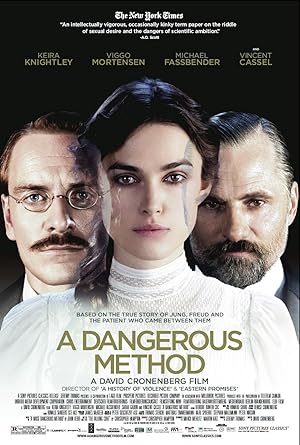
A Dangerous Method
Suffering from hysteria, Sabina Spielrein is hospitalized under the care of Dr. Carl Jung who has begun using Dr. Sigmund Freud's talking cure with some of his patients. Spielrain's psychological problems are deeply rooted in her childhood and violent father. She is highly intelligent however and hopes to be a doctor, eventually becoming a psychiatrist in her own right. The married Jung and Spielrein eventually become lovers. Jung and Freud develop an almost father-son relationship with Freud seeing the young Jung as his likely successor as the standard-bearer of his beliefs. A deep rift develops between them when Jung diverges from Freud's belief that while psychoanalysis can reveal the cause of psychological problems it cannot cure the patient.
Working with a mid-range budget of $15.0M, the film achieved a steady performer with $27.5M in global revenue (+83% profit margin).
19 wins & 38 nominations


Plot Structure
Story beats plotted across runtime


Narrative Arc
Emotional journey through the story's key moments
Story Circle
Blueprint 15-beat structure
Arcplot Score Breakdown
Weighted: Precision (70%) + Arc (15%) + Theme (15%)
A Dangerous Method (2011) demonstrates deliberately positioned narrative architecture, characteristic of David Cronenberg's storytelling approach. This structural analysis examines how the film's 15-point plot structure maps to proven narrative frameworks across 1 hour and 39 minutes. With an Arcplot score of 7.1, the film balances conventional beats with creative variation.
Characters
Cast & narrative archetypes

Carl Jung
Sabina Spielrein
Sigmund Freud
Emma Jung
Otto Gross
Main Cast & Characters
Carl Jung
Played by Michael Fassbender
Swiss psychiatrist who develops analytical psychology and struggles with his mentorship under Freud
Sabina Spielrein
Played by Keira Knightley
Russian patient turned psychoanalyst who becomes romantically involved with Jung
Sigmund Freud
Played by Viggo Mortensen
Founder of psychoanalysis who serves as Jung's mentor before their philosophical split
Emma Jung
Played by Sarah Gadon
Carl Jung's wealthy, loyal wife who struggles with his infidelity
Otto Gross
Played by Vincent Cassel
Anarchistic psychiatrist and patient who encourages Jung to embrace sexual freedom
Structural Analysis
The Status Quo at 1 minutes (1% through the runtime) establishes Jung is an ambitious, controlled psychiatrist at Burghölzli Hospital in 1904 Zurich, living a respectable married life, his rational world perfectly ordered before the arrival of his most challenging patient.. Significantly, this early placement immediately immerses viewers in the story world.
The inciting incident occurs at 13 minutes when Sabina begins to respond to Jung's psychoanalytic treatment, revealing the sexual trauma underlying her hysteria. This breakthrough creates an intense psychological connection between doctor and patient that threatens Jung's professional boundaries.. At 13% through the film, this Disruption is delayed, allowing extended setup of the story world. This beat shifts the emotional landscape, launching the protagonist into the central conflict.
The First Threshold at 26 minutes marks the transition into Act II, occurring at 26% of the runtime. This indicates the protagonist's commitment to Jung makes the active choice to begin an affair with Sabina, crossing the boundary between doctor and patient. This decision plunges him into the morally ambiguous world where his theories about the unconscious must be lived, not just studied., moving from reaction to action.
At 50 minutes, the Midpoint arrives at 51% of the runtime—precisely centered, creating perfect narrative symmetry. Structural examination shows that this crucial beat False defeat: Jung's wife Emma confronts him about the affair, and he ends his sexual relationship with Sabina. Simultaneously, his intellectual disagreements with Freud intensify. What seemed like liberation now reveals its cost - his marriage, his professional reputation, and his bond with his mentor are all at risk., fundamentally raising what's at risk. The emotional intensity shifts, dividing the narrative into clear before-and-after phases.
The Collapse moment at 73 minutes (74% through) represents the emotional nadir. Here, All is lost: Jung and Freud's relationship ends in mutual recrimination and permanent estrangement. The father-son dynamic between mentor and protégé dies. Jung loses both Sabina and Freud, the two relationships that promised transformation. His professional reputation is damaged, and he faces isolation from the psychoanalytic establishment., reveals the protagonist at their lowest point. This beat's placement in the final quarter sets up the climactic reversal.
The Second Threshold at 81 minutes initiates the final act resolution at 82% of the runtime. Jung accepts the synthesis: he cannot reconcile these opposites but must forge his own path. He commits to developing his own theories (collective unconscious, archetypes) independent of Freud. He gains clarity that the conflict between reason and desire, structure and chaos, is the permanent human condition, not a problem to be solved., demonstrating the transformation achieved throughout the journey.
Emotional Journey
A Dangerous Method's emotional architecture traces a deliberate progression across 15 carefully calibrated beats.
Narrative Framework
This structural analysis employs systematic plot point analysis that identifies crucial turning points. By mapping A Dangerous Method against these established plot points, we can identify how David Cronenberg utilizes or subverts traditional narrative conventions. The plot point approach reveals not only adherence to structural principles but also creative choices that distinguish A Dangerous Method within the biography genre.
David Cronenberg's Structural Approach
Among the 12 David Cronenberg films analyzed on Arcplot, the average structural score is 7.1, reflecting strong command of classical structure. A Dangerous Method takes a more unconventional approach compared to the director's typical style. For comparative analysis, explore the complete David Cronenberg filmography.
Comparative Analysis
Additional biography films include After Thomas, Taking Woodstock and The Fire Inside. For more David Cronenberg analyses, see The Brood, The Dead Zone and Eastern Promises.
Plot Points by Act
Act I
SetupStatus Quo
Jung is an ambitious, controlled psychiatrist at Burghölzli Hospital in 1904 Zurich, living a respectable married life, his rational world perfectly ordered before the arrival of his most challenging patient.
Theme
Sabina, during their early sessions, articulates the theme: the struggle between suppression and expression, between what society demands and what the unconscious desires - a question that will define Jung's professional and personal journey.
Worldbuilding
Establishes Jung's world: his "talking cure" methodology, his marriage to Emma, the psychiatric establishment of early 1900s, and his admiration for Freud's theories. Introduces Sabina Spielrein as a severely disturbed patient with violent hysteria.
Disruption
Sabina begins to respond to Jung's psychoanalytic treatment, revealing the sexual trauma underlying her hysteria. This breakthrough creates an intense psychological connection between doctor and patient that threatens Jung's professional boundaries.
Resistance
Jung corresponds with Freud about Sabina's case, leading to their first meeting. Sabina continues her recovery, becoming educated and articulate. Jung wrestles with growing attraction to his patient while maintaining professional ethics. His world of reason debates against emerging desire.
Act II
ConfrontationFirst Threshold
Jung makes the active choice to begin an affair with Sabina, crossing the boundary between doctor and patient. This decision plunges him into the morally ambiguous world where his theories about the unconscious must be lived, not just studied.
Mirror World
Otto Gross, a brilliant but unrestrained psychoanalyst, enters as Jung's patient and becomes a philosophical mirror. Gross advocates complete sexual freedom and living out one's desires - embodying the id-driven life that challenges Jung's superego-controlled existence.
Premise
Jung explores the dangerous promise of the premise: conducting a passionate affair with Sabina while developing his professional relationship with Freud. He experiences the liberation and guilt of transgression, pursues his mystical interests, and begins to diverge from Freud's strict sexual theory of neurosis.
Midpoint
False defeat: Jung's wife Emma confronts him about the affair, and he ends his sexual relationship with Sabina. Simultaneously, his intellectual disagreements with Freud intensify. What seemed like liberation now reveals its cost - his marriage, his professional reputation, and his bond with his mentor are all at risk.
Opposition
The opposition closes in: Freud and Jung's relationship deteriorates into bitter conflict over theory and personal betrayals. Sabina, now recovered and educated, demands recognition and struggles with her love for Jung. Emma suffers the consequences of Jung's choices. Jung's attempt to have both worlds - respectability and passion, Freud's approval and independent thought - collapses.
Collapse
All is lost: Jung and Freud's relationship ends in mutual recrimination and permanent estrangement. The father-son dynamic between mentor and protégé dies. Jung loses both Sabina and Freud, the two relationships that promised transformation. His professional reputation is damaged, and he faces isolation from the psychoanalytic establishment.
Crisis
Jung endures his dark night: professionally isolated, personally guilt-ridden, having betrayed his wife and lost both his patient-lover and his mentor. He confronts the wreckage of his attempt to reconcile opposing forces - reason and passion, loyalty and independence, ethics and desire.
Act III
ResolutionSecond Threshold
Jung accepts the synthesis: he cannot reconcile these opposites but must forge his own path. He commits to developing his own theories (collective unconscious, archetypes) independent of Freud. He gains clarity that the conflict between reason and desire, structure and chaos, is the permanent human condition, not a problem to be solved.
Synthesis
The finale shows Jung establishing his own school of analytical psychology, reconciled with Emma who remains his partner. A final meeting with Sabina years later reveals her trajectory as a psychoanalyst in Russia. Jung has synthesized his experiences into a new theoretical framework that acknowledges both rational and mystical dimensions of the psyche.
Transformation
Final image: Jung, now autonomous and mature, has integrated his experiences of passion and transgression into wisdom. Unlike the controlled, ambitious doctor of the opening, he has become a figure who embraces paradox - professional yet mystical, ethical yet aware of the unconscious' s power. The transformation is acceptance of complexity rather than conquest of it.