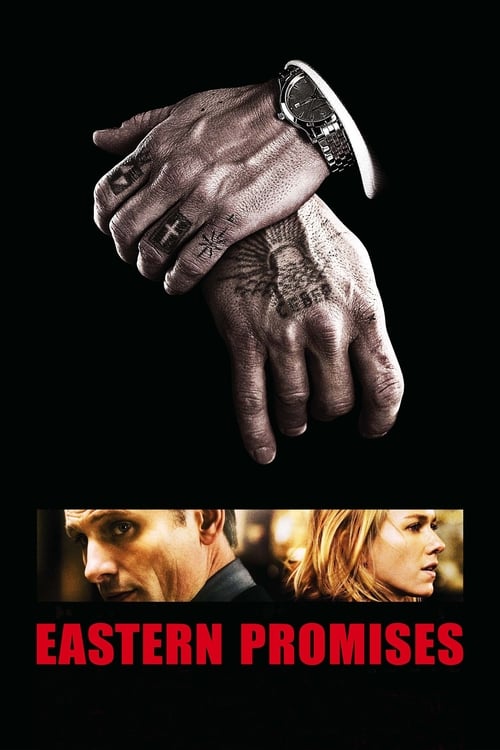
Eastern Promises
A Russian teenager living in London dies during childbirth but leaves clues in her diary that could tie her child to a rape involving a violent Russian mob family.
Working with a respectable budget of $51.5M, the film achieved a respectable showing with $56.1M in global revenue (+9% profit margin).
Nominated for 1 Oscar. 28 wins & 74 nominations


Plot Structure
Story beats plotted across runtime


Narrative Arc
Emotional journey through the story's key moments
Story Circle
Blueprint 15-beat structure
Arcplot Score Breakdown
Weighted: Precision (70%) + Arc (15%) + Theme (15%)
Eastern Promises (2007) exemplifies precise narrative architecture, characteristic of David Cronenberg's storytelling approach. This structural analysis examines how the film's 15-point plot structure maps to proven narrative frameworks across 1 hour and 41 minutes. With an Arcplot score of 7.3, the film balances conventional beats with creative variation.
Characters
Cast & narrative archetypes

Nikolai Luzhin
Anna Khitrova
Semyon
Kirill
Main Cast & Characters
Nikolai Luzhin
Played by Viggo Mortensen
A mysterious driver for the Russian mafia who harbors dangerous secrets and operates with calculated precision.
Anna Khitrova
Played by Naomi Watts
A compassionate midwife who becomes entangled with the Russian mob while trying to find a dead girl's family.
Semyon
Played by Armin Mueller-Stahl
The charming but ruthless patriarch of the Russian mafia family who runs his criminal empire from a restaurant.
Kirill
Played by Vincent Cassel
Semyon's volatile, insecure son who desperately seeks his father's approval while struggling with his own demons.
Structural Analysis
The Status Quo at 1 minutes (1% through the runtime) establishes A brutal throat-slitting in a barbershop intercut with a pregnant teenage girl Tatiana collapsing in a pharmacy, bleeding. Violence and vulnerability established as the film's dual poles in rain-soaked London.. Of particular interest, this early placement immediately immerses viewers in the story world.
The inciting incident occurs at 13 minutes when Anna discovers Tatiana's diary written in Russian and becomes determined to find the dead girl's family. The diary becomes the MacGuffin that will pull Anna into the criminal underworld and threaten Semyon's empire.. At 13% through the film, this Disruption is delayed, allowing extended setup of the story world. This beat shifts the emotional landscape, launching the protagonist into the central conflict.
The First Threshold at 26 minutes marks the transition into Act II, occurring at 25% of the runtime. This demonstrates the protagonist's commitment to Anna gives Semyon the diary to translate, not realizing she's handed evidence of his crimes to the perpetrator himself. She crosses into the criminal world's sphere of influence, now a target whether she knows it or not., moving from reaction to action.
At 51 minutes, the Midpoint arrives at 51% of the runtime—precisely centered, creating perfect narrative symmetry. Of particular interest, this crucial beat The diary translation reveals Semyon himself raped 14-year-old Tatiana, and the baby is his. This false defeat raises the stakes catastrophically—Anna now possesses evidence that could destroy Semyon, making her and her family targets for elimination., fundamentally raising what's at risk. The emotional intensity shifts, dividing the narrative into clear before-and-after phases.
The Collapse moment at 75 minutes (75% through) represents the emotional nadir. Here, The brutal bathhouse fight—Nikolai, naked and vulnerable, is ambushed by two Chechen assassins with linoleum knives. In an extended, visceral sequence, he barely survives, nearly dying for a cover identity and a surrogate family that betrayed him., shows the protagonist at their lowest point. This beat's placement in the final quarter sets up the climactic reversal.
The Second Threshold at 81 minutes initiates the final act resolution at 80% of the runtime. The revelation: Nikolai is an undercover FSB agent who has been building a case against the Vory v Zakone. His identity transforms—he's not a criminal seeking redemption but an officer who sacrificed everything for justice. Anna finally understands who she can trust., demonstrating the transformation achieved throughout the journey.
Emotional Journey
Eastern Promises's emotional architecture traces a deliberate progression across 15 carefully calibrated beats.
Narrative Framework
This structural analysis employs a 15-point narrative structure framework that maps key story moments. By mapping Eastern Promises against these established plot points, we can identify how David Cronenberg utilizes or subverts traditional narrative conventions. The plot point approach reveals not only adherence to structural principles but also creative choices that distinguish Eastern Promises within the thriller genre.
David Cronenberg's Structural Approach
Among the 12 David Cronenberg films analyzed on Arcplot, the average structural score is 7.1, reflecting strong command of classical structure. Eastern Promises represents one of the director's most structurally precise works. For comparative analysis, explore the complete David Cronenberg filmography.
Comparative Analysis
Additional thriller films include The Warriors, Thunderball and Rustom. For more David Cronenberg analyses, see The Brood, The Dead Zone and A Dangerous Method.
Plot Points by Act
Act I
SetupStatus Quo
A brutal throat-slitting in a barbershop intercut with a pregnant teenage girl Tatiana collapsing in a pharmacy, bleeding. Violence and vulnerability established as the film's dual poles in rain-soaked London.
Theme
Anna's uncle Stepan warns about digging into the past: "Sometimes terrible things happen. Sometimes we have to live with them." The theme of confronting versus accepting the darkness in family and heritage is stated.
Worldbuilding
The parallel worlds are established: Anna's life as a midwife, her Russian immigrant family, and the glimpse of the Vory v Zakone underworld. Tatiana dies in childbirth; Anna keeps her diary and the baby. Nikolai disposes of a body for Semyon's family.
Disruption
Anna discovers Tatiana's diary written in Russian and becomes determined to find the dead girl's family. The diary becomes the MacGuffin that will pull Anna into the criminal underworld and threaten Semyon's empire.
Resistance
Anna debates whether to pursue the diary's secrets. Her uncle Stepan reluctantly begins translating it. She visits the Trans-Siberian restaurant, meeting Semyon who appears grandfatherly but is actually the crime boss. Nikolai observes her with interest.
Act II
ConfrontationFirst Threshold
Anna gives Semyon the diary to translate, not realizing she's handed evidence of his crimes to the perpetrator himself. She crosses into the criminal world's sphere of influence, now a target whether she knows it or not.
Mirror World
Nikolai and Anna share a significant conversation outside the restaurant. He warns her away while simultaneously being drawn to her goodness. Their connection represents the thematic B-story: can someone escape the identity their world has given them?
Premise
The promise of the premise unfolds: Anna investigates Tatiana's past while Nikolai navigates the brutal politics of the Vory v Zakone. We see the tattoo culture, the vor hierarchy, Kirill's instability, and Semyon's cold manipulation. The diary's contents slowly reveal Tatiana was trafficked and raped.
Midpoint
The diary translation reveals Semyon himself raped 14-year-old Tatiana, and the baby is his. This false defeat raises the stakes catastrophically—Anna now possesses evidence that could destroy Semyon, making her and her family targets for elimination.
Opposition
Semyon orders Anna's family killed. Nikolai helps dispose of another body while rising in the organization. Kirill's erratic behavior intensifies. Semyon manipulates events to have Nikolai receive his vor stars, but secretly arranges for Chechen hitmen to kill him as a decoy for Kirill.
Collapse
The brutal bathhouse fight—Nikolai, naked and vulnerable, is ambushed by two Chechen assassins with linoleum knives. In an extended, visceral sequence, he barely survives, nearly dying for a cover identity and a surrogate family that betrayed him.
Crisis
Nikolai lies in hospital, covered in wounds. Anna visits him, and the emotional weight of his sacrifice hangs in the air. The question of who Nikolai really is and what he's willing to die for reaches its darkest point.
Act III
ResolutionSecond Threshold
The revelation: Nikolai is an undercover FSB agent who has been building a case against the Vory v Zakone. His identity transforms—he's not a criminal seeking redemption but an officer who sacrificed everything for justice. Anna finally understands who she can trust.
Synthesis
Semyon is arrested based on the diary evidence and DNA. Kirill is left devastated by his father's exposure. Anna successfully adopts baby Christine. Nikolai, having completed his mission, inherits the vor throne—trapped in the identity he created.
Transformation
Nikolai sits alone in the Trans-Siberian restaurant, now the boss. Anna has the baby and her ordinary life. But Nikolai's transformation is bittersweet—he's become what he pretended to be, his victory indistinguishable from imprisonment. The cycle of violence continues.