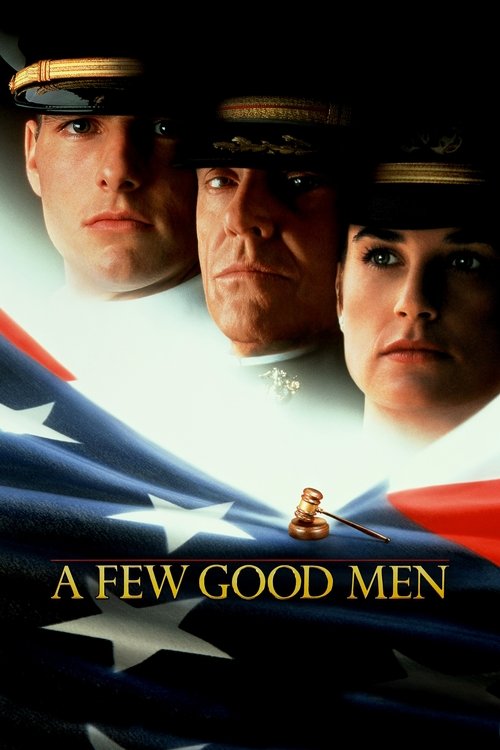
A Few Good Men
When cocky military lawyer Lt. Daniel Kaffee and his co-counsel, Lt. Cmdr. JoAnne Galloway, are assigned to a murder case, they uncover a hazing ritual that could implicate high-ranking officials such as shady Col. Nathan Jessep.
Despite a mid-range budget of $40.0M, A Few Good Men became a box office phenomenon, earning $243.2M worldwide—a remarkable 508% return.
Nominated for 4 Oscars. 11 wins & 30 nominations


Plot Structure
Story beats plotted across runtime


Narrative Arc
Emotional journey through the story's key moments
Story Circle
Blueprint 15-beat structure
Arcplot Score Breakdown
Weighted: Precision (70%) + Arc (15%) + Theme (15%)
A Few Good Men (1992) exemplifies meticulously timed dramatic framework, characteristic of Rob Reiner's storytelling approach. This structural analysis examines how the film's 15-point plot structure maps to proven narrative frameworks across 2 hours and 18 minutes. With an Arcplot score of 6.8, the film balances conventional beats with creative variation.
Characters
Cast & narrative archetypes

Lt. Daniel Kaffee
Col. Nathan Jessup
Lt. Cdr. JoAnne Galloway
Lt. Sam Weinberg
Cpl. Harold Dawson
Pfc. Louden Downey
Capt. Jack Ross
Lt. Col. Matthew Markinson
Lt. Jonathan Kendrick
Main Cast & Characters
Lt. Daniel Kaffee
Played by Tom Cruise
A cocky Navy lawyer who avoids trial, forced to defend two Marines in a murder case that challenges his principles.
Col. Nathan Jessup
Played by Jack Nicholson
A commanding officer at Guantanamo Bay whose authoritarian leadership and code of honor mask darker moral compromises.
Lt. Cdr. JoAnne Galloway
Played by Demi Moore
An idealistic internal affairs lawyer who recruits Kaffee and pushes him to fight for the truth despite personal risk.
Lt. Sam Weinberg
Played by Kevin Pollak
Kaffee's loyal friend and colleague who provides moral support and reality checks throughout the case.
Cpl. Harold Dawson
Played by Wolfgang Bodison
A principled Marine defendant who refuses to accept a plea deal, insisting on honor and standing up for what he believes.
Pfc. Louden Downey
Played by James Marshall
A young, uncertain Marine defendant who follows orders and struggles with the moral weight of his actions.
Capt. Jack Ross
Played by Kevin Bacon
The prosecuting attorney who is tough but fair, respecting the law while pursuing justice as he sees it.
Lt. Col. Matthew Markinson
Played by J.T. Walsh
A conflicted officer at Guantanamo who struggles with conscience versus duty in covering up the truth.
Lt. Jonathan Kendrick
Played by Kiefer Sutherland
An aggressive officer who carried out Jessup's orders and lies under oath to protect the chain of command.
Structural Analysis
The Status Quo at 2 minutes (2% through the runtime) establishes Lt. Daniel Kaffee plea-bargains cases in his office, showing his pattern of avoiding trial and taking the easy route - a hotshot lawyer who has never tried a case in court.. Notably, this early placement immediately immerses viewers in the story world.
The inciting incident occurs at 17 minutes when Kaffee is assigned to defend two Marines accused of murdering a fellow Marine, Santiago, at Guantanamo Bay. The case is more serious than his usual plea-bargain work and involves command authority.. At 12% through the film, this Disruption aligns precisely with traditional story structure. This beat shifts the emotional landscape, launching the protagonist into the central conflict.
The First Threshold at 35 minutes marks the transition into Act II, occurring at 26% of the runtime. This illustrates the protagonist's commitment to After the meeting with Jessep and discovering inconsistencies in the official story, Kaffee makes the active choice to take the case to trial rather than accept a plea bargain, committing to fight for his clients., moving from reaction to action.
At 70 minutes, the Midpoint arrives at 50% of the runtime—precisely centered, creating perfect narrative symmetry. Of particular interest, this crucial beat False defeat: The revelation that Santiago was never going to be transferred despite the order, undermining Kaffee's defense theory. Lt. Kendrick's testimony is damaging, and the case appears to be falling apart., fundamentally raising what's at risk. The emotional intensity shifts, dividing the narrative into clear before-and-after phases.
The Collapse moment at 104 minutes (75% through) represents the emotional nadir. Here, Lt. Col. Markinson commits suicide rather than testify, taking with him crucial evidence about the Code Red order. Kaffee loses his key witness and the team faces their darkest moment., indicates the protagonist at their lowest point. This beat's placement in the final quarter sets up the climactic reversal.
The Second Threshold at 111 minutes initiates the final act resolution at 80% of the runtime. Kaffee realizes the inconsistency in Jessep's account - why order a Code Red if Santiago was being transferred? He synthesizes his legal skills with his newfound honor, deciding to go for the truth regardless of personal risk., demonstrating the transformation achieved throughout the journey.
Emotional Journey
A Few Good Men's emotional architecture traces a deliberate progression across 15 carefully calibrated beats.
Narrative Framework
This structural analysis employs proven narrative structure principles that track dramatic progression. By mapping A Few Good Men against these established plot points, we can identify how Rob Reiner utilizes or subverts traditional narrative conventions. The plot point approach reveals not only adherence to structural principles but also creative choices that distinguish A Few Good Men within the drama genre.
Rob Reiner's Structural Approach
Among the 17 Rob Reiner films analyzed on Arcplot, the average structural score is 6.9, demonstrating varied approaches to story architecture. A Few Good Men takes a more unconventional approach compared to the director's typical style. For comparative analysis, explore the complete Rob Reiner filmography.
Comparative Analysis
Additional drama films include After Thomas, South Pacific and Dirty Dancing: Havana Nights. For more Rob Reiner analyses, see The Sure Thing, The American President and The Story of Us.
Plot Points by Act
Act I
SetupStatus Quo
Lt. Daniel Kaffee plea-bargains cases in his office, showing his pattern of avoiding trial and taking the easy route - a hotshot lawyer who has never tried a case in court.
Theme
Galloway challenges Kaffee: "It's not about what I believe. It's about what I can prove." The film's central question: Will truth and honor matter more than expedience?
Worldbuilding
Introduction to Kaffee's world of plea bargains, the military justice system, and the Guantanamo Bay case. We meet Dawson and Downey charged with murder, and see Kaffee's reputation as someone who avoids real fights.
Disruption
Kaffee is assigned to defend two Marines accused of murdering a fellow Marine, Santiago, at Guantanamo Bay. The case is more serious than his usual plea-bargain work and involves command authority.
Resistance
Kaffee resists taking the case seriously, planning to plea bargain. Galloway and Weinberg debate with him about the defendants' story that they were following orders. Kaffee investigates reluctantly, visiting Guantanamo and meeting Col. Jessep.
Act II
ConfrontationFirst Threshold
After the meeting with Jessep and discovering inconsistencies in the official story, Kaffee makes the active choice to take the case to trial rather than accept a plea bargain, committing to fight for his clients.
Mirror World
Kaffee's developing respect for Galloway's integrity and Dawson's unwavering belief in honor and the code. This relationship subplot will teach Kaffee about standing for something beyond convenience.
Premise
Kaffee investigates the Code Red theory, prepares for trial, and conducts courtroom examination. The fun of watching Kaffee use his legal skills in actual combat, building the case that Dawson and Downey were following orders.
Midpoint
False defeat: The revelation that Santiago was never going to be transferred despite the order, undermining Kaffee's defense theory. Lt. Kendrick's testimony is damaging, and the case appears to be falling apart.
Opposition
The defense struggles as evidence mounts against them. Kaffee's confidence wavers. Markinson disappears. The pressure intensifies with Jessep's looming testimony, and Kaffee must decide whether to directly challenge a decorated colonel.
Collapse
Lt. Col. Markinson commits suicide rather than testify, taking with him crucial evidence about the Code Red order. Kaffee loses his key witness and the team faces their darkest moment.
Crisis
Kaffee and team process the loss and the seemingly impossible odds. They debate whether to put Jessep on the stand. Kaffee must find the courage to risk everything on a confrontation he might lose.
Act III
ResolutionSecond Threshold
Kaffee realizes the inconsistency in Jessep's account - why order a Code Red if Santiago was being transferred? He synthesizes his legal skills with his newfound honor, deciding to go for the truth regardless of personal risk.
Synthesis
The climactic cross-examination of Jessep. Kaffee uses everything he's learned - his legal talent AND his commitment to truth - to break Jessep down, culminating in "You can't handle the truth!" and Jessep's confession. Verdict and resolution.
Transformation
Dawson salutes Kaffee, recognizing him as an officer worthy of respect. Kaffee has transformed from a lawyer who avoided standing for anything into one who fought for honor and truth, mirroring his father's legacy.