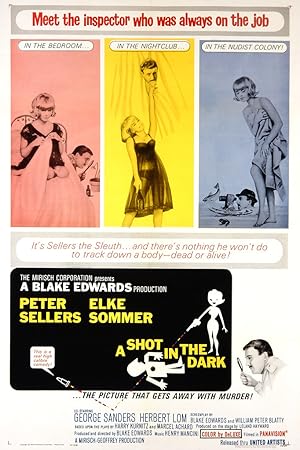
A Shot in the Dark
Ballon household: Benjamin Ballon and his wife Madame Ballon, Henri Lafarge the head Butler and his wife Madame Lafarge the Cook, Miguel Ostos the Head Chauffeur, Maria Gambrelli the third maid, Pierre the second Chauffeur and his wife Dudo the head Maid, Georges the Gardener and his wife Simone the second Maid, Maurice the second Butler. Affairs: Monsieur Ballon and Maria, Maria and Miguel, Henri and Dudo, Madame Ballon and Henri, Pierre and Simone. Who killed who: Madame Ballon accidentally shot Miguel because she suspected her husband of having an affair with Maria and wanted to kill him. Madame LaFarge killed Georges because he threatened to break up with her. Simone killed Dudo to eliminate her because she was in the way of her affair with Pierre. Monsieur Ballon killed Henri because he was having an affair with his wife. Blackmailers: Georges blackmailing Monsieur Ballon (Seen leaving Maria's room). Maurice blackmailing Madame Ballon. (Seen leaving Maria's room).
The film earned $12.4M at the global box office.
Nominated for 1 BAFTA Award3 nominations


Plot Structure
Story beats plotted across runtime


Narrative Arc
Emotional journey through the story's key moments
Story Circle
Blueprint 15-beat structure
Arcplot Score Breakdown
Weighted: Precision (70%) + Arc (15%) + Theme (15%)
A Shot in the Dark (1964) exemplifies deliberately positioned dramatic framework, characteristic of Blake Edwards's storytelling approach. This structural analysis examines how the film's 15-point plot structure maps to proven narrative frameworks across 1 hour and 42 minutes. With an Arcplot score of 6.8, the film balances conventional beats with creative variation.
Characters
Cast & narrative archetypes

Inspector Jacques Clouseau
Maria Gambrelli
Chief Inspector Charles Dreyfus
Benjamin Ballon
Hercule LaJoy
Main Cast & Characters
Inspector Jacques Clouseau
Played by Peter Sellers
Bumbling but persistent French detective investigating a murder at a millionaire's estate. His incompetence is matched only by his unshakeable confidence.
Maria Gambrelli
Played by Elke Sommer
Beautiful parlor maid accused of murder who becomes the object of Clouseau's romantic interest and protection.
Chief Inspector Charles Dreyfus
Played by Herbert Lom
Clouseau's increasingly unhinged superior who descends into madness trying to remove the incompetent inspector from the case.
Benjamin Ballon
Played by George Sanders
Wealthy millionaire and nudist camp owner whose chauffeur is murdered, setting the investigation in motion.
Hercule LaJoy
Played by Graham Stark
Clouseau's long-suffering assistant who endures his boss's chaos with resigned patience.
Structural Analysis
The Status Quo at 1 minutes (1% through the runtime) establishes Inspector Clouseau receives a medal and commendation, establishing him as a bumbling but self-confident detective celebrated despite his incompetence.. The analysis reveals that this early placement immediately immerses viewers in the story world.
The inciting incident occurs at 13 minutes when A murder occurs at millionaire Benjamin Ballon's mansion, and Maria Gambrelli is found holding the gun over the body, seeming to be an open-and-shut case.. At 13% through the film, this Disruption is delayed, allowing extended setup of the story world. This beat shifts the emotional landscape, launching the protagonist into the central conflict.
The First Threshold at 26 minutes marks the transition into Act II, occurring at 25% of the runtime. This indicates the protagonist's commitment to Clouseau actively chooses to pursue Maria's innocence against all evidence and orders, committing himself to proving she didn't commit the murder despite everyone else's certainty of her guilt., moving from reaction to action.
At 52 minutes, the Midpoint arrives at 51% of the runtime—precisely centered, creating perfect narrative symmetry. Of particular interest, this crucial beat After multiple murders with Maria present at each scene, Clouseau's certainty of her innocence becomes increasingly untenable. Dreyfus begins to suffer a mental breakdown from Clouseau's incompetence. The stakes escalate dramatically., fundamentally raising what's at risk. The emotional intensity shifts, dividing the narrative into clear before-and-after phases.
The Collapse moment at 78 minutes (76% through) represents the emotional nadir. Here, Maria is arrested and all evidence overwhelmingly points to her guilt. Clouseau is removed from the case. His career, credibility, and chance to save Maria appear completely lost. Dreyfus celebrates., indicates the protagonist at their lowest point. This beat's placement in the final quarter sets up the climactic reversal.
The Second Threshold at 83 minutes initiates the final act resolution at 81% of the runtime. Clouseau realizes the truth: all the evidence was too perfect, too convenient. His illogical faith in Maria's innocence allows him to see what logic-bound investigators missed—the real killer's identity., demonstrating the transformation achieved throughout the journey.
Emotional Journey
A Shot in the Dark's emotional architecture traces a deliberate progression across 15 carefully calibrated beats.
Narrative Framework
This structural analysis employs a 15-point narrative structure framework that maps key story moments. By mapping A Shot in the Dark against these established plot points, we can identify how Blake Edwards utilizes or subverts traditional narrative conventions. The plot point approach reveals not only adherence to structural principles but also creative choices that distinguish A Shot in the Dark within the comedy genre.
Blake Edwards's Structural Approach
Among the 15 Blake Edwards films analyzed on Arcplot, the average structural score is 7.1, reflecting strong command of classical structure. A Shot in the Dark takes a more unconventional approach compared to the director's typical style. For comparative analysis, explore the complete Blake Edwards filmography.
Comparative Analysis
Additional comedy films include The Bad Guys, Ella Enchanted and The Evening Star. For more Blake Edwards analyses, see Revenge of the Pink Panther, Curse of the Pink Panther and 10.
Plot Points by Act
Act I
SetupStatus Quo
Inspector Clouseau receives a medal and commendation, establishing him as a bumbling but self-confident detective celebrated despite his incompetence.
Theme
Commissioner Dreyfus expresses his frustration with Clouseau, establishing the theme: blind certainty versus actual competence, and how perception differs from reality.
Worldbuilding
Introduction to the world of French law enforcement, Clouseau's oblivious incompetence, his relationship with his superior Dreyfus, and the setup of the Ballon mansion murder case.
Disruption
A murder occurs at millionaire Benjamin Ballon's mansion, and Maria Gambrelli is found holding the gun over the body, seeming to be an open-and-shut case.
Resistance
Clouseau investigates the murder scene and becomes instantly infatuated with Maria. Despite all evidence against her, he insists on her innocence and debates with Dreyfus about taking the case.
Act II
ConfrontationFirst Threshold
Clouseau actively chooses to pursue Maria's innocence against all evidence and orders, committing himself to proving she didn't commit the murder despite everyone else's certainty of her guilt.
Mirror World
Clouseau's relationship with Maria deepens as she represents the thematic mirror: she appears guilty but is innocent, just as Clouseau appears competent but is incompetent, yet both perceptions are wrong.
Premise
The comedic promise of the premise: Clouseau bumbles through investigating the mansion residents, causing chaos and destruction while more bodies pile up, yet Maria keeps being found at each scene.
Midpoint
After multiple murders with Maria present at each scene, Clouseau's certainty of her innocence becomes increasingly untenable. Dreyfus begins to suffer a mental breakdown from Clouseau's incompetence. The stakes escalate dramatically.
Opposition
The evidence against Maria mounts impossibly high; Dreyfus actively works to stop Clouseau; the real killer continues eliminating witnesses; Clouseau's methods create more chaos than progress.
Collapse
Maria is arrested and all evidence overwhelmingly points to her guilt. Clouseau is removed from the case. His career, credibility, and chance to save Maria appear completely lost. Dreyfus celebrates.
Crisis
Clouseau faces his darkest moment, questioning himself but refusing to abandon his irrational certainty in Maria's innocence, processing what he's missed despite having no rational basis for his belief.
Act III
ResolutionSecond Threshold
Clouseau realizes the truth: all the evidence was too perfect, too convenient. His illogical faith in Maria's innocence allows him to see what logic-bound investigators missed—the real killer's identity.
Synthesis
Clouseau confronts the real murderer at a final gathering, chaos ensues, and through sheer bumbling luck combined with his unwavering conviction, he exposes the true killer and saves Maria.
Transformation
Clouseau is vindicated and celebrated once again, having solved the case. He remains exactly as incompetent and oblivious as before, yet has proven that blind faith can triumph where logic fails—a perfect inversion of the opening.