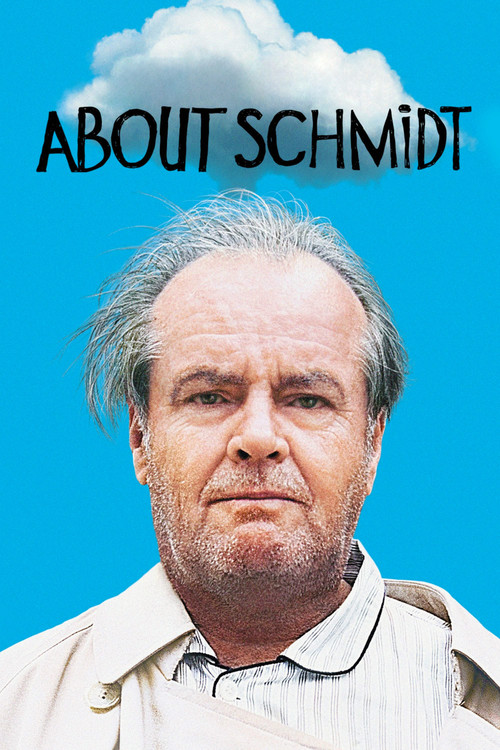
About Schmidt
A recently retired man embarks on a journey to his estranged daughter's wedding, only to discover more about himself and life than he ever expected.
Despite a moderate budget of $30.0M, About Schmidt became a box office success, earning $105.8M worldwide—a 253% return.
Nominated for 2 Oscars. 25 wins & 71 nominations


Plot Structure
Story beats plotted across runtime


Narrative Arc
Emotional journey through the story's key moments
Story Circle
Blueprint 15-beat structure
Arcplot Score Breakdown
Weighted: Precision (70%) + Arc (15%) + Theme (15%)
About Schmidt (2002) showcases meticulously timed story structure, characteristic of Alexander Payne's storytelling approach. This structural analysis examines how the film's 15-point plot structure maps to proven narrative frameworks across 2 hours and 5 minutes. With an Arcplot score of 6.6, the film balances conventional beats with creative variation.
Characters
Cast & narrative archetypes

Warren Schmidt
Randall Hertzel
Jeannie Schmidt
Roberta Hertzel
Helen Schmidt
Main Cast & Characters
Warren Schmidt
Played by Jack Nicholson
A newly retired insurance actuary who faces an existential crisis after his wife's death and daughter's upcoming wedding to a man he despises.
Randall Hertzel
Played by Dermot Mulroney
Schmidt's prospective son-in-law, a waterbed salesman who lacks ambition and sophistication.
Jeannie Schmidt
Played by Hope Davis
Warren's daughter who is marrying Randall despite her father's disapproval.
Roberta Hertzel
Played by Kathy Bates
Randall's free-spirited, unconventional mother who challenges Schmidt's rigid worldview.
Helen Schmidt
Played by June Squibb
Warren's wife of 42 years whose sudden death triggers his crisis of meaning.
Structural Analysis
The Status Quo at 1 minutes (1% through the runtime) establishes Warren Schmidt sits at his empty desk watching the clock tick to 5:00 PM on his final day of work, a lifetime of actuarial tables reduced to watching seconds pass—a man whose entire identity was his job now facing obsolescence.. Structural examination shows that this early placement immediately immerses viewers in the story world.
The inciting incident occurs at 15 minutes when Helen collapses and dies while vacuuming, leaving Warren utterly alone. His irritation with her transforms instantly to grief and guilt—the woman he took for granted is gone, and his retirement fantasy of quiet companionship dies with her.. At 12% through the film, this Disruption aligns precisely with traditional story structure. This beat shifts the emotional landscape, launching the protagonist into the central conflict.
The First Threshold at 31 minutes marks the transition into Act II, occurring at 25% of the runtime. This illustrates the protagonist's commitment to Warren decides to drive his Winnebago across country to Denver, ostensibly for the wedding but really to stop it and find some purpose. He actively chooses to leave his empty house and attempt to matter in his daughter's life., moving from reaction to action.
At 63 minutes, the Midpoint arrives at 50% of the runtime—precisely centered, creating perfect narrative symmetry. Significantly, this crucial beat Warren arrives in Denver early and truly sees Randall's world—the waterbed store, the pyramid scheme, the family's casual vulgarity. His fears are confirmed: Jeannie is marrying beneath her. But he also sees Jeannie's fierce commitment to this life, making his mission feel futile., fundamentally raising what's at risk. The emotional intensity shifts, dividing the narrative into clear before-and-after phases.
The Collapse moment at 94 minutes (75% through) represents the emotional nadir. Here, At the rehearsal dinner, Warren rises to speak and everything he planned to say—his objections, his concerns—dies in his throat. He gives a hollow, generic toast, surrendering completely. His last chance to matter, to change anything, passes unused., demonstrates the protagonist at their lowest point. This beat's placement in the final quarter sets up the climactic reversal.
The Second Threshold at 100 minutes initiates the final act resolution at 80% of the runtime. Warren drives away from the wedding alone, heading back to Omaha. He accepts that he cannot control his daughter's life, cannot undo his wife's death, cannot make his career meaningful retroactively. He must face his own insignificance directly., demonstrating the transformation achieved throughout the journey.
Emotional Journey
About Schmidt's emotional architecture traces a deliberate progression across 15 carefully calibrated beats.
Narrative Framework
This structural analysis employs structural analysis methodology used to understand storytelling architecture. By mapping About Schmidt against these established plot points, we can identify how Alexander Payne utilizes or subverts traditional narrative conventions. The plot point approach reveals not only adherence to structural principles but also creative choices that distinguish About Schmidt within the drama genre.
Alexander Payne's Structural Approach
Among the 6 Alexander Payne films analyzed on Arcplot, the average structural score is 7.0, reflecting strong command of classical structure. About Schmidt takes a more unconventional approach compared to the director's typical style. For comparative analysis, explore the complete Alexander Payne filmography.
Comparative Analysis
Additional drama films include After Thomas, South Pacific and Dirty Dancing: Havana Nights. For more Alexander Payne analyses, see The Descendants, The Holdovers and Election.
Plot Points by Act
Act I
SetupStatus Quo
Warren Schmidt sits at his empty desk watching the clock tick to 5:00 PM on his final day of work, a lifetime of actuarial tables reduced to watching seconds pass—a man whose entire identity was his job now facing obsolescence.
Theme
Warren sees the Childreach commercial asking "What is one person's life worth to another?" and decides to sponsor Ngudu, establishing the film's central question about legacy, connection, and whether an individual life has meaning.
Worldbuilding
Warren's hollow retirement unfolds—the awkward party, his replacement who doesn't need his help, the suffocating domestic routine with Helen, his barely concealed contempt for her habits, and his growing dread that 42 years of work meant nothing.
Disruption
Helen collapses and dies while vacuuming, leaving Warren utterly alone. His irritation with her transforms instantly to grief and guilt—the woman he took for granted is gone, and his retirement fantasy of quiet companionship dies with her.
Resistance
Warren stumbles through widowerhood—the funeral, discovering Helen's love letters from his friend Ray, confronting Ray in impotent rage, and growing desperate to prevent Jeannie's marriage to Randall. He debates whether to intervene or let go.
Act II
ConfrontationFirst Threshold
Warren decides to drive his Winnebago across country to Denver, ostensibly for the wedding but really to stop it and find some purpose. He actively chooses to leave his empty house and attempt to matter in his daughter's life.
Mirror World
Warren meets Randall's family—particularly Roberta Hertzel, Randall's exuberant, boundary-less mother. She represents everything Warren isn't: emotionally open, physically uninhibited, living authentically rather than through repression and propriety.
Premise
Warren's road trip becomes a meditation on mortality and meaning—he visits his childhood home (now a tire store), his college (where no one remembers him), writes confessional letters to Ngudu, and grows increasingly determined to save Jeannie from Randall.
Midpoint
Warren arrives in Denver early and truly sees Randall's world—the waterbed store, the pyramid scheme, the family's casual vulgarity. His fears are confirmed: Jeannie is marrying beneath her. But he also sees Jeannie's fierce commitment to this life, making his mission feel futile.
Opposition
Warren's attempts to intervene backfire repeatedly—Jeannie dismisses his concerns, Roberta corners him in the hot tub forcing uncomfortable intimacy, and every effort to assert control reveals his own powerlessness. The wedding approaches inexorably.
Collapse
At the rehearsal dinner, Warren rises to speak and everything he planned to say—his objections, his concerns—dies in his throat. He gives a hollow, generic toast, surrendering completely. His last chance to matter, to change anything, passes unused.
Crisis
Warren moves through the wedding day in numb acceptance—walking Jeannie down the aisle, watching her marry Randall, performing the father-of-the-bride role while feeling utterly disconnected from meaning or purpose.
Act III
ResolutionSecond Threshold
Warren drives away from the wedding alone, heading back to Omaha. He accepts that he cannot control his daughter's life, cannot undo his wife's death, cannot make his career meaningful retroactively. He must face his own insignificance directly.
Synthesis
Warren returns to his empty house and writes a final letter to Ngudu, confessing that he is weak and a failure, that his life has made no difference to anyone, that once he dies it will be as if he never existed. He confronts the void completely.
Transformation
Warren receives a letter from Ngudu's nun containing the boy's crayon drawing of two figures holding hands. Warren breaks down crying—one small child across the world knows he exists and drew him with love. His life meant something to someone after all.