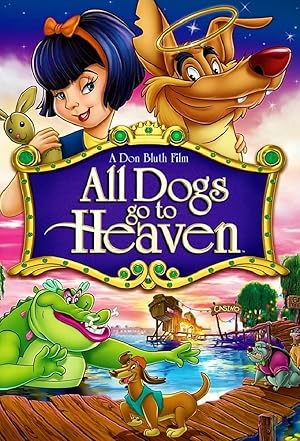
All Dogs Go to Heaven
Charlie B. Barkin (Burt Reynolds), a rascally German Shepherd with a shady past, breaks out of the New Orleans Dog Pound with the help of his faithful friend Itchy (Dom De Luise), a nervously hyperactive dachshund. He then makes tracks to reunite with his gambling casino partner Carface Malone (Vic Tayback), a shifty pitbull who has planned a dastardly, and potentially deadly, double cross. Suddenly, Charlie finds himself at the Pearly Gates, face to face with the Heavenly Whippet (Melba Moore). Charlie weasels his way back to earth and reunites with Itchy. He plots his revenge against Carface and, along the way, acquires help from a little girl named Anne-Marie (who can talk to animals). After a series of fiendish schemes, close scrapes and unexpected adventures, both Charlie and Anne Marie find their lives at stake. Only one can be saved and the outcome is in Charlie's paws...
Working with a modest budget of $13.8M, the film achieved a steady performer with $27.1M in global revenue (+96% profit margin).


Plot Structure
Story beats plotted across runtime


Narrative Arc
Emotional journey through the story's key moments
Story Circle
Blueprint 15-beat structure
Arcplot Score Breakdown
Weighted: Precision (70%) + Arc (15%) + Theme (15%)
All Dogs Go to Heaven (1989) exhibits precise narrative architecture, characteristic of Don Bluth's storytelling approach. This structural analysis examines how the film's 15-point plot structure maps to proven narrative frameworks across 1 hour and 24 minutes. With an Arcplot score of 7.4, the film balances conventional beats with creative variation.
Characters
Cast & narrative archetypes

Charlie B. Barkin
Itchy Itchiford
Anne-Marie
Carface Carruthers
Flo
Killer
Main Cast & Characters
Charlie B. Barkin
Played by Burt Reynolds
A roguish German Shepherd who is murdered by his former partner and returns to Earth to seek revenge and redemption.
Itchy Itchiford
Played by Dom DeLuise
Charlie's loyal dachshund friend who helps him navigate the afterlife and his return to Earth.
Anne-Marie
Played by Judith Barsi
A young orphan girl with the ability to talk to animals who becomes Charlie's unlikely companion and moral compass.
Carface Carruthers
Played by Vic Tayback
A ruthless pit bull crime boss who murders Charlie and exploits Anne-Marie for his gambling operation.
Flo
Played by Loni Anderson
A kind-hearted collie who works at the dog pound and later helps care for Anne-Marie.
Killer
Played by Charles Nelson Reilly
Carface's dim-witted but loyal pit bull henchman who follows orders without question.
Structural Analysis
The Status Quo at 1 minutes (1% through the runtime) establishes Charlie B. Barkin is a charismatic con-artist dog running a profitable casino in New Orleans with his partner Carface, living large and carefree.. The analysis reveals that this early placement immediately immerses viewers in the story world.
The inciting incident occurs at 10 minutes when Carface betrays and murders Charlie, getting him drunk on a boat and then drowning him, sending Charlie to Heaven.. At 12% through the film, this Disruption aligns precisely with traditional story structure. This beat shifts the emotional landscape, launching the protagonist into the central conflict.
The First Threshold at 21 minutes marks the transition into Act II, occurring at 25% of the runtime. This demonstrates the protagonist's commitment to Charlie and Itchy kidnap Anne-Marie, a young orphan girl with the ability to talk to animals, from Carface's lair. Charlie decides to use her powers to build his own rival casino and get revenge., moving from reaction to action.
At 42 minutes, the Midpoint arrives at 49% of the runtime—precisely centered, creating perfect narrative symmetry. Notably, this crucial beat Anne-Marie, feverish and sick, expresses her wish to have a family. Charlie promises to help her find one but is torn between his selfish goals and genuine care. He has a nightmare vision of Hell, warning him of his fate. False victory of casino success meets the reality of moral consequences., fundamentally raising what's at risk. The emotional intensity shifts, dividing the narrative into clear before-and-after phases.
The Collapse moment at 61 minutes (73% through) represents the emotional nadir. Here, Carface captures Anne-Marie and ties her up in a burning building on Mardi Gras night. Charlie's life watch is nearly stopped. He faces literal death (his watch running out) and the death of his chance at redemption if Anne-Marie dies., reveals the protagonist at their lowest point. This beat's placement in the final quarter sets up the climactic reversal.
The Second Threshold at 66 minutes initiates the final act resolution at 79% of the runtime. Charlie chooses to give his watch to Anne-Marie to save her life rather than wind it for himself. This selfless act of love represents his complete transformation from selfish con-artist to sacrificial hero., demonstrating the transformation achieved throughout the journey.
Emotional Journey
All Dogs Go to Heaven's emotional architecture traces a deliberate progression across 15 carefully calibrated beats.
Narrative Framework
This structural analysis employs proven narrative structure principles that track dramatic progression. By mapping All Dogs Go to Heaven against these established plot points, we can identify how Don Bluth utilizes or subverts traditional narrative conventions. The plot point approach reveals not only adherence to structural principles but also creative choices that distinguish All Dogs Go to Heaven within the animation genre.
Don Bluth's Structural Approach
Among the 8 Don Bluth films analyzed on Arcplot, the average structural score is 7.1, reflecting strong command of classical structure. All Dogs Go to Heaven represents one of the director's most structurally precise works. For comparative analysis, explore the complete Don Bluth filmography.
Comparative Analysis
Additional animation films include The Bad Guys, Puss in Boots and Violet Evergarden: Eternity and the Auto Memory Doll. For more Don Bluth analyses, see The Land Before Time, Thumbelina and The Secret of NIMH.
Plot Points by Act
Act I
SetupStatus Quo
Charlie B. Barkin is a charismatic con-artist dog running a profitable casino in New Orleans with his partner Carface, living large and carefree.
Theme
Itchy warns Charlie, "You can't trust Carface," hinting at the film's core theme about loyalty, trust, and redemption through selfless love.
Worldbuilding
Establishment of the dog underworld in New Orleans, Charlie's partnership with Carface, his friendship with Itchy, and his selfish, gambling lifestyle. Charlie is released from the dog pound and returns expecting his share of the casino.
Disruption
Carface betrays and murders Charlie, getting him drunk on a boat and then drowning him, sending Charlie to Heaven.
Resistance
Charlie arrives in Heaven but refuses to accept his death. He debates with the Heavenly Whippet, steals his life watch, and winds it to return to Earth, warned that when it stops he'll be gone forever. He reunites with Itchy and plots revenge against Carface.
Act II
ConfrontationFirst Threshold
Charlie and Itchy kidnap Anne-Marie, a young orphan girl with the ability to talk to animals, from Carface's lair. Charlie decides to use her powers to build his own rival casino and get revenge.
Mirror World
Anne-Marie represents innocence and unconditional love. She wants to find a family and believes Charlie is good. Their relationship becomes the thematic heart—she will teach Charlie what it means to truly care for someone else.
Premise
Charlie exploits Anne-Marie's gift to win bets and build his casino empire. Fun montages of races and schemes. Anne-Marie gets sick but Charlie prioritizes business. Their bonding grows despite Charlie's selfish motives. Includes "Let's Make Music Together" and various cons.
Midpoint
Anne-Marie, feverish and sick, expresses her wish to have a family. Charlie promises to help her find one but is torn between his selfish goals and genuine care. He has a nightmare vision of Hell, warning him of his fate. False victory of casino success meets the reality of moral consequences.
Opposition
Carface escalates attacks. Charlie becomes increasingly conflicted between keeping Anne-Marie for profit and doing right by her. He sets up a meeting with a potential family (the Walters) but struggles with letting her go. Carface plots to kill Charlie again and kidnaps Anne-Marie.
Collapse
Carface captures Anne-Marie and ties her up in a burning building on Mardi Gras night. Charlie's life watch is nearly stopped. He faces literal death (his watch running out) and the death of his chance at redemption if Anne-Marie dies.
Crisis
Charlie processes his dark night: he can save himself by winding his watch, or risk everything to save Anne-Marie. He realizes he truly loves her and that redemption matters more than survival. He chooses sacrifice.
Act III
ResolutionSecond Threshold
Charlie chooses to give his watch to Anne-Marie to save her life rather than wind it for himself. This selfless act of love represents his complete transformation from selfish con-artist to sacrificial hero.
Synthesis
Charlie and Itchy rescue Anne-Marie from the burning building. Carface falls to his death. Charlie reunites Anne-Marie with the Walters family, fulfilling his promise. His watch stops and he dies, but his sacrifice redeems him. He ascends to Heaven, forgiven.
Transformation
Anne-Marie has a loving family. Charlie, now an angel, watches over her with Itchy. The selfish gambler has become a guardian angel through love and sacrifice. The closing image mirrors the opening but shows complete transformation: Charlie has earned his place in Heaven.