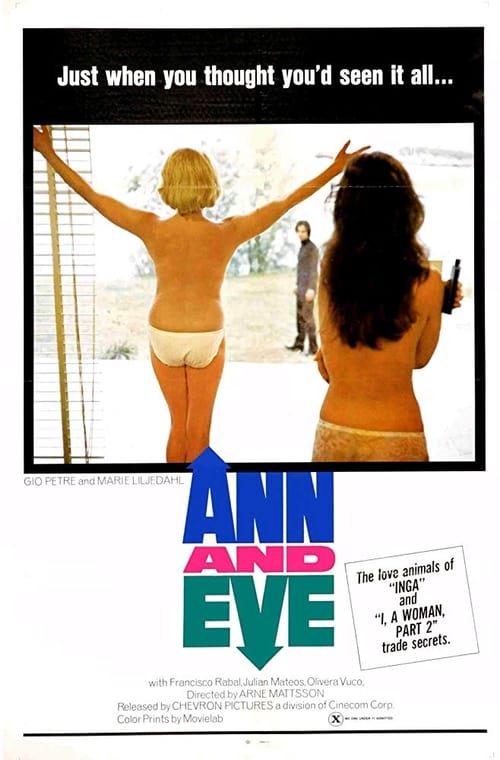
Ann and Eve
The story concerns the Yugoslavian holiday of two toothsome Swedish girls. One of the girls, played by Maria Liljedahl, is (metaphorically speaking) a world-champion in the promiscuity sweepstakes, bedding men (and women) in great profusion. Somehow, the movie also manages to be about film reviewers and film directors. Variety) commented '...the film's inherently good visual and physical qualities are themselves dissipated in [the director's] cynicism, ennui, and involuted intellectual mirror tricks.'
The film earned $18.0M at the global box office.
Plot Structure
Story beats plotted across runtime


Narrative Arc
Emotional journey through the story's key moments
Story Circle
Blueprint 15-beat structure
Arcplot Score Breakdown
Weighted: Precision (70%) + Arc (15%) + Theme (15%)
Ann and Eve (1970) exhibits precise narrative architecture, characteristic of Arne Mattsson's storytelling approach. This structural analysis examines how the film's 15-point plot structure maps to proven narrative frameworks across 1 hour and 44 minutes. With an Arcplot score of 7.3, the film balances conventional beats with creative variation.
Structural Analysis
The Status Quo at 1 minutes (1% through the runtime) establishes Ann's ordinary life is established, showing her daily routine and existing relationships before the central conflict begins.. Structural examination shows that this early placement immediately immerses viewers in the story world.
The inciting incident occurs at 12 minutes when An unexpected event or encounter disrupts Ann's status quo, creating the central conflict or relationship that will drive the story.. At 12% through the film, this Disruption aligns precisely with traditional story structure. This beat shifts the emotional landscape, launching the protagonist into the central conflict.
The First Threshold at 26 minutes marks the transition into Act II, occurring at 25% of the runtime. This shows the protagonist's commitment to Ann makes an active choice to pursue a new path or relationship, committing to the journey into Act 2., moving from reaction to action.
At 52 minutes, the Midpoint arrives at 50% of the runtime—precisely centered, creating perfect narrative symmetry. Significantly, this crucial beat A false victory or revelation occurs, raising the stakes and changing Ann's understanding of her situation., fundamentally raising what's at risk. The emotional intensity shifts, dividing the narrative into clear before-and-after phases.
The Collapse moment at 78 minutes (75% through) represents the emotional nadir. Here, Ann experiences her lowest point, a moment of loss or despair that contains a metaphorical death of hope or identity., demonstrates the protagonist at their lowest point. This beat's placement in the final quarter sets up the climactic reversal.
The Second Threshold at 83 minutes initiates the final act resolution at 80% of the runtime. A realization or new information synthesizes Ann's journey, providing clarity and resolve for the final confrontation., demonstrating the transformation achieved throughout the journey.
Emotional Journey
Ann and Eve's emotional architecture traces a deliberate progression across 15 carefully calibrated beats.
Narrative Framework
This structural analysis employs systematic plot point analysis that identifies crucial turning points. By mapping Ann and Eve against these established plot points, we can identify how Arne Mattsson utilizes or subverts traditional narrative conventions. The plot point approach reveals not only adherence to structural principles but also creative choices that distinguish Ann and Eve within the drama genre.
Comparative Analysis
Additional drama films include After Thomas, South Pacific and Dirty Dancing: Havana Nights.
Plot Points by Act
Act I
SetupStatus Quo
Ann's ordinary life is established, showing her daily routine and existing relationships before the central conflict begins.
Theme
A supporting character hints at the thematic core about identity, connection, or choice that will drive the narrative.
Worldbuilding
The world of the film is established, introducing key characters, relationships, and the social/emotional context of Ann's life.
Disruption
An unexpected event or encounter disrupts Ann's status quo, creating the central conflict or relationship that will drive the story.
Resistance
Ann resists or debates the implications of the disruption, weighing her options and receiving guidance or pressure from others.
Act II
ConfrontationFirst Threshold
Ann makes an active choice to pursue a new path or relationship, committing to the journey into Act 2.
Mirror World
A key relationship or subplot is introduced that reflects the thematic questions, often representing what Ann needs to learn.
Premise
Ann explores the new world of possibilities, experiencing the promise of change and connection that the premise offers.
Midpoint
A false victory or revelation occurs, raising the stakes and changing Ann's understanding of her situation.
Opposition
Pressure intensifies as external forces or internal doubts close in, threatening Ann's goals and relationships.
Collapse
Ann experiences her lowest point, a moment of loss or despair that contains a metaphorical death of hope or identity.
Crisis
In the emotional aftermath of collapse, Ann processes her loss and searches for a path forward.
Act III
ResolutionSecond Threshold
A realization or new information synthesizes Ann's journey, providing clarity and resolve for the final confrontation.
Synthesis
Ann executes her plan, confronts the central conflict, and resolves the story's key relationships and questions.
Transformation
The closing image mirrors the opening, revealing Ann's transformation and the resolution of the thematic journey.