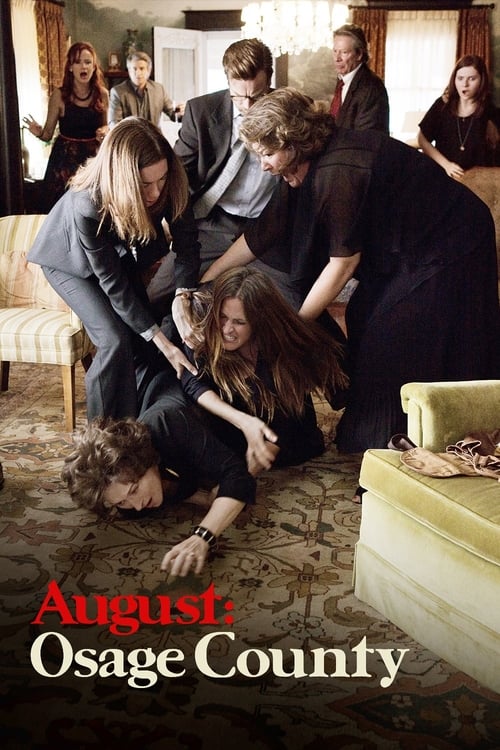
August: Osage County
An intense look at the lives of the strong-willed daughters of the Weston family, whose paths have diverged until a family crisis brings them back to the Midwest house they grew up in, and to the dysfunctional mother who raised them.
Despite a moderate budget of $25.0M, August: Osage County became a financial success, earning $74.2M worldwide—a 197% return.
Nominated for 2 Oscars. 16 wins & 67 nominations


Plot Structure
Story beats plotted across runtime


Narrative Arc
Emotional journey through the story's key moments
Story Circle
Blueprint 15-beat structure
Arcplot Score Breakdown
Weighted: Precision (70%) + Arc (15%) + Theme (15%)
August: Osage County (2013) exemplifies precise narrative design, characteristic of John Wells's storytelling approach. This structural analysis examines how the film's 15-point plot structure maps to proven narrative frameworks across 2 hours and 1 minutes. With an Arcplot score of 7.0, the film balances conventional beats with creative variation.
Characters
Cast & narrative archetypes

Barbara Weston
Violet Weston
Ivy Weston
Karen Weston
Bill Fordham
Beverly Weston
Mattie Fae Aiken
Charlie Aiken
Little Charles Aiken
Main Cast & Characters
Barbara Weston
Played by Julia Roberts
The eldest daughter who returns home to confront her toxic mother and unravel family secrets during a crisis.
Violet Weston
Played by Meryl Streep
The pill-addicted, caustic matriarch whose venomous truth-telling tears the family apart.
Ivy Weston
Played by Julianne Nicholson
The middle daughter who stayed behind to care for her parents, harboring her own secret romance.
Karen Weston
Played by Juliette Lewis
The youngest daughter, perpetually optimistic and engaged to a questionable man, avoiding harsh realities.
Bill Fordham
Played by Ewan McGregor
Barbara's estranged husband, a professor who has left her for a younger woman.
Beverly Weston
Played by Sam Shepard
The alcoholic patriarch and poet whose disappearance catalyzes the family reunion.
Mattie Fae Aiken
Played by Margo Martindale
Violet's sister, bitter and complicit in family cruelty, especially toward her son.
Charlie Aiken
Played by Chris Cooper
Mattie Fae's kind-hearted husband who tries to keep peace and support his son.
Little Charles Aiken
Played by Benedict Cumberbatch
The awkward, sensitive cousin who shares a forbidden romance with Ivy.
Structural Analysis
The Status Quo at 1 minutes (1% through the runtime) establishes Beverly Weston interviews a young Native American woman, Johnna, to be a live-in cook and caretaker for his wife Violet, who has mouth cancer. He quotes T.S. Eliot, revealing the cultured but dysfunctional state of the household before catastrophe strikes.. Of particular interest, this early placement immediately immerses viewers in the story world.
The inciting incident occurs at 12 minutes when Beverly disappears. Violet calls Barbara in Colorado to inform her that her father is missing. This inciting incident forces the scattered Weston family to return to Oklahoma and confront their shared past.. At 10% through the film, this Disruption aligns precisely with traditional story structure. This beat shifts the emotional landscape, launching the protagonist into the central conflict.
The First Threshold at 26 minutes marks the transition into Act II, occurring at 22% of the runtime. This illustrates the protagonist's commitment to The sheriff arrives to inform the family that Beverly's body has been found in a lake - he drowned himself. The family must now stay for the funeral, forcing them to remain in close quarters and face the toxic family dynamics they've been avoiding., moving from reaction to action.
At 58 minutes, the Midpoint arrives at 48% of the runtime—precisely centered, creating perfect narrative symmetry. Structural examination shows that this crucial beat The infamous dinner scene erupts. Violet, high on pills, verbally eviscerates each family member, revealing cruel truths and deliberate provocations. Barbara physically attacks her mother, wrestling her to the ground. The false civility is shattered - there's no going back to pretending this family functions., fundamentally raising what's at risk. The emotional intensity shifts, dividing the narrative into clear before-and-after phases.
The Collapse moment at 89 minutes (73% through) represents the emotional nadir. Here, Violet reveals the devastating truth: Little Charles is actually Beverly's son from an affair with Mattie Fae, making him Ivy's half-brother. This crushes Ivy's hope for escape and happiness. The family's darkest secret destroys the one relationship that offered hope for redemption., demonstrates the protagonist at their lowest point. This beat's placement in the final quarter sets up the climactic reversal.
The Second Threshold at 97 minutes initiates the final act resolution at 80% of the runtime. Barbara discovers that Violet was holding Beverly's suicide note the entire time and never told anyone. This final betrayal - that Violet knew Beverly planned to abandon her - reveals the depth of her mother's narcissism and completes Barbara's understanding that her mother cannot change., demonstrating the transformation achieved throughout the journey.
Emotional Journey
August: Osage County's emotional architecture traces a deliberate progression across 15 carefully calibrated beats.
Narrative Framework
This structural analysis employs structural analysis methodology used to understand storytelling architecture. By mapping August: Osage County against these established plot points, we can identify how John Wells utilizes or subverts traditional narrative conventions. The plot point approach reveals not only adherence to structural principles but also creative choices that distinguish August: Osage County within the comedy genre.
John Wells's Structural Approach
Among the 3 John Wells films analyzed on Arcplot, the average structural score is 7.3, reflecting strong command of classical structure. August: Osage County takes a more unconventional approach compared to the director's typical style. For comparative analysis, explore the complete John Wells filmography.
Comparative Analysis
Additional comedy films include The Bad Guys, Ella Enchanted and The Evening Star. For more John Wells analyses, see The Company Men, Burnt.
Plot Points by Act
Act I
SetupStatus Quo
Beverly Weston interviews a young Native American woman, Johnna, to be a live-in cook and caretaker for his wife Violet, who has mouth cancer. He quotes T.S. Eliot, revealing the cultured but dysfunctional state of the household before catastrophe strikes.
Theme
Beverly tells Johnna about his wife's addiction and illness, stating: "Life is very long" - a misquote of Eliot that establishes the film's theme of enduring family dysfunction and the exhausting weight of dysfunctional relationships over time.
Worldbuilding
Beverly's opening monologue and interaction with Johnna establishes the Weston family's Oklahoma setting, Violet's cancer and pill addiction, Beverly's alcoholism, and the hired help dynamic. The oppressive August heat and isolated prairie home become characters themselves.
Disruption
Beverly disappears. Violet calls Barbara in Colorado to inform her that her father is missing. This inciting incident forces the scattered Weston family to return to Oklahoma and confront their shared past.
Resistance
The three Weston daughters - Barbara, Ivy, and Karen - along with their significant others, converge on the family home. Violet's sister Mattie Fae and her family also arrive. The family awaits news of Beverly while old tensions and dynamics resurface.
Act II
ConfrontationFirst Threshold
The sheriff arrives to inform the family that Beverly's body has been found in a lake - he drowned himself. The family must now stay for the funeral, forcing them to remain in close quarters and face the toxic family dynamics they've been avoiding.
Mirror World
Barbara's strained relationship with her own daughter Jean and separated husband Bill mirrors the mother-daughter dysfunction between Barbara and Violet. This subplot carries the theme of inherited family toxicity and the question of whether these patterns can be broken.
Premise
The promise of the premise: an explosive family reunion. Secret relationships are hinted at (Ivy and Little Charles), Karen's fiancé shows his sleazy side, Violet's cruelty escalates under the guise of grief and pills, and Barbara tries to maintain control as family tensions build toward eruption.
Midpoint
The infamous dinner scene erupts. Violet, high on pills, verbally eviscerates each family member, revealing cruel truths and deliberate provocations. Barbara physically attacks her mother, wrestling her to the ground. The false civility is shattered - there's no going back to pretending this family functions.
Opposition
Relationships fracture: Bill admits to continuing his affair; Karen refuses to see the truth about her predatory fiancé; Barbara discovers Jean has been smoking pot with the adult son of the housekeeper; Violet's attacks become more targeted and vicious. Barbara tries to control everyone but loses control of everything.
Collapse
Violet reveals the devastating truth: Little Charles is actually Beverly's son from an affair with Mattie Fae, making him Ivy's half-brother. This crushes Ivy's hope for escape and happiness. The family's darkest secret destroys the one relationship that offered hope for redemption.
Crisis
Barbara confronts the wreckage of her family and her own complicity in the dysfunction. Ivy prepares to leave with Little Charles despite the revelation. Barbara processes her failure to save anyone - her daughter, her marriage, her sisters, or herself from becoming like Violet.
Act III
ResolutionSecond Threshold
Barbara discovers that Violet was holding Beverly's suicide note the entire time and never told anyone. This final betrayal - that Violet knew Beverly planned to abandon her - reveals the depth of her mother's narcissism and completes Barbara's understanding that her mother cannot change.
Synthesis
Barbara makes the choice her father made: she leaves. Unlike the opening where the family was summoned, now they scatter - Karen to her delusions, Ivy to New York alone, Barbara back to Colorado. Each daughter chooses their own form of escape from Violet's toxicity. The house empties.
Transformation
Violet, alone except for Johnna, crawls on the floor calling for her own long-dead mother. The woman who drove everyone away with her cruelty is left with nothing but her pills and memories. Johnna silently comforts her, the only person left - a paid employee with nowhere else to go. The cycle of abandonment completes.