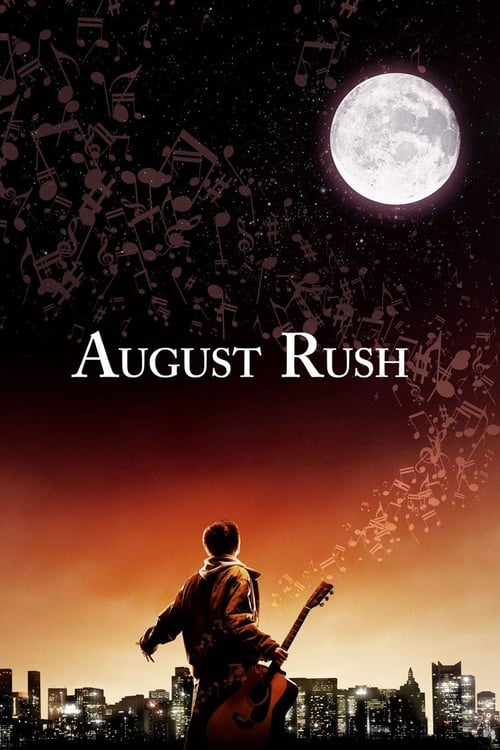
August Rush
Lyla and Louis, a singer and a musician, fall in love, but are soon compelled to separate. Lyla is forced to give up her newborn but unknown to her, he grows up to become a musical genius.
Despite a moderate budget of $25.0M, August Rush became a commercial success, earning $66.1M worldwide—a 164% return.
Nominated for 1 Oscar. 4 wins & 11 nominations


Plot Structure
Story beats plotted across runtime


Narrative Arc
Emotional journey through the story's key moments
Story Circle
Blueprint 15-beat structure
Arcplot Score Breakdown
Weighted: Precision (70%) + Arc (15%) + Theme (15%)
August Rush (2007) demonstrates precise narrative architecture, characteristic of Kirsten Sheridan's storytelling approach. This structural analysis examines how the film's 15-point plot structure maps to proven narrative frameworks across 1 hour and 54 minutes. With an Arcplot score of 7.0, the film balances conventional beats with creative variation.
Characters
Cast & narrative archetypes

Evan Taylor / August Rush
Lyla Novacek
Louis Connelly
Wizard
Richard Jeffries
Thomas Novacek
Main Cast & Characters
Evan Taylor / August Rush
Played by Freddie Highmore
A musically gifted 11-year-old orphan who believes his parents are alive and that music will reunite them.
Lyla Novacek
Played by Keri Russell
A classical cellist who had a brief romance that resulted in a child she believes died at birth.
Louis Connelly
Played by Jonathan Rhys Meyers
An Irish rock guitarist who gave up music after a devastating breakup, unaware he has a son.
Wizard
Played by Robin Williams
A charismatic street musician and con artist who exploits young musical talents for profit.
Richard Jeffries
Played by Terrence Howard
A Juilliard counselor who discovers Evan's extraordinary talent and mentors him.
Thomas Novacek
Played by William Sadler
Lyla's controlling father who manipulated events to keep Lyla and Louis apart.
Structural Analysis
The Status Quo at 1 minutes (1% through the runtime) establishes Evan stands in a wheat field, arms outstretched, "listening" to the music in nature. Establishes his extraordinary connection to sound and his isolation in the orphanage, waiting for parents he's never met.. The analysis reveals that this early placement immediately immerses viewers in the story world.
The inciting incident occurs at 13 minutes when Evan runs away from the orphanage, compelled by an inexplicable certainty that if he goes to New York City, the music will lead him to his parents. His journey begins.. At 11% through the film, this Disruption aligns precisely with traditional story structure. This beat shifts the emotional landscape, launching the protagonist into the central conflict.
The First Threshold at 27 minutes marks the transition into Act II, occurring at 24% of the runtime. This reveals the protagonist's commitment to August picks up a guitar for the first time in Washington Square Park and instinctively plays a stunning improvisation. He commits fully to music as his path to finding his parents. This is his active choice to embrace his gift., moving from reaction to action.
At 57 minutes, the Midpoint arrives at 50% of the runtime—precisely centered, creating perfect narrative symmetry. Structural examination shows that this crucial beat August's rhapsody is accepted for performance in Central Park—a false victory. He believes this concert will unite him with his parents. The stakes raise: all three characters are now in NYC, circling each other. The clock starts ticking toward the concert., fundamentally raising what's at risk. The emotional intensity shifts, dividing the narrative into clear before-and-after phases.
The Collapse moment at 84 minutes (74% through) represents the emotional nadir. Here, Wizard locks August in a basement room, preventing him from reaching the concert. August's dream of reuniting with his parents through music appears to die. He's trapped, the concert is about to start without him, and his parents are out there, unreachable., reveals the protagonist at their lowest point. This beat's placement in the final quarter sets up the climactic reversal.
The Second Threshold at 93 minutes initiates the final act resolution at 81% of the runtime. August escapes through a window and runs toward Central Park. He chooses to believe in the power of music one final time, combining his street survival skills (learned from Wizard) with his musical gift (learned at Juilliard). Faith drives him forward., demonstrating the transformation achieved throughout the journey.
Emotional Journey
August Rush's emotional architecture traces a deliberate progression across 15 carefully calibrated beats.
Narrative Framework
This structural analysis employs proven narrative structure principles that track dramatic progression. By mapping August Rush against these established plot points, we can identify how Kirsten Sheridan utilizes or subverts traditional narrative conventions. The plot point approach reveals not only adherence to structural principles but also creative choices that distinguish August Rush within the family genre.
Comparative Analysis
Additional family films include The Black Stallion, The Bad Guys and Ella Enchanted.
Plot Points by Act
Act I
SetupStatus Quo
Evan stands in a wheat field, arms outstretched, "listening" to the music in nature. Establishes his extraordinary connection to sound and his isolation in the orphanage, waiting for parents he's never met.
Theme
Evan tells another boy: "I believe in music the way some people believe in fairy tales." The film's central theme—that music is a mystical force connecting separated souls—is established early.
Worldbuilding
Intercut establishing three worlds: Evan in the orphanage believing his parents will find him through music; Lyla, a cellist haunted by the past; Louis, a guitarist who abandoned his band. Flashbacks reveal their one night together 11 years ago and the car accident that separated them.
Disruption
Evan runs away from the orphanage, compelled by an inexplicable certainty that if he goes to New York City, the music will lead him to his parents. His journey begins.
Resistance
Evan arrives in NYC and encounters street musician kids. Wizard, a charismatic Fagin-like figure, discovers Evan's prodigious talent and takes him in, renaming him "August Rush." Evan resists structure but is drawn to the promise of performing. Meanwhile, Lyla learns her son didn't die as her father claimed.
Act II
ConfrontationFirst Threshold
August picks up a guitar for the first time in Washington Square Park and instinctively plays a stunning improvisation. He commits fully to music as his path to finding his parents. This is his active choice to embrace his gift.
Mirror World
August meets a young girl cellist in the park who connects with him through music. She represents the pure, connective power of music—foreshadowing his reunion with Lyla, also a cellist. The Mirror World character who embodies the theme.
Premise
The "promise of the premise": August discovers and develops his musical genius. He sneaks into Juilliard, impresses a maestro who takes him in, and begins formal training. He composes his rhapsody. Meanwhile, Lyla searches for her son and Louis returns to NYC, both drawn by music and memory.
Midpoint
August's rhapsody is accepted for performance in Central Park—a false victory. He believes this concert will unite him with his parents. The stakes raise: all three characters are now in NYC, circling each other. The clock starts ticking toward the concert.
Opposition
Forces conspire against reunion: Wizard finds August and demands he return to the streets to make money. The maestro searches for August but can't find him. Lyla's father interferes. Louis and Lyla nearly cross paths multiple times but keep missing each other. Time runs short before the concert.
Collapse
Wizard locks August in a basement room, preventing him from reaching the concert. August's dream of reuniting with his parents through music appears to die. He's trapped, the concert is about to start without him, and his parents are out there, unreachable.
Crisis
August sits in darkness, devastated. He processes the loss of his dream while the concert begins. Meanwhile, Lyla and Louis separately make their way toward Central Park, drawn by instinct and memory, not knowing their son will be there.
Act III
ResolutionSecond Threshold
August escapes through a window and runs toward Central Park. He chooses to believe in the power of music one final time, combining his street survival skills (learned from Wizard) with his musical gift (learned at Juilliard). Faith drives him forward.
Synthesis
August races through NYC streets and arrives at the concert. He takes the podium and conducts his rhapsody. In the audience, Lyla and Louis separately hear the music and are drawn forward, finally seeing each other across the crowd as they recognize their son on stage.
Transformation
August finishes conducting, turns, and sees his parents together in the audience. He smiles, knowing. The family is reunited through music—the very thing Evan believed in from the beginning. The boy who stood alone in a field now stands before thousands, connected to his parents at last.