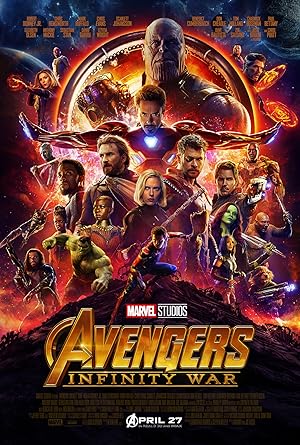
Avengers: Infinity War
As the Avengers and their allies have continued to protect the world from threats too large for any one hero to handle, a new danger has emerged from the cosmic shadows: Thanos. A despot of intergalactic infamy, his goal is to collect all six Infinity Stones, artifacts of unimaginable power, and use them to inflict his twisted will on all of reality. Everything the Avengers have fought for has led up to this moment, the fate of Earth and existence has never been more uncertain.
Despite a enormous budget of $300.0M, Avengers: Infinity War became a box office phenomenon, earning $2052.4M worldwide—a remarkable 584% return. This commercial performance validated the ambitious narrative scope, proving that audiences embrace distinctive approach even at blockbuster scale.
Nominated for 1 Oscar. 48 wins & 80 nominations


Plot Structure
Story beats plotted across runtime


Narrative Arc
Emotional journey through the story's key moments
Story Circle
Blueprint 15-beat structure
Arcplot Score Breakdown
Weighted: Precision (70%) + Arc (15%) + Theme (15%)
Avengers: Infinity War (2018) exemplifies meticulously timed narrative architecture, characteristic of Joe Russo's storytelling approach. This structural analysis examines how the film's 15-point plot structure maps to proven narrative frameworks across 2 hours and 29 minutes. With an Arcplot score of 2.7, the film takes an unconventional approach to traditional narrative frameworks.
Structural Analysis
The Status Quo at 1 minutes (1% through the runtime) establishes The Asgardian refugee ship drifts in space, already under attack by Thanos. Thor's distress call plays: "This is the Asgardian refugee vessel Statesman. We are under assault." Bodies litter the floor, establishing the new post-Ragnarok status quo of desperate survival.. Structural examination shows that this early placement immediately immerses viewers in the story world.
The inciting incident occurs at 15 minutes when Bruce warns Tony and Strange: "Thanos is coming. He's coming for the Stones." The threat that has loomed in the background for years becomes immediate and real. Vision is attacked in Scotland simultaneously. The status quo shatters as Earth's heroes realize they face an extinction-level threat.. At 10% through the film, this Disruption aligns precisely with traditional story structure. This beat shifts the emotional landscape, launching the protagonist into the central conflict.
The First Threshold at 33 minutes marks the transition into Act II, occurring at 22% of the runtime. This demonstrates the protagonist's commitment to Tony, Strange, and Peter are pulled into space aboard Ebony Maw's ship with the Time Stone. Tony crosses the point of no return: "We're in a flying doughnut, billions of miles from Earth, with no backup." Meanwhile Steve Rogers emerges from the shadows to save Vision and Wanda, committing the separated Avengers to unite and fight. The teams are now fully committed to their missions., moving from reaction to action.
At 67 minutes, the Midpoint arrives at 45% of the runtime—arriving early, accelerating into Act IIb complications. The analysis reveals that this crucial beat Thanos arrives on Knowhere and tortures the Collector, revealing he already has the Reality Stone. He captures Gamora despite the Guardians' ambush. The false victory (the heroes' plans are in motion) becomes false defeat - Thanos is ahead of them, more powerful than expected, and now has leverage over the one person who knows the Soul Stone's location. Stakes raise dramatically., fundamentally raising what's at risk. The emotional intensity shifts, dividing the narrative into clear before-and-after phases.
The Collapse moment at 100 minutes (67% through) represents the emotional nadir. Here, Thanos sacrifices Gamora on Vormir to obtain the Soul Stone. The literal death of Thanos's daughter - the only person he loves - represents the film's darkest thematic moment. The villain proves willing to pay the ultimate cost for his goal, while simultaneously demonstrating the heroes' greatest fear: that love and connection become weapons against them. "What did it cost?" "Everything."., reveals the protagonist at their lowest point. This beat's placement in the final quarter sets up the climactic reversal.
The Second Threshold at 110 minutes initiates the final act resolution at 74% of the runtime. Wanda makes the devastating choice to destroy the Mind Stone while Vision is still attached to it, killing the man she loves to stop Thanos. This represents the synthesis of the film's theme - true sacrifice means losing what you cannot bear to lose. Vision tells her "It's all right. You could never hurt me. I just... Feel you." The heroes finally embrace the cost of victory., demonstrating the transformation achieved throughout the journey.
Emotional Journey
Avengers: Infinity War's emotional architecture traces a deliberate progression across 15 carefully calibrated beats.
Narrative Framework
This structural analysis employs proven narrative structure principles that track dramatic progression. By mapping Avengers: Infinity War against these established plot points, we can identify how Joe Russo utilizes or subverts traditional narrative conventions. The plot point approach reveals not only adherence to structural principles but also creative choices that distinguish Avengers: Infinity War within the action genre.
Joe Russo's Structural Approach
Among the 4 Joe Russo films analyzed on Arcplot, the average structural score is 5.8, showcasing experimental approaches to narrative form. Avengers: Infinity War takes a more unconventional approach compared to the director's typical style. For comparative analysis, explore the complete Joe Russo filmography.
Comparative Analysis
Additional action films include The Bad Guys, Puss in Boots and Venom: The Last Dance. For more Joe Russo analyses, see The Gray Man, Captain America: Civil War and Captain America: The Winter Soldier.
Plot Points by Act
Act I
SetupStatus Quo
The Asgardian refugee ship drifts in space, already under attack by Thanos. Thor's distress call plays: "This is the Asgardian refugee vessel Statesman. We are under assault." Bodies litter the floor, establishing the new post-Ragnarok status quo of desperate survival.
Theme
Thanos states the theme to Loki: "I know what it's like to lose. To feel so desperately that you're right, yet to fail nonetheless." The film explores the cost of sacrifice, the burden of difficult choices, and whether the ends justify the means.
Worldbuilding
Opening sequence establishes Thanos's power as he defeats Hulk and kills Loki and Heimdall. Transitions to Earth where we see the scattered Avengers in their post-Civil War status quo: Tony and Pepper discussing marriage, Bruce crashing into the Sanctum, Strange and Wong protecting the Time Stone, Vision and Wanda in Scotland. The Guardians respond to the Asgardian distress call.
Disruption
Bruce warns Tony and Strange: "Thanos is coming. He's coming for the Stones." The threat that has loomed in the background for years becomes immediate and real. Vision is attacked in Scotland simultaneously. The status quo shatters as Earth's heroes realize they face an extinction-level threat.
Resistance
Heroes debate how to respond. Tony calls Steve Rogers. Strange refuses to give up the Time Stone. Vision suggests destroying the Mind Stone. The Guardians debate helping Thor. Characters wrestle with what they're willing to sacrifice, what alliances to rebuild, and whether they can win. Multiple groups begin forming plans.
Act II
ConfrontationFirst Threshold
Tony, Strange, and Peter are pulled into space aboard Ebony Maw's ship with the Time Stone. Tony crosses the point of no return: "We're in a flying doughnut, billions of miles from Earth, with no backup." Meanwhile Steve Rogers emerges from the shadows to save Vision and Wanda, committing the separated Avengers to unite and fight. The teams are now fully committed to their missions.
Mirror World
Thor bonds with Rocket while traveling to Nidavellir, revealing his deep losses: "What more could I lose?" This relationship subplot carries the theme - Thor must learn that there's always more to lose and more to fight for. Rocket's compassion draws out Thor's vulnerability and renewed purpose.
Premise
The promise of the premise: Avengers and Guardians unite across multiple storylines. Tony/Strange/Guardians plan their attack on Titan. Cap/Widow/Falcon bring Vision to Wakanda for protection and potential Mind Stone extraction. Thor forges Stormbreaker. The teams execute their strategies with characteristic humor and action. Heroes work together in exciting new combinations.
Midpoint
Thanos arrives on Knowhere and tortures the Collector, revealing he already has the Reality Stone. He captures Gamora despite the Guardians' ambush. The false victory (the heroes' plans are in motion) becomes false defeat - Thanos is ahead of them, more powerful than expected, and now has leverage over the one person who knows the Soul Stone's location. Stakes raise dramatically.
Opposition
Pressure intensifies on all fronts. Thanos forces Gamora to reveal the Soul Stone's location by torturing Nebula. On Titan, the heroes nearly defeat Thanos but Quill's emotional reaction ruins the plan. In Wakanda, Thanos's army overwhelms the defenses despite Thor's arrival with Stormbreaker. Thanos acquires both Soul and Mind Stones. Heroes' flaws (emotion over strategy, divided loyalties) cost them everything.
Collapse
Thanos sacrifices Gamora on Vormir to obtain the Soul Stone. The literal death of Thanos's daughter - the only person he loves - represents the film's darkest thematic moment. The villain proves willing to pay the ultimate cost for his goal, while simultaneously demonstrating the heroes' greatest fear: that love and connection become weapons against them. "What did it cost?" "Everything."
Crisis
After obtaining the Soul Stone, Thanos arrives on Titan where the heroes' plan fails when Quill learns of Gamora's death and attacks in grief. Thanos brutally defeats Tony, nearly killing him. Strange surrenders the Time Stone to save Tony's life, abandoning his oath to protect it. In Wakanda, despite Thor's powerful arrival, the heroes cannot prevent Thanos from reaching Vision. All seems lost.
Act III
ResolutionSecond Threshold
Wanda makes the devastating choice to destroy the Mind Stone while Vision is still attached to it, killing the man she loves to stop Thanos. This represents the synthesis of the film's theme - true sacrifice means losing what you cannot bear to lose. Vision tells her "It's all right. You could never hurt me. I just... feel you." The heroes finally embrace the cost of victory.
Synthesis
Thanos uses the Time Stone to reverse Vision's destruction and rips the Mind Stone from his head, completing the Infinity Gauntlet. Thor strikes Thanos through the chest with Stormbreaker, but Thanos tells him "You should have gone for the head" and snaps his fingers. Heroes across the universe disintegrate into ash: Bucky, Black Panther, Groot, Wanda, Sam, Mantis, Drax, Quill, Strange, and Peter Parker. Thanos achieves his goal and vanishes.
Transformation
Thanos sits peacefully watching the sunrise on a remote planet, smiling with satisfaction. The closing image mirrors his earlier scenes but shows his transformation - mission accomplished, perfectly balanced as all things should be. Meanwhile the surviving heroes are shattered and scattered, transformed from Earth's Mightiest Heroes into traumatized survivors of an incomprehensible loss. Nick Fury disintegrates after sending a signal to Captain Marvel. The world has fundamentally changed.