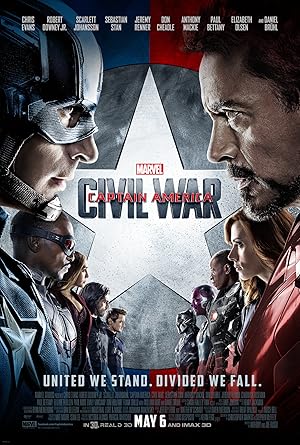
Captain America: Civil War
With many people fearing the actions of super heroes, the government decides to push for the Hero Registration Act, a law that limits a hero's actions. This results in a division in The Avengers. Iron Man stands with this Act, claiming that their actions must be kept in check otherwise cities will continue to be destroyed, but Captain America feels that saving the world is daring enough and that they cannot rely on the government to protect the world. This escalates into an all-out war between Team Iron Man (Iron Man, Black Panther, Vision, Black Widow, War Machine, and Spider-Man) and Team Captain America (Captain America, Bucky Barnes, Falcon, Scarlet Witch, Hawkeye, and Ant Man) while a new villain emerges.
Despite a blockbuster budget of $250.0M, Captain America: Civil War became a financial success, earning $1155.0M worldwide—a 362% return. This commercial performance validated the ambitious narrative scope, showing that audiences embrace bold vision even at blockbuster scale.
16 wins & 73 nominations


Plot Structure
Story beats plotted across runtime


Narrative Arc
Emotional journey through the story's key moments
Story Circle
Blueprint 15-beat structure
Arcplot Score Breakdown
Weighted: Precision (70%) + Arc (15%) + Theme (15%)
Captain America: Civil War (2016) reveals precise narrative design, characteristic of Joe Russo's storytelling approach. This structural analysis examines how the film's 15-point plot structure maps to proven narrative frameworks across 2 hours and 27 minutes. With an Arcplot score of 6.9, the film balances conventional beats with creative variation.
Characters
Cast & narrative archetypes

Steve Rogers / Captain America
Tony Stark / Iron Man
Bucky Barnes / Winter Soldier
Helmut Zemo
Natasha Romanoff / Black Widow
T'Challa / Black Panther
Peter Parker / Spider-Man
Wanda Maximoff / Scarlet Witch
Vision
Sam Wilson / Falcon
James Rhodes / War Machine
Clint Barton / Hawkeye
Main Cast & Characters
Steve Rogers / Captain America
Played by Chris Evans
World War II super-soldier struggling with his duty to protect versus his loyalty to his friend Bucky, leading the anti-registration faction.
Tony Stark / Iron Man
Played by Robert Downey Jr.
Billionaire inventor haunted by collateral damage from Avengers operations, championing government oversight and accountability.
Bucky Barnes / Winter Soldier
Played by Sebastian Stan
Steve's childhood friend and brainwashed assassin seeking redemption while being hunted for a terrorist attack he didn't commit.
Helmut Zemo
Played by Daniel Brühl
Sokovian intelligence officer who manipulates the Avengers into destroying themselves to avenge his family killed in Sokovia.
Natasha Romanoff / Black Widow
Played by Scarlett Johansson
Pragmatic spy and Avenger who supports the Sokovia Accords but struggles with divided loyalties between Tony and Steve.
T'Challa / Black Panther
Played by Chadwick Boseman
Prince of Wakanda seeking vengeance for his father's assassination, pursuing Bucky with single-minded determination.
Peter Parker / Spider-Man
Played by Tom Holland
Teenage superhero recruited by Tony Stark to help capture Captain America, eager to prove himself to his new mentor.
Wanda Maximoff / Scarlet Witch
Played by Elizabeth Olsen
Young Avenger whose powers cause civilian casualties, becoming the catalyst for the Sokovia Accords and feeling responsible for the team's division.
Vision
Played by Paul Bettany
Synthetic being struggling to understand humanity and his feelings for Wanda while logically supporting government oversight.
Sam Wilson / Falcon
Played by Anthony Mackie
Former pararescue and Steve's loyal ally who follows him into opposition against the Sokovia Accords.
James Rhodes / War Machine
Played by Don Cheadle
Military officer and Tony's best friend who strongly believes in accountability and chain of command.
Clint Barton / Hawkeye
Played by Jeremy Renner
Retired Avenger who comes out of retirement to help Steve, risking his family's safety for his principles.
Structural Analysis
The Status Quo at 1 minutes (1% through the runtime) establishes The Avengers operate as a unified team, conducting a mission in Lagos to stop Crossbones. Steve Rogers leads with confidence, the team works together seamlessly, representing their current status as Earth's protectors.. Significantly, this early placement immediately immerses viewers in the story world.
The inciting incident occurs at 18 minutes when Secretary Ross presents the Sokovia Accords to the Avengers, demanding they sign over their autonomy to UN oversight. The team must choose between signing away their independence or becoming outlaws.. At 12% through the film, this Disruption aligns precisely with traditional story structure. This beat shifts the emotional landscape, launching the protagonist into the central conflict.
The First Threshold at 37 minutes marks the transition into Act II, occurring at 25% of the runtime. This reveals the protagonist's commitment to Steve chooses to protect Bucky rather than sign the Accords, going rogue to pursue him independently. This active choice to defy the Accords and his team puts him on a collision course with Tony and the authorities., moving from reaction to action.
At 74 minutes, the Midpoint arrives at 50% of the runtime—precisely centered, creating perfect narrative symmetry. Significantly, this crucial beat The airport battle begins - the epic superhero confrontation the film promised. False defeat: despite the spectacle, Steve's team loses, most are captured, and War Machine is critically injured by Vision. The stakes have become devastatingly real., fundamentally raising what's at risk. The emotional intensity shifts, dividing the narrative into clear before-and-after phases.
The Collapse moment at 111 minutes (76% through) represents the emotional nadir. Here, Tony discovers that Bucky killed his parents. Zemo reveals the tape of the Winter Soldier assassinating Howard and Maria Stark. The revelation that Steve knew and hid this truth destroys their friendship. All is lost - the Avengers are truly broken., illustrates the protagonist at their lowest point. This beat's placement in the final quarter sets up the climactic reversal.
The Second Threshold at 118 minutes initiates the final act resolution at 80% of the runtime. Steve drops his shield, choosing Bucky and his principles over the Captain America identity Tony gave him. He realizes he can be true to himself without the symbols. Tony is left broken. Both men make their final choices about who they are., demonstrating the transformation achieved throughout the journey.
Emotional Journey
Captain America: Civil War's emotional architecture traces a deliberate progression across 15 carefully calibrated beats.
Narrative Framework
This structural analysis employs a 15-point narrative structure framework that maps key story moments. By mapping Captain America: Civil War against these established plot points, we can identify how Joe Russo utilizes or subverts traditional narrative conventions. The plot point approach reveals not only adherence to structural principles but also creative choices that distinguish Captain America: Civil War within the action genre.
Joe Russo's Structural Approach
Among the 4 Joe Russo films analyzed on Arcplot, the average structural score is 5.8, showcasing experimental approaches to narrative form. Captain America: Civil War represents one of the director's most structurally precise works. For comparative analysis, explore the complete Joe Russo filmography.
Comparative Analysis
Additional action films include The Bad Guys, Puss in Boots and Venom: The Last Dance. For more Joe Russo analyses, see Avengers: Infinity War, The Gray Man and Captain America: The Winter Soldier.
Plot Points by Act
Act I
SetupStatus Quo
The Avengers operate as a unified team, conducting a mission in Lagos to stop Crossbones. Steve Rogers leads with confidence, the team works together seamlessly, representing their current status as Earth's protectors.
Theme
After the Lagos incident causes civilian casualties, the theme of accountability and consequences is introduced. The question: "Should those with power be controlled, or should they remain free to act on their conscience?"
Worldbuilding
Establishes the Avengers' current operations, the Lagos mission and its tragic outcome with civilian deaths, introduction of the Sokovia Accords as a response to collateral damage, and the brewing tension between freedom and oversight.
Disruption
Secretary Ross presents the Sokovia Accords to the Avengers, demanding they sign over their autonomy to UN oversight. The team must choose between signing away their independence or becoming outlaws.
Resistance
The Avengers debate the Accords. Tony supports oversight due to guilt over Ultron; Steve resists government control. The ideological divide deepens. Peggy Carter's death reminds Steve of standing for principles. The Vienna bombing kills King T'Chaka, and Bucky is framed.
Act II
ConfrontationFirst Threshold
Steve chooses to protect Bucky rather than sign the Accords, going rogue to pursue him independently. This active choice to defy the Accords and his team puts him on a collision course with Tony and the authorities.
Mirror World
Steve reunites with Bucky, who represents loyalty and the past. Their relationship embodies the thematic conflict: standing by your principles and those you trust versus bending to external authority. Bucky is the mirror showing Steve who he truly is.
Premise
The "promise of the premise" - superheroes fighting superheroes. Steve and Bucky evade capture; Tony recruits Spider-Man; teams form on both sides; the investigation into the real bomber continues; leads point to Siberia and the other Winter Soldiers.
Midpoint
The airport battle begins - the epic superhero confrontation the film promised. False defeat: despite the spectacle, Steve's team loses, most are captured, and War Machine is critically injured by Vision. The stakes have become devastatingly real.
Opposition
Steve and Bucky escape to Siberia while Tony discovers he was wrong about Bucky. The team is imprisoned in the Raft. Zemo's true plan unfolds. Tony learns the truth and goes to help Steve, but opposition intensifies as all parties converge on the Siberian facility.
Collapse
Tony discovers that Bucky killed his parents. Zemo reveals the tape of the Winter Soldier assassinating Howard and Maria Stark. The revelation that Steve knew and hid this truth destroys their friendship. All is lost - the Avengers are truly broken.
Crisis
Tony, consumed by grief and rage, fights Steve and Bucky. The brutal personal battle destroys what remains of their bond. Steve must choose between his friend and his principles. The emotional darkness as the family fractures completely.
Act III
ResolutionSecond Threshold
Steve drops his shield, choosing Bucky and his principles over the Captain America identity Tony gave him. He realizes he can be true to himself without the symbols. Tony is left broken. Both men make their final choices about who they are.
Synthesis
The aftermath: Steve breaks his team out of the Raft; Bucky enters cryosleep in Wakanda; T'Challa chooses mercy over vengeance with Zemo; Tony receives Steve's letter acknowledging their bond despite their differences; an uneasy resolution with fractures remaining.
Transformation
Steve, now a fugitive without his shield, remains committed to protecting people on his own terms. The closing image shows him as a different kind of hero - no longer Captain America the symbol, but Steve Rogers the man who stands by his principles.