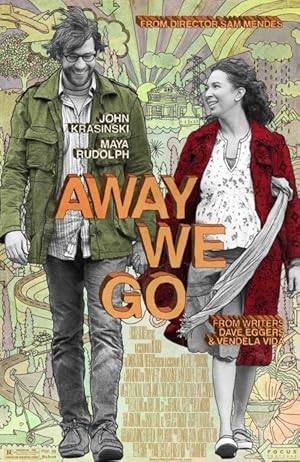
Away We Go
Burt Farlander and Verona De Tessant are a couple steeped in eccentricity and irregularity but are very much in love. So when they find out that Verona is pregnant they take it in stride. Verona is enjoying pregnancy, Burt is already practicing skills that he believes a good father should have, and they live in the same state as Burt's parents Jerry and Gloria so their child-to-be can have grandparents. But when Burt and Verona go to dinner at his parents', they shake up the younger couple with surprising news: they have decided to move to Antwerp, Belgium. Verona lost her parents when she was relatively young, so she is very much alarmed, but the resilient couple quickly find a way to turn it into a positive: they embark on a search for the exact right place for them to raise their daughter-to-be. They go to every place they can think of, meeting family and friends along the way, with laughter and sadness. This is a road trip the parents-to-be will always remember.
The film underperformed commercially against its moderate budget of $17.0M, earning $15.8M globally (-7% loss).
3 wins & 10 nominations


Plot Structure
Story beats plotted across runtime


Narrative Arc
Emotional journey through the story's key moments
Story Circle
Blueprint 15-beat structure
Arcplot Score Breakdown
Weighted: Precision (70%) + Arc (15%) + Theme (15%)
Away We Go (2009) exhibits carefully calibrated story structure, characteristic of Sam Mendes's storytelling approach. This structural analysis examines how the film's 15-point plot structure maps to proven narrative frameworks across 1 hour and 38 minutes. With an Arcplot score of 7.3, the film balances conventional beats with creative variation.
Characters
Cast & narrative archetypes

Burt Farlander
Verona De Tessant
Lily
LN
Tom
Munch
Main Cast & Characters
Burt Farlander
Played by John Krasinski
An expectant father searching for the perfect place to raise his family, struggling with anxiety about becoming a good parent.
Verona De Tessant
Played by Maya Rudolph
Burt's pregnant partner, a medical illustrator seeking stability and community for their growing family.
Lily
Played by Allison Janney
Verona's former boss in Phoenix, a bitter and crude woman who represents a cautionary tale of bad parenting.
LN
Played by Maggie Gyllenhaal
Burt's New Age cousin in Madison, an extreme attachment-parenting advocate who judges conventional parenting choices.
Tom
Played by Chris Messina
Burt's college friend in Montreal who struggles with heartbreak after his wife left him with their daughter.
Munch
Played by Melanie Lynskey
Verona's close friend in Miami who has experienced multiple miscarriages and represents the pain of unfulfilled parenthood.
Structural Analysis
The Status Quo at 1 minutes (1% through the runtime) establishes Burt and Verona lie in bed in their ramshackle house, discussing their uncertain future. They're in their early 30s, expecting their first child, living near Burt's parents in a modest, makeshift life. The image establishes their loving but directionless relationship.. Structural examination shows that this early placement immediately immerses viewers in the story world.
The inciting incident occurs at 11 minutes when Burt's parents announce they're moving to Belgium a month before the baby is due. The only reason Burt and Verona lived in this location—proximity to family—vanishes. They're suddenly unmoored with no home base and no plan.. At 12% through the film, this Disruption aligns precisely with traditional story structure. This beat shifts the emotional landscape, launching the protagonist into the central conflict.
The First Threshold at 24 minutes marks the transition into Act II, occurring at 24% of the runtime. This shows the protagonist's commitment to Burt and Verona actively choose to embark on a cross-country journey to find a new home. They create a list of cities where friends and family live. This choice launches them into Act 2—a journey of discovery about family, home, and what kind of parents they want to be., moving from reaction to action.
At 50 minutes, the Midpoint arrives at 51% of the runtime—precisely centered, creating perfect narrative symmetry. Notably, this crucial beat In Montreal, Burt and Verona experience their friends Tom and Munch's warm, loving, chaotic family—the first positive example. False victory: they think they've found the answer (Montreal could be home). Stakes raise as they get closer to their due date and the question becomes more urgent., fundamentally raising what's at risk. The emotional intensity shifts, dividing the narrative into clear before-and-after phases.
The Collapse moment at 71 minutes (73% through) represents the emotional nadir. Here, Verona breaks down emotionally, confessing her deepest fear: that she'll be a terrible mother because her own parents are dead and she has no model. The "whiff of death" is literal (her dead parents) and metaphorical (death of her confidence). She questions whether they can do this at all., illustrates the protagonist at their lowest point. This beat's placement in the final quarter sets up the climactic reversal.
The Second Threshold at 77 minutes initiates the final act resolution at 79% of the runtime. Burt has a realization: home isn't a place or a perfect family model—it's them, together. He proposes they return to the house where Verona grew up, near the lake where her parents lived. Synthesis of the journey: they can honor the past while creating their own future. The answer was in their love all along., demonstrating the transformation achieved throughout the journey.
Emotional Journey
Away We Go's emotional architecture traces a deliberate progression across 15 carefully calibrated beats.
Narrative Framework
This structural analysis employs a 15-point narrative structure framework that maps key story moments. By mapping Away We Go against these established plot points, we can identify how Sam Mendes utilizes or subverts traditional narrative conventions. The plot point approach reveals not only adherence to structural principles but also creative choices that distinguish Away We Go within the comedy genre.
Sam Mendes's Structural Approach
Among the 9 Sam Mendes films analyzed on Arcplot, the average structural score is 6.5, demonstrating varied approaches to story architecture. Away We Go represents one of the director's most structurally precise works. For comparative analysis, explore the complete Sam Mendes filmography.
Comparative Analysis
Additional comedy films include The Bad Guys, Ella Enchanted and The Evening Star. For more Sam Mendes analyses, see Revolutionary Road, American Beauty and Empire of Light.
Plot Points by Act
Act I
SetupStatus Quo
Burt and Verona lie in bed in their ramshackle house, discussing their uncertain future. They're in their early 30s, expecting their first child, living near Burt's parents in a modest, makeshift life. The image establishes their loving but directionless relationship.
Theme
During a visit to Burt's parents, his mother Jerry casually asks, "Are you guys finally going to grow up?" The question of what it means to be adults and proper parents—the film's central theme—is stated early.
Worldbuilding
Establishing Burt and Verona's quirky, unconventional relationship. They're deeply in love but lack direction. Verona's parents are dead; they live near Burt's aging parents. They prepare for the baby with endearing incompetence. Their vulnerability and need for family is established.
Disruption
Burt's parents announce they're moving to Belgium a month before the baby is due. The only reason Burt and Verona lived in this location—proximity to family—vanishes. They're suddenly unmoored with no home base and no plan.
Resistance
Burt and Verona debate what to do. Should they stay? Move? Where would they go? Verona suggests visiting friends and family across North America to find the right place to raise their child. They wrestle with the decision, confronting their fears about becoming parents without a support system.
Act II
ConfrontationFirst Threshold
Burt and Verona actively choose to embark on a cross-country journey to find a new home. They create a list of cities where friends and family live. This choice launches them into Act 2—a journey of discovery about family, home, and what kind of parents they want to be.
Mirror World
First stop: Phoenix, visiting Burt's former colleague Lily and her family. Lily represents one extreme parenting style—controlling, performative, judgmental. The subplot of examining different family models begins. Each location will hold up a mirror to who Burt and Verona are and who they want to become.
Premise
The "promise of the premise"—a road trip through America examining different families. Phoenix (Lily's dysfunction), Tucson (Verona's sister with her own sadness), Madison (LN's New Age commune family), Montreal (Tom and Munch's loving chaos). Each stop reveals what home isn't, while Burt and Verona grow closer.
Midpoint
In Montreal, Burt and Verona experience their friends Tom and Munch's warm, loving, chaotic family—the first positive example. False victory: they think they've found the answer (Montreal could be home). Stakes raise as they get closer to their due date and the question becomes more urgent.
Opposition
The journey continues but grows heavier. Miami brings them to Burt's brother, whose marriage is crumbling. The joyful exploration darkens as they encounter more broken families and disappointment. Verona's unresolved grief about her own parents surfaces. The closer they get to the baby's arrival, the more anxious and lost they feel.
Collapse
Verona breaks down emotionally, confessing her deepest fear: that she'll be a terrible mother because her own parents are dead and she has no model. The "whiff of death" is literal (her dead parents) and metaphorical (death of her confidence). She questions whether they can do this at all.
Crisis
Dark night of the soul. Burt and Verona sit with the weight of Verona's grief and fear. The journey has shown them what they don't want, but they still don't know what they do want. They're running out of time and options. The question hangs: can they create a family without a roadmap?
Act III
ResolutionSecond Threshold
Burt has a realization: home isn't a place or a perfect family model—it's them, together. He proposes they return to the house where Verona grew up, near the lake where her parents lived. Synthesis of the journey: they can honor the past while creating their own future. The answer was in their love all along.
Synthesis
Burt and Verona return to Verona's childhood home by the lake. They move in, creating their own space. They prepare for the baby not by copying others but by trusting themselves. The finale resolves the thematic question: family is what you make it, built on love and commitment, not perfection or convention.
Transformation
Final image mirrors the opening: Burt and Verona lie together, but now in Verona's childhood home by the lake. Same intimate position, but transformed—they've found their home, not through external validation but through their bond. They're ready to be parents on their own terms.