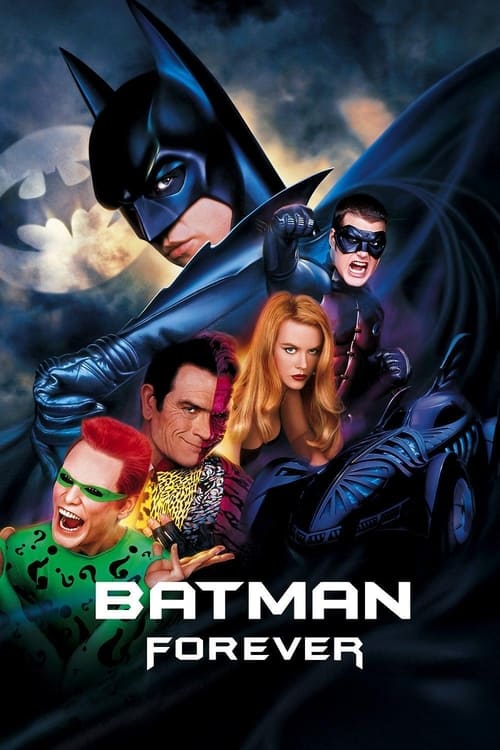
Batman Forever
Batman faces off against two foes: the schizophrenic, horribly scarred former District Attorney Harvey Dent, aka Two-Face, and the Riddler, a disgruntled ex-Wayne Enterprises inventor seeking revenge against his former employer by unleashing his brain-sucking weapon on Gotham City's residents. As the caped crusader also copes with tortured memories of his parents' murder, he has a new romance, with psychologist Chase Meridian.
Despite a significant budget of $100.0M, Batman Forever became a commercial success, earning $336.5M worldwide—a 237% return.
Nominated for 3 Oscars. 10 wins & 26 nominations


Plot Structure
Story beats plotted across runtime


Narrative Arc
Emotional journey through the story's key moments
Story Circle
Blueprint 15-beat structure
Arcplot Score Breakdown
Weighted: Precision (70%) + Arc (15%) + Theme (15%)
Batman Forever (1995) exemplifies carefully calibrated plot construction, characteristic of Joel Schumacher's storytelling approach. This structural analysis examines how the film's 15-point plot structure maps to proven narrative frameworks across 2 hours and 1 minutes. With an Arcplot score of 6.8, the film balances conventional beats with creative variation.
Characters
Cast & narrative archetypes

Bruce Wayne / Batman
Dr. Chase Meridian
Dick Grayson / Robin
Edward Nygma / The Riddler
Harvey Dent / Two-Face
Alfred Pennyworth
Main Cast & Characters
Bruce Wayne / Batman
Played by Val Kilmer
Gotham's dark knight vigilante struggling with his dual identity and seeking balance between justice and vengeance.
Dr. Chase Meridian
Played by Nicole Kidman
A criminal psychologist fascinated by the Batman persona and drawn to both Bruce Wayne and his masked alter ego.
Dick Grayson / Robin
Played by Chris O'Donnell
A young acrobat seeking revenge for his family's murder who becomes Batman's partner and learns to channel his anger.
Edward Nygma / The Riddler
Played by Jim Carrey
A brilliant but unstable Wayne Enterprises employee who becomes obsessed with Batman and creates elaborate puzzles to prove his superiority.
Harvey Dent / Two-Face
Played by Tommy Lee Jones
Gotham's former district attorney transformed into a vengeful villain after acid scarring, making decisions based on the flip of a coin.
Alfred Pennyworth
Played by Michael Gough
Bruce Wayne's loyal butler and father figure who provides wisdom, support, and occasional reality checks.
Structural Analysis
The Status Quo at 1 minutes (1% through the runtime) establishes Batman suits up in the Batcave, methodically preparing for action. Alfred asks if he'll be taking a sandwich, establishing the lonely, ritualistic existence of Bruce Wayne as Gotham's protector.. Of particular interest, this early placement immediately immerses viewers in the story world.
The inciting incident occurs at 14 minutes when Edward Nygma demonstrates his brain-wave manipulation device to Bruce Wayne, who rejects it as "raising too many questions." Nygma's obsession with Bruce curdles into murderous rage as he kills his supervisor and fakes a suicide, beginning his transformation into The Riddler.. At 12% through the film, this Disruption aligns precisely with traditional story structure. This beat shifts the emotional landscape, launching the protagonist into the central conflict.
The First Threshold at 30 minutes marks the transition into Act II, occurring at 25% of the runtime. This illustrates the protagonist's commitment to Bruce Wayne chooses to take Dick Grayson into Wayne Manor despite Alfred's concerns. Dick, consumed by vengeance, discovers the Batcave. Bruce commits to being responsible for another person's fate, mirroring his own origin while confronting someone who shares his trauma., moving from reaction to action.
At 60 minutes, the Midpoint arrives at 50% of the runtime—precisely centered, creating perfect narrative symmetry. The analysis reveals that this crucial beat At Edward Nygma's grand party unveiling The Box, Bruce realizes Nygma is The Riddler. Meanwhile, Dick steals the Batmobile to confront Two-Face, forcing Batman to rescue him. Bruce declares he will stop being Batman, believing he can finally have a normal life with Chase—a false victory., fundamentally raising what's at risk. The emotional intensity shifts, dividing the narrative into clear before-and-after phases.
The Collapse moment at 89 minutes (73% through) represents the emotional nadir. Here, Two-Face and The Riddler attack Wayne Manor, destroying the Batcave and shooting Bruce. Chase is kidnapped. The Riddler taunts Bruce: "If you kill me, you'll never save them." Alfred pulls Bruce from the wreckage as his world literally collapses around him—his home, his love, his identity all destroyed., shows the protagonist at their lowest point. This beat's placement in the final quarter sets up the climactic reversal.
The Second Threshold at 96 minutes initiates the final act resolution at 80% of the runtime. Bruce awakens with clarity: "I choose to be Batman." He solves The Riddler's final clue and accepts Dick as his partner Robin. No longer fighting his identity or driven by guilt, Bruce embraces being both the man and the symbol—whole for the first time., demonstrating the transformation achieved throughout the journey.
Emotional Journey
Batman Forever's emotional architecture traces a deliberate progression across 15 carefully calibrated beats.
Narrative Framework
This structural analysis employs structural analysis methodology used to understand storytelling architecture. By mapping Batman Forever against these established plot points, we can identify how Joel Schumacher utilizes or subverts traditional narrative conventions. The plot point approach reveals not only adherence to structural principles but also creative choices that distinguish Batman Forever within the action genre.
Joel Schumacher's Structural Approach
Among the 17 Joel Schumacher films analyzed on Arcplot, the average structural score is 7.0, reflecting strong command of classical structure. Batman Forever takes a more unconventional approach compared to the director's typical style. For comparative analysis, explore the complete Joel Schumacher filmography.
Comparative Analysis
Additional action films include The Bad Guys, Puss in Boots and Venom: The Last Dance. For more Joel Schumacher analyses, see The Phantom of the Opera, Trespass and St. Elmo's Fire.
Plot Points by Act
Act I
SetupStatus Quo
Batman suits up in the Batcave, methodically preparing for action. Alfred asks if he'll be taking a sandwich, establishing the lonely, ritualistic existence of Bruce Wayne as Gotham's protector.
Theme
Dr. Chase Meridian tells Batman, "Hot entrance. You like strong women. I've done my homework. Or do I need skintight vinyl and a whip?" She probes his psychology, foreshadowing the theme that Batman must confront who he really is beneath the mask.
Worldbuilding
Gotham City is established as a neon-drenched metropolis under siege. We meet Two-Face robbing a bank, Edward Nygma as an obsessive Wayne Enterprises employee, and Bruce Wayne as a stoic billionaire haunted by his past. Chase Meridian is introduced as a criminal psychologist fascinated by Batman.
Disruption
Edward Nygma demonstrates his brain-wave manipulation device to Bruce Wayne, who rejects it as "raising too many questions." Nygma's obsession with Bruce curdles into murderous rage as he kills his supervisor and fakes a suicide, beginning his transformation into The Riddler.
Resistance
Bruce debates his dual life while being pursued by Chase Meridian. Two-Face attacks the circus, killing the Flying Graysons while Dick survives. Bruce takes in the orphaned Dick Grayson, seeing his own trauma reflected. Nygma begins sending riddles to Bruce, escalating his vendetta.
Act II
ConfrontationFirst Threshold
Bruce Wayne chooses to take Dick Grayson into Wayne Manor despite Alfred's concerns. Dick, consumed by vengeance, discovers the Batcave. Bruce commits to being responsible for another person's fate, mirroring his own origin while confronting someone who shares his trauma.
Mirror World
Chase Meridian invites Bruce Wayne to her office, intrigued by Batman but drawn to Bruce. She explains that Batman is not a true split personality but something else—a man wrestling with identity. Their romantic connection offers Bruce a path to wholeness outside the mask.
Premise
The Riddler partners with Two-Face, building his mind-control empire through "The Box" device that steals Gotham's secrets. Dick Grayson rebels against Bruce, demanding to fight Two-Face. Batman pursues Nygma's trail of riddles while falling for Chase. Bruce grapples with whether to reveal his identity to her.
Midpoint
At Edward Nygma's grand party unveiling The Box, Bruce realizes Nygma is The Riddler. Meanwhile, Dick steals the Batmobile to confront Two-Face, forcing Batman to rescue him. Bruce declares he will stop being Batman, believing he can finally have a normal life with Chase—a false victory.
Opposition
Bruce suppresses his Batman identity and pursues Chase romantically. The Riddler and Two-Face terrorize Gotham while Batman is absent. Dick continues training, determined to become a vigilante. The Riddler uses his device to discover Batman's true identity, and the villains plan their ultimate strike on Wayne Manor.
Collapse
Two-Face and The Riddler attack Wayne Manor, destroying the Batcave and shooting Bruce. Chase is kidnapped. The Riddler taunts Bruce: "If you kill me, you'll never save them." Alfred pulls Bruce from the wreckage as his world literally collapses around him—his home, his love, his identity all destroyed.
Crisis
Bruce lies unconscious, flashing back to his parents' funeral. He finally recovers his repressed memory: as a child, he fell into the cave and discovered the bat, choosing it as his symbol before his parents died. He didn't become Batman out of guilt—he was always meant to be Batman.
Act III
ResolutionSecond Threshold
Bruce awakens with clarity: "I choose to be Batman." He solves The Riddler's final clue and accepts Dick as his partner Robin. No longer fighting his identity or driven by guilt, Bruce embraces being both the man and the symbol—whole for the first time.
Synthesis
Batman and Robin infiltrate Claw Island together. Robin confronts Two-Face but chooses not to kill him, breaking the cycle of vengeance. Batman defeats The Riddler by destroying his brain device. Two-Face falls to his death by his own coin. Chase and Dick are saved, and Nygma is left mad in Arkham.
Transformation
Chase visits Nygma in Arkham; he claims to know Batman's identity but reveals only madness. She tells Bruce his secret is safe. The final image: Batman and Robin race toward the camera as partners, no longer alone. Bruce has found family, purpose, and peace with who he truly is.