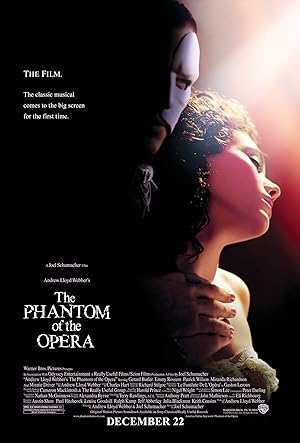
The Phantom of the Opera
Begins when an opera ghost terrorizes the cast and crew of the French Opera House while tutoring a chorus girl. He finally drives the lead soprano crazy so she and her friend leave. The girl is able to sing lead one night but the soprano doesn't want her show stolen so she comes back. The ghost demands they keep giving his protégé lead roles. Meanwhile, His pupil falls in love with the Vicomte de Chagny, but the Phantom is in love with Christine, his student. The Phantom is outraged by their love and kidnaps Christine to be his eternal bride. Will Raoul, the Vicomte, be able to stop this dastardly plan?
Despite a respectable budget of $70.0M, The Phantom of the Opera became a solid performer, earning $154.7M worldwide—a 121% return.
Nominated for 3 Oscars. 7 wins & 42 nominations


Plot Structure
Story beats plotted across runtime


Narrative Arc
Emotional journey through the story's key moments
Story Circle
Blueprint 15-beat structure
Arcplot Score Breakdown
Weighted: Precision (70%) + Arc (15%) + Theme (15%)
The Phantom of the Opera (2004) reveals carefully calibrated narrative design, characteristic of Joel Schumacher's storytelling approach. This structural analysis examines how the film's 15-point plot structure maps to proven narrative frameworks across 2 hours and 21 minutes. With an Arcplot score of 6.8, the film balances conventional beats with creative variation.
Structural Analysis
The Status Quo at 2 minutes (1% through the runtime) establishes The 1919 auction at the Paris Opera House reveals a decrepit, forgotten world. An elderly Raoul purchases a music box and the restored chandelier, suggesting a tragic past beneath the grandeur.. Of particular interest, this early placement immediately immerses viewers in the story world.
The inciting incident occurs at 17 minutes when Carlotta storms off after the Phantom drops a backdrop on her. The new managers force Christine to take the lead role in Il Muto, thrusting her from obscurity into the spotlight against the Phantom's wishes.. At 12% through the film, this Disruption aligns precisely with traditional story structure. This beat shifts the emotional landscape, launching the protagonist into the central conflict.
The First Threshold at 36 minutes marks the transition into Act II, occurring at 25% of the runtime. This shows the protagonist's commitment to Christine makes the irreversible choice to follow the Phantom through the mirror and down to his lair beneath the opera house. She crosses into his dark, obsessive world, leaving the safety of the surface behind., moving from reaction to action.
At 71 minutes, the Midpoint arrives at 50% of the runtime—precisely centered, creating perfect narrative symmetry. Significantly, this crucial beat Christine unmasks the Phantom during "The Point of No Return," revealing his disfigurement to the entire opera house. This public humiliation transforms him from mysterious teacher to exposed, dangerous monster. The stakes explode., fundamentally raising what's at risk. The emotional intensity shifts, dividing the narrative into clear before-and-after phases.
The Collapse moment at 106 minutes (75% through) represents the emotional nadir. Here, The chandelier crashes during the masquerade, causing chaos and death. The Phantom appears atop it in his Red Death costume, asserting total control. All hope of stopping him through conventional means dies in the flames and screams., indicates the protagonist at their lowest point. This beat's placement in the final quarter sets up the climactic reversal.
The Second Threshold at 113 minutes initiates the final act resolution at 80% of the runtime. Christine chooses to perform in the Phantom's opera as bait, synthesizing courage with compassion. She realizes the only way to defeat him isn't through violence but through the one thing he's never experienced: unconditional human compassion., demonstrating the transformation achieved throughout the journey.
Emotional Journey
The Phantom of the Opera's emotional architecture traces a deliberate progression across 15 carefully calibrated beats.
Narrative Framework
This structural analysis employs a 15-point narrative structure framework that maps key story moments. By mapping The Phantom of the Opera against these established plot points, we can identify how Joel Schumacher utilizes or subverts traditional narrative conventions. The plot point approach reveals not only adherence to structural principles but also creative choices that distinguish The Phantom of the Opera within the drama genre.
Joel Schumacher's Structural Approach
Among the 17 Joel Schumacher films analyzed on Arcplot, the average structural score is 7.0, reflecting strong command of classical structure. The Phantom of the Opera takes a more unconventional approach compared to the director's typical style. For comparative analysis, explore the complete Joel Schumacher filmography.
Comparative Analysis
Additional drama films include After Thomas, South Pacific and Dirty Dancing: Havana Nights. For more Joel Schumacher analyses, see Batman Forever, Trespass and St. Elmo's Fire.
Plot Points by Act
Act I
SetupStatus Quo
The 1919 auction at the Paris Opera House reveals a decrepit, forgotten world. An elderly Raoul purchases a music box and the restored chandelier, suggesting a tragic past beneath the grandeur.
Theme
Madame Giry warns the new managers about the Phantom's requirements: "He's always been here... the Opera Ghost." The theme emerges: beauty, obsession, and the price of artistic perfection.
Worldbuilding
Flashback to 1870: Christine is a chorus girl mourning her father, the Opera House operates under the Phantom's mysterious demands, and Carlotta reigns as the temperamental prima donna. The supernatural legend permeates every corner.
Disruption
Carlotta storms off after the Phantom drops a backdrop on her. The new managers force Christine to take the lead role in Il Muto, thrusting her from obscurity into the spotlight against the Phantom's wishes.
Resistance
Christine grapples with her sudden fame while the Phantom continues her secret vocal training through the mirror. Raoul, her childhood sweetheart, returns and rekindles their connection, creating a romantic triangle.
Act II
ConfrontationFirst Threshold
Christine makes the irreversible choice to follow the Phantom through the mirror and down to his lair beneath the opera house. She crosses into his dark, obsessive world, leaving the safety of the surface behind.
Mirror World
In the Phantom's lair, Christine discovers his sanctuary of music, candles, and a masked figure who has composed "The Music of the Night" for her. This world represents pure artistic obsession without human connection.
Premise
The promised premise unfolds: Christine navigates between two worlds—the Phantom's dark artistic devotion below and Raoul's romantic love above. She performs, explores her voice's potential, and the opera house buzzes with supernatural intrigue.
Midpoint
Christine unmasks the Phantom during "The Point of No Return," revealing his disfigurement to the entire opera house. This public humiliation transforms him from mysterious teacher to exposed, dangerous monster. The stakes explode.
Opposition
The Phantom escalates his attacks: murdering Buquet, crashing the chandelier, and writing a dark opera demanding Christine as his star. Raoul and the managers plot to trap him while Christine is caught between guilt, fear, and obligation.
Collapse
The chandelier crashes during the masquerade, causing chaos and death. The Phantom appears atop it in his Red Death costume, asserting total control. All hope of stopping him through conventional means dies in the flames and screams.
Crisis
Christine faces her darkest moment: trapped between her loyalty to Raoul and her complex bond with the Phantom. She must perform in his opera "Don Juan Triumphant," knowing it's a trap, with no clear path to survival or freedom.
Act III
ResolutionSecond Threshold
Christine chooses to perform in the Phantom's opera as bait, synthesizing courage with compassion. She realizes the only way to defeat him isn't through violence but through the one thing he's never experienced: unconditional human compassion.
Synthesis
The finale erupts: Christine and the Phantom perform "The Point of No Return," Raoul is captured, and Christine must choose. She kisses the Phantom with genuine compassion, breaking his obsession and freeing everyone. He releases them and vanishes.
Transformation
Christine leaves the music box on the Phantom's throne with the ring, a gesture of forgiveness. In 1919, elderly Raoul places a rose on her grave, mirroring the Phantom's own offering—suggesting the phantom lived on, transformed by her compassion.