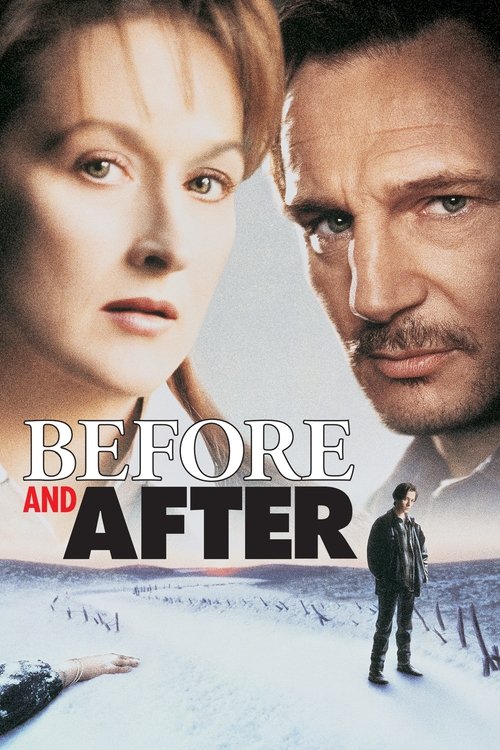
Before and After
Two parents deal with the effects when their son is accused of murdering his girlfriend.
The film commercial failure against its mid-range budget of $35.0M, earning $8.8M globally (-75% loss). While initial box office returns were modest, the film has gained appreciation for its compelling narrative within the crime genre.


Plot Structure
Story beats plotted across runtime


Narrative Arc
Emotional journey through the story's key moments
Story Circle
Blueprint 15-beat structure
Arcplot Score Breakdown
Weighted: Precision (70%) + Arc (15%) + Theme (15%)
Before and After (1996) showcases meticulously timed narrative architecture, characteristic of Barbet Schroeder's storytelling approach. This structural analysis examines how the film's 15-point plot structure maps to proven narrative frameworks across 1 hour and 48 minutes. With an Arcplot score of 7.4, the film balances conventional beats with creative variation.
Characters
Cast & narrative archetypes

Carolyn Ryan
Ben Ryan
Jacob Ryan
Judith Ryan
Panos Demeris
Fran Conklin
Main Cast & Characters
Carolyn Ryan
Played by Meryl Streep
A successful pediatrician and mother who struggles to protect her son while maintaining her moral compass when he's accused of murder.
Ben Ryan
Played by Liam Neeson
A sculptor and father who takes extreme measures to protect his family, including destroying evidence and lying to authorities.
Jacob Ryan
Played by Edward Furlong
A teenage son accused of murdering his girlfriend, struggling with trauma and memory loss about the night of the crime.
Judith Ryan
Played by Julia Weldon
The younger daughter of the Ryan family who witnesses the family's unraveling and struggles with divided loyalties.
Panos Demeris
Played by Alfred Molina
The defense attorney hired to represent Jacob, who must navigate the family's secrets and lies to build a case.
Fran Conklin
Played by Ann Magnuson
The aggressive district attorney determined to prosecute Jacob Ryan for murder.
Structural Analysis
The Status Quo at 2 minutes (1% through the runtime) establishes The Ryan family celebrates in their idyllic New England home. Carolyn (Meryl Streep) is a successful pediatrician, Ben (Liam Neeson) is an accomplished sculptor, their son Jacob is bright and artistic, and daughter Judith plays cello. They appear to be the perfect family in their close-knit community.. Of particular interest, this early placement immediately immerses viewers in the story world.
The inciting incident occurs at 12 minutes when Martha Taverner is found dead in the snow. Police begin investigating what appears to be a murder. The news reaches the Ryan family, and Jacob mysteriously disappears from home, triggering immediate suspicion.. At 11% through the film, this Disruption aligns precisely with traditional story structure. This beat shifts the emotional landscape, launching the protagonist into the central conflict.
The First Threshold at 26 minutes marks the transition into Act II, occurring at 24% of the runtime. This reveals the protagonist's commitment to Ben makes the active choice to hide evidence and lie to police when they come to question the family. Carolyn reluctantly goes along with the deception. They cross the line from innocent parents to accomplices, entering a world of lies and moral compromise., moving from reaction to action.
At 51 minutes, the Midpoint arrives at 48% of the runtime—precisely centered, creating perfect narrative symmetry. Structural examination shows that this crucial beat Jacob is found and returns home, but instead of relief, the family faces a worse reality: Jacob admits he was with Martha when she died but claims it was self-defense after she attacked him. The stakes raise - now they must decide whether to believe him and how to proceed legally., fundamentally raising what's at risk. The emotional intensity shifts, dividing the narrative into clear before-and-after phases.
The Collapse moment at 77 minutes (71% through) represents the emotional nadir. Here, Jacob's full story emerges in devastating detail - Martha was pregnant and during an argument, violence occurred. Whether intentional murder or tragic accident remains ambiguous. The family's attempts to protect him may have destroyed any chance of a fair trial. Ben realizes his actions may have doomed his son rather than saved him., demonstrates the protagonist at their lowest point. This beat's placement in the final quarter sets up the climactic reversal.
The Second Threshold at 85 minutes initiates the final act resolution at 79% of the runtime. Carolyn and Ben realize they must stop trying to control the outcome and instead support Jacob through the truth, whatever it is. They choose honesty and facing consequences over continued deception. They finally unite not in protection, but in acceptance of reality and unconditional love., demonstrating the transformation achieved throughout the journey.
Emotional Journey
Before and After's emotional architecture traces a deliberate progression across 15 carefully calibrated beats.
Narrative Framework
This structural analysis employs proven narrative structure principles that track dramatic progression. By mapping Before and After against these established plot points, we can identify how Barbet Schroeder utilizes or subverts traditional narrative conventions. The plot point approach reveals not only adherence to structural principles but also creative choices that distinguish Before and After within the crime genre.
Barbet Schroeder's Structural Approach
Among the 6 Barbet Schroeder films analyzed on Arcplot, the average structural score is 7.1, reflecting strong command of classical structure. Before and After represents one of the director's most structurally precise works. For comparative analysis, explore the complete Barbet Schroeder filmography.
Comparative Analysis
Additional crime films include The Bad Guys, Rustom and The Whole Ten Yards. For more Barbet Schroeder analyses, see Kiss of Death, Desperate Measures and Murder by Numbers.
Plot Points by Act
Act I
SetupStatus Quo
The Ryan family celebrates in their idyllic New England home. Carolyn (Meryl Streep) is a successful pediatrician, Ben (Liam Neeson) is an accomplished sculptor, their son Jacob is bright and artistic, and daughter Judith plays cello. They appear to be the perfect family in their close-knit community.
Theme
Ben discusses with a colleague the nature of truth in art and life, suggesting that "the truth isn't always what it appears to be" - foreshadowing the moral ambiguity and subjective nature of truth that will define the family's crisis.
Worldbuilding
Establishment of the Ryan family's privileged life in their small Massachusetts town. Jacob's relationship with girlfriend Martha is introduced. The family dynamics show typical teenage rebellion mixed with genuine affection. The community is tight-knit, where everyone knows everyone.
Disruption
Martha Taverner is found dead in the snow. Police begin investigating what appears to be a murder. The news reaches the Ryan family, and Jacob mysteriously disappears from home, triggering immediate suspicion.
Resistance
The family debates how to respond. Ben discovers evidence suggesting Jacob's involvement - bloody clothes and the missing car. Rather than going to police, Ben destroys evidence and attempts to protect his son. Carolyn is initially resistant but paralyzed by maternal instinct versus moral duty.
Act II
ConfrontationFirst Threshold
Ben makes the active choice to hide evidence and lie to police when they come to question the family. Carolyn reluctantly goes along with the deception. They cross the line from innocent parents to accomplices, entering a world of lies and moral compromise.
Mirror World
Attorney Panos Demeris is introduced as the family's legal counsel. He represents the "by the book" moral perspective and the rule of law, contrasting sharply with Ben's vigilante protection. His presence forces the family to confront the legal and ethical implications of their choices.
Premise
The promise of the premise: a family torn apart by secrets. The community turns against them. Judith is bullied at school. Jacob remains missing. Ben and Carolyn's marriage strains under the weight of their different coping mechanisms - Ben's aggressive protection versus Carolyn's medical ethics and need for truth.
Midpoint
Jacob is found and returns home, but instead of relief, the family faces a worse reality: Jacob admits he was with Martha when she died but claims it was self-defense after she attacked him. The stakes raise - now they must decide whether to believe him and how to proceed legally.
Opposition
The prosecution builds their case. Evidence mounts against Jacob. The community's hostility intensifies. Ben's earlier destruction of evidence is discovered, potentially making things worse. Carolyn and Ben's marriage deteriorates as they clash over how protective versus honest to be. The Taverner family's grief adds emotional weight.
Collapse
Jacob's full story emerges in devastating detail - Martha was pregnant and during an argument, violence occurred. Whether intentional murder or tragic accident remains ambiguous. The family's attempts to protect him may have destroyed any chance of a fair trial. Ben realizes his actions may have doomed his son rather than saved him.
Crisis
The dark night of the soul. Ben and Carolyn must confront that their son may have killed someone and their own complicity made it worse. Their perfect family image is shattered. They face the loss of Jacob to prison, their marriage, their community standing, and their own moral compass.
Act III
ResolutionSecond Threshold
Carolyn and Ben realize they must stop trying to control the outcome and instead support Jacob through the truth, whatever it is. They choose honesty and facing consequences over continued deception. They finally unite not in protection, but in acceptance of reality and unconditional love.
Synthesis
The trial proceeds. The family testifies truthfully, acknowledging their mistakes. Jacob faces judgment. The resolution is bittersweet - there are consequences for everyone. The family must rebuild on a foundation of painful truth rather than comfortable lies. Reconciliation with community begins slowly.
Transformation
The family, though scarred and changed, remains together. They are no longer the perfect family from the opening but something more real - flawed people who chose truth over comfort. Ben and Carolyn hold each other, having learned that love means accepting reality, not denying it. The transformation is subtle but profound: from innocence to experience, from perfection to authenticity.