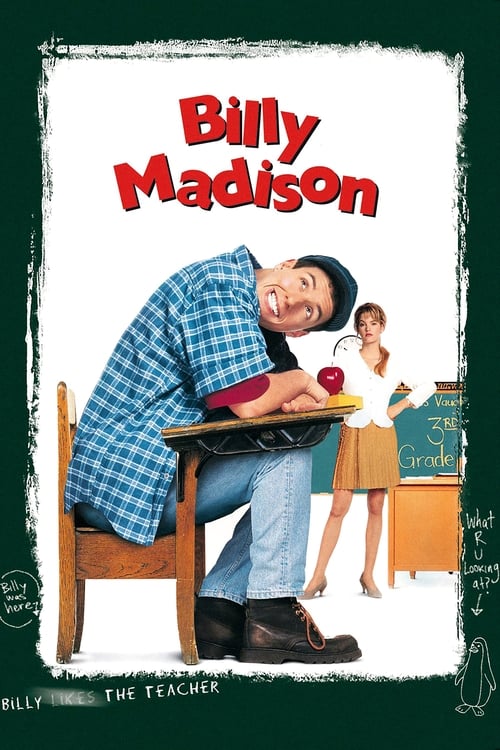
Billy Madison
Billy Madison is the 27 year-old son of Bryan Madison, a very rich man who has made his living in the hotel industry. Billy stands to inherit his father's empire, but only if he can make it through all 12 grades, 2 weeks per grade, to prove that he has what it takes to run the family business.
Despite its limited budget of $10.0M, Billy Madison became a box office success, earning $26.5M worldwide—a 165% return.


Plot Structure
Story beats plotted across runtime


Narrative Arc
Emotional journey through the story's key moments
Story Circle
Blueprint 15-beat structure
Arcplot Score Breakdown
Weighted: Precision (70%) + Arc (15%) + Theme (15%)
Billy Madison (1995) showcases deliberately positioned narrative design, characteristic of Tamra Davis's storytelling approach. This structural analysis examines how the film's 15-point plot structure maps to proven narrative frameworks across 1 hour and 30 minutes. With an Arcplot score of 7.3, the film balances conventional beats with creative variation.
Characters
Cast & narrative archetypes

Billy Madison
Veronica Vaughn
Eric Gordon
Brian Madison
Frank
Principal Max Anderson
Main Cast & Characters
Billy Madison
Played by Adam Sandler
A lazy, immature 27-year-old heir who must repeat grades 1-12 to prove he can run his father's hotel empire.
Veronica Vaughn
Played by Bridgette Wilson-Sampras
A compassionate third-grade teacher who initially dismisses Billy but becomes his love interest and moral compass.
Eric Gordon
Played by Bradley Whitford
A ruthless, ambitious executive who manipulates his way toward controlling Madison Hotels and serves as Billy's primary antagonist.
Brian Madison
Played by Darren McGavin
Billy's wealthy father and hotel magnate who challenges his son to prove his worth before handing over the company.
Frank
Played by Norm Macdonald
Billy's loyal butler and surrogate father figure who supports him throughout his educational journey.
Principal Max Anderson
Played by Josh Mostel
The high school principal who becomes an unlikely ally and mentor to Billy during his final academic challenge.
Structural Analysis
The Status Quo at 1 minutes (1% through the runtime) establishes Billy Madison lounges by the pool at his father's mansion, living a life of lazy luxury as an immature 27-year-old heir who has never had to work or grow up.. Significantly, this early placement immediately immerses viewers in the story world.
The inciting incident occurs at 10 minutes when Billy's father announces he's handing the company to Eric Gordon instead of Billy, revealing that he bribed teachers to pass Billy through school, exposing Billy's achievements as fraudulent.. At 11% through the film, this Disruption aligns precisely with traditional story structure. This beat shifts the emotional landscape, launching the protagonist into the central conflict.
The First Threshold at 22 minutes marks the transition into Act II, occurring at 24% of the runtime. This indicates the protagonist's commitment to Billy makes the active choice to start first grade, entering the world of elementary school as an adult student, committing to genuine personal growth for the first time., moving from reaction to action.
At 44 minutes, the Midpoint arrives at 49% of the runtime—precisely centered, creating perfect narrative symmetry. The analysis reveals that this crucial beat Billy successfully reaches high school and wins Veronica's respect and affection, appearing to have achieved his goal. False victory—he seems to be succeeding but Eric is plotting against him., fundamentally raising what's at risk. The emotional intensity shifts, dividing the narrative into clear before-and-after phases.
The Collapse moment at 65 minutes (72% through) represents the emotional nadir. Here, Billy's elementary school principal commits suicide after Eric blackmails him about the original bribery, creating a literal "whiff of death" and devastating Billy with guilt and failure., demonstrates the protagonist at their lowest point. This beat's placement in the final quarter sets up the climactic reversal.
The Second Threshold at 71 minutes initiates the final act resolution at 79% of the runtime. Billy realizes Eric is the true villain and chooses to confront him not just for the company but to genuinely prove his growth. He synthesizes his newfound maturity with determination to do the right thing., demonstrating the transformation achieved throughout the journey.
Emotional Journey
Billy Madison's emotional architecture traces a deliberate progression across 15 carefully calibrated beats.
Narrative Framework
This structural analysis employs a 15-point narrative structure framework that maps key story moments. By mapping Billy Madison against these established plot points, we can identify how Tamra Davis utilizes or subverts traditional narrative conventions. The plot point approach reveals not only adherence to structural principles but also creative choices that distinguish Billy Madison within the comedy genre.
Tamra Davis's Structural Approach
Among the 4 Tamra Davis films analyzed on Arcplot, the average structural score is 6.8, demonstrating varied approaches to story architecture. Billy Madison represents one of the director's most structurally precise works. For comparative analysis, explore the complete Tamra Davis filmography.
Comparative Analysis
Additional comedy films include The Bad Guys, Ella Enchanted and The Evening Star. For more Tamra Davis analyses, see CB4, Crossroads and Half Baked.
Plot Points by Act
Act I
SetupStatus Quo
Billy Madison lounges by the pool at his father's mansion, living a life of lazy luxury as an immature 27-year-old heir who has never had to work or grow up.
Theme
Billy's father tells him he has "wasted his life" and never truly earned anything, establishing the theme that real achievement requires genuine effort and growth.
Worldbuilding
Introduction to Billy's privileged but empty life, his father's hotel empire, sleazy VP Eric Gordon positioned to take over the company, and Billy's complete unsuitability for responsibility.
Disruption
Billy's father announces he's handing the company to Eric Gordon instead of Billy, revealing that he bribed teachers to pass Billy through school, exposing Billy's achievements as fraudulent.
Resistance
Billy debates whether he can actually go back to school and prove himself. He negotiates with his father for a chance to redo grades 1-12 in two-week intervals to earn the company legitimately.
Act II
ConfrontationFirst Threshold
Billy makes the active choice to start first grade, entering the world of elementary school as an adult student, committing to genuine personal growth for the first time.
Mirror World
Billy meets third-grade teacher Veronica Vaughn, who represents maturity, authenticity, and earned respect—everything Billy lacks but needs to become.
Premise
Billy experiences the "fun and games" of an adult going through grade school—initially humiliated but gradually connecting with kids, learning actual lessons, and slowly maturing while pursuing Veronica.
Midpoint
Billy successfully reaches high school and wins Veronica's respect and affection, appearing to have achieved his goal. False victory—he seems to be succeeding but Eric is plotting against him.
Opposition
Eric Gordon escalates his schemes to undermine Billy, pressures mount as Billy struggles with actual high school academics, and his old immature tendencies threaten his progress.
Collapse
Billy's elementary school principal commits suicide after Eric blackmails him about the original bribery, creating a literal "whiff of death" and devastating Billy with guilt and failure.
Crisis
Billy spirals into darkness, feeling responsible for the principal's death, questioning whether his quest was worth the cost, and nearly abandoning his journey toward maturity.
Act III
ResolutionSecond Threshold
Billy realizes Eric is the true villain and chooses to confront him not just for the company but to genuinely prove his growth. He synthesizes his newfound maturity with determination to do the right thing.
Synthesis
Billy faces Eric in an academic decathlon, demonstrates real knowledge and growth, exposes Eric's corruption, and wins through genuine effort rather than privilege or shortcuts.
Transformation
Billy declines to take over Madison Hotels, instead choosing to go to college—proving his transformation is complete. He now values genuine achievement over inherited wealth, the opposite of his opening image.