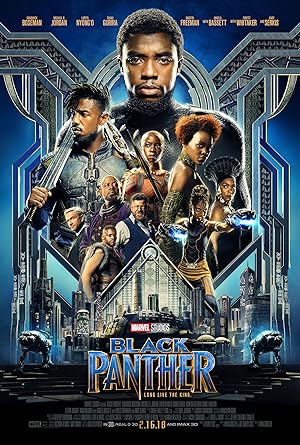
Black Panther
After the events of Captain America: Civil War, Prince T'Challa returns home to the reclusive, technologically advanced African nation of Wakanda to serve as his country's new king. However, T'Challa soon finds that he is challenged for the throne from factions within his own country. When two foes conspire to destroy Wakanda, the hero known as Black Panther must team up with C.I.A. agent Everett K. Ross and members of the Dora Milaje, Wakandan special forces, to prevent Wakanda from being dragged into a world war.
Despite a major studio investment of $200.0M, Black Panther became a runaway success, earning $1349.9M worldwide—a remarkable 575% return. This commercial performance validated the ambitious narrative scope, proving that audiences embrace compelling narrative even at blockbuster scale.
3 Oscars. 124 wins & 289 nominations


Plot Structure
Story beats plotted across runtime


Narrative Arc
Emotional journey through the story's key moments
Story Circle
Blueprint 15-beat structure
Arcplot Score Breakdown
Weighted: Precision (70%) + Arc (15%) + Theme (15%)
Black Panther (2018) reveals meticulously timed plot construction, characteristic of Ryan Coogler's storytelling approach. This structural analysis examines how the film's 15-point plot structure maps to proven narrative frameworks across 2 hours and 15 minutes. With an Arcplot score of 6.8, the film balances conventional beats with creative variation.
Characters
Cast & narrative archetypes

T'Challa / Black Panther
Erik Killmonger
Nakia
Okoye
Shuri
Ramonda
W'Kabi
Everett Ross
Ulysses Klaue
M'Baku
Main Cast & Characters
T'Challa / Black Panther
Played by Chadwick Boseman
Prince of Wakanda who must take the throne after his father's death and defend his nation from internal and external threats.
Erik Killmonger
Played by Michael B. Jordan
T'Challa's cousin seeking revenge and the Wakandan throne, driven by his painful past and radical vision for Wakanda's future.
Nakia
Played by Lupita Nyong'o
Wakandan spy and T'Challa's former lover who advocates for Wakanda to share its resources with the oppressed world.
Okoye
Played by Danai Gurira
Fiercely loyal general of the Dora Milaje who struggles between duty to the throne and loyalty to her king.
Shuri
Played by Letitia Wright
T'Challa's brilliant younger sister and chief of Wakandan technology who provides gadgets and wisdom with humor.
Ramonda
Played by Angela Bassett
Queen Mother of Wakanda who guides her children through grief and political turmoil with strength and grace.
W'Kabi
Played by Daniel Kaluuya
Head of Wakandan security and T'Challa's friend who becomes disillusioned and sides with Killmonger's vision.
Everett Ross
Played by Martin Freeman
CIA agent who aids T'Challa and becomes an unlikely ally to Wakanda during the crisis.
Ulysses Klaue
Played by Andy Serkis
South African arms dealer and smuggler obsessed with Wakandan vibranium and chaos.
M'Baku
Played by Winston Duke
Leader of the Jabari tribe who challenges T'Challa but ultimately proves honorable and crucial to saving Wakanda.
Structural Analysis
The Status Quo at 1 minutes (1% through the runtime) establishes 1992 Oakland - Young T'Chaka tells young N'Jobu a story about Wakanda and the Black Panther, establishing the hidden utopian nation and its traditions. Shows the world before T'Challa's kingship.. The analysis reveals that this early placement immediately immerses viewers in the story world.
The inciting incident occurs at 17 minutes when M'Baku challenges T'Challa for the throne at the coronation ceremony. T'Challa must fight without the power of the Black Panther, facing immediate threat to his claim as king and forcing him to prove himself.. At 13% through the film, this Disruption is delayed, allowing extended setup of the story world. This beat shifts the emotional landscape, launching the protagonist into the central conflict.
The First Threshold at 35 minutes marks the transition into Act II, occurring at 26% of the runtime. This shows the protagonist's commitment to T'Challa decides to leave Wakanda and pursue Klaue in Busan, South Korea. This active choice to venture into the outside world marks his commitment to a different kind of kingship than his father's total isolation., moving from reaction to action.
At 68 minutes, the Midpoint arrives at 50% of the runtime—precisely centered, creating perfect narrative symmetry. Significantly, this crucial beat Killmonger rescues Klaue and kills him, bringing his body to Wakanda. Killmonger reveals himself as N'Jadaka, son of N'Jobu, the lost prince. A false defeat - T'Challa's mission fails and a legitimate challenger appears with a claim to the throne., fundamentally raising what's at risk. The emotional intensity shifts, dividing the narrative into clear before-and-after phases.
The Collapse moment at 102 minutes (76% through) represents the emotional nadir. Here, T'Challa, defeated and thrown from the waterfall, is left for dead. The whiff of death is literal - he appears to have drowned. His kingship, his mission, and his life seem over as Killmonger takes the throne and begins his war., indicates the protagonist at their lowest point. This beat's placement in the final quarter sets up the climactic reversal.
The Second Threshold at 107 minutes initiates the final act resolution at 79% of the runtime. T'Challa tells his father "You were wrong to turn your back on the rest of the world." He synthesizes the lesson - Wakanda must help, but through compassion, not Killmonger's conquest. Returns to challenge Killmonger with new understanding and purpose., demonstrating the transformation achieved throughout the journey.
Emotional Journey
Black Panther's emotional architecture traces a deliberate progression across 15 carefully calibrated beats.
Narrative Framework
This structural analysis employs systematic plot point analysis that identifies crucial turning points. By mapping Black Panther against these established plot points, we can identify how Ryan Coogler utilizes or subverts traditional narrative conventions. The plot point approach reveals not only adherence to structural principles but also creative choices that distinguish Black Panther within the action genre.
Ryan Coogler's Structural Approach
Among the 4 Ryan Coogler films analyzed on Arcplot, the average structural score is 6.7, demonstrating varied approaches to story architecture. Black Panther represents one of the director's most structurally precise works. For comparative analysis, explore the complete Ryan Coogler filmography.
Comparative Analysis
Additional action films include The Bad Guys, Puss in Boots and Venom: The Last Dance. For more Ryan Coogler analyses, see Fruitvale Station, Creed and Black Panther: Wakanda Forever.
Plot Points by Act
Act I
SetupStatus Quo
1992 Oakland - Young T'Chaka tells young N'Jobu a story about Wakanda and the Black Panther, establishing the hidden utopian nation and its traditions. Shows the world before T'Challa's kingship.
Theme
T'Chaka confronts N'Jobu: "You are a prince of Wakanda who has stolen vibranium... you are an outsider." The central question is stated: What is Wakanda's responsibility to the outside world? Isolationism vs intervention.
Worldbuilding
Introduces present-day Wakanda, T'Challa as new king after T'Chaka's death (Civil War), the tribal structure, advanced technology hidden from the world, Shuri's lab, the Dora Milaje, and the coronation ceremony traditions.
Disruption
M'Baku challenges T'Challa for the throne at the coronation ceremony. T'Challa must fight without the power of the Black Panther, facing immediate threat to his claim as king and forcing him to prove himself.
Resistance
T'Challa defeats M'Baku and becomes king. Klaue resurfaces, prompting debate about breaking Wakanda's isolationist stance. T'Challa grapples with his father's legacy and whether to pursue Klaue outside Wakanda's borders.
Act II
ConfrontationFirst Threshold
T'Challa decides to leave Wakanda and pursue Klaue in Busan, South Korea. This active choice to venture into the outside world marks his commitment to a different kind of kingship than his father's total isolation.
Mirror World
T'Challa reunites with Nakia in Busan. She represents the thematic counterpoint - an outward-focused War Dog who believes Wakanda should help the world. Their relationship embodies the isolationism vs intervention debate.
Premise
The promise of the premise: Black Panther in action in the outside world. Busan casino infiltration and car chase, capturing Klaue, T'Challa working with CIA (Ross), showcasing Wakandan technology and warrior skills on the global stage.
Midpoint
Killmonger rescues Klaue and kills him, bringing his body to Wakanda. Killmonger reveals himself as N'Jadaka, son of N'Jobu, the lost prince. A false defeat - T'Challa's mission fails and a legitimate challenger appears with a claim to the throne.
Opposition
Killmonger challenges for the throne. T'Challa faces his family's sins as the truth about N'Jobu emerges. In ritual combat, Killmonger defeats T'Challa and throws him over the waterfall, apparently killing him. Killmonger becomes king and orders Wakanda's weapons sent worldwide.
Collapse
T'Challa, defeated and thrown from the waterfall, is left for dead. The whiff of death is literal - he appears to have drowned. His kingship, his mission, and his life seem over as Killmonger takes the throne and begins his war.
Crisis
T'Challa, rescued by M'Baku, recovers in the snow with the Jabari tribe. He journeys to the ancestral plane, confronting his father about the lie of Wakanda's righteousness. Dark night of processing his family's sins and finding new purpose.
Act III
ResolutionSecond Threshold
T'Challa tells his father "You were wrong to turn your back on the rest of the world." He synthesizes the lesson - Wakanda must help, but through compassion, not Killmonger's conquest. Returns to challenge Killmonger with new understanding and purpose.
Synthesis
T'Challa returns, rallies allies (Nakia, Shuri, Okoye, M'Baku, Ross). Civil war erupts in Wakanda. Final battle combines Wakandan tradition with the outside world's needs. T'Challa defeats Killmonger, who chooses death over bondage, echoing ancestors' choice.
Transformation
T'Challa addresses the United Nations, revealing Wakanda to the world. The closing image mirrors the opening - but now Wakanda shares instead of hides. T'Challa has transformed from an isolationist heir into a king who bridges worlds.