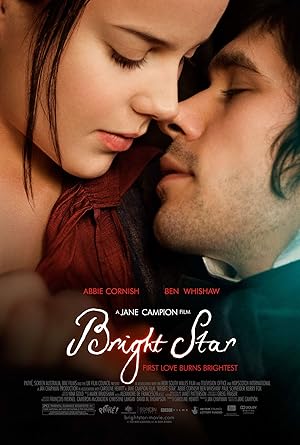
Bright Star
It's 1818 in Hampstead Village on the outskirts of London. Poet Charles Brown lives in one half of a house, the Dilkes family the other. Through association with the Dilkes, the fatherless Brawne family knows Mr. Brown. Mr. Brown and the Brawne's eldest daughter, Fanny, don't like each other. She thinks him arrogant and rude; he feels that she's a pretentious flirt, knowing only how to sew (admittedly well as she makes all her own fashionable clothes), and voicing opinions on subjects about which she knows nothing. Insecure struggling poet John Keats comes to live with his friend, Mr. Brown. Miss Brawne and Mr. Keats have a mutual attraction to each other, but their relationship is slow to develop, in part, since Mr. Brown does whatever he can to keep the two apart. Other obstacles face the couple, including their eventual overwhelming passion for each other clouding their view of what the other does, Mr. Keats' struggling career, which offers him little in the way of monetary security (which will lead to Mrs. Brawne not giving consent for them to marry), and health issues which had earlier taken the life of Mr. Keats' brother, Tom.
Working with a tight budget of $10.0M, the film achieved a modest success with $14.4M in global revenue (+44% profit margin).
Nominated for 1 Oscar. 16 wins & 54 nominations


Plot Structure
Story beats plotted across runtime


Narrative Arc
Emotional journey through the story's key moments
Story Circle
Blueprint 15-beat structure
Arcplot Score Breakdown
Weighted: Precision (70%) + Arc (15%) + Theme (15%)
Bright Star (2009) exemplifies carefully calibrated story structure, characteristic of Jane Campion's storytelling approach. This structural analysis examines how the film's 15-point plot structure maps to proven narrative frameworks across 1 hour and 59 minutes. With an Arcplot score of 7.4, the film balances conventional beats with creative variation.
Characters
Cast & narrative archetypes

Fanny Brawne
John Keats
Charles Armitage Brown
Mrs. Brawne
Toots Brawne
Main Cast & Characters
Fanny Brawne
Played by Abbie Cornish
A spirited young woman passionate about fashion and needlework who falls deeply in love with John Keats despite her family's concerns about his financial prospects.
John Keats
Played by Ben Whishaw
A struggling Romantic poet in fragile health, devoted to his art and tormented by poverty, who experiences profound love with Fanny Brawne.
Charles Armitage Brown
Played by Paul Schneider
Keats' protective friend, mentor, and housemate who disapproves of the poet's relationship with Fanny, believing it distracts from his work.
Mrs. Brawne
Played by Kerry Fox
Fanny's pragmatic widowed mother who initially opposes the romance due to Keats' poverty but gradually softens to his genuine character.
Toots Brawne
Played by Thomas Sangster
Fanny's younger brother who befriends Keats and serves as an innocent go-between for the lovers.
Structural Analysis
The Status Quo at 2 minutes (2% through the runtime) establishes Fanny Brawne sews elaborate fashions in her room, demonstrating her artistic nature and creative spirit but living a constrained life in Regency England with no knowledge of poetry or deeper artistic expression.. Of particular interest, this early placement immediately immerses viewers in the story world.
The inciting incident occurs at 14 minutes when Fanny asks Keats to teach her about poetry. This curiosity disrupts her practical, fashion-focused world and creates the opportunity for connection with the impoverished poet she previously dismissed.. At 12% through the film, this Disruption aligns precisely with traditional story structure. This beat shifts the emotional landscape, launching the protagonist into the central conflict.
The First Threshold at 29 minutes marks the transition into Act II, occurring at 24% of the runtime. This reveals the protagonist's commitment to Fanny and Keats acknowledge their love for each other. Fanny actively chooses to pursue this relationship despite the social and financial obstacles, entering a world of romantic devotion that defies practicality., moving from reaction to action.
At 60 minutes, the Midpoint arrives at 50% of the runtime—precisely centered, creating perfect narrative symmetry. Significantly, this crucial beat Keats begins showing clear signs of tuberculosis (coughing blood). What seemed like a delayed but eventual happy ending now becomes threatened. The stakes shift from "when can we marry?" to "will we have time at all?" False victory becomes false defeat., fundamentally raising what's at risk. The emotional intensity shifts, dividing the narrative into clear before-and-after phases.
The Collapse moment at 89 minutes (75% through) represents the emotional nadir. Here, Keats departs for Italy, knowing he will die there. The lovers' final parting is a death—of their dreams, their future, their physical connection. Fanny is left behind, her entire identity now bound to someone she will never see again., reveals the protagonist at their lowest point. This beat's placement in the final quarter sets up the climactic reversal.
The Second Threshold at 96 minutes initiates the final act resolution at 81% of the runtime. News arrives: Keats has died in Rome. The abstract fear becomes concrete fact. Fanny must now synthesize her grief into understanding—that their love, preserved in his poetry and her memory, has become immortal even as his body failed., demonstrating the transformation achieved throughout the journey.
Emotional Journey
Bright Star's emotional architecture traces a deliberate progression across 15 carefully calibrated beats.
Narrative Framework
This structural analysis employs proven narrative structure principles that track dramatic progression. By mapping Bright Star against these established plot points, we can identify how Jane Campion utilizes or subverts traditional narrative conventions. The plot point approach reveals not only adherence to structural principles but also creative choices that distinguish Bright Star within the biography genre.
Jane Campion's Structural Approach
Among the 3 Jane Campion films analyzed on Arcplot, the average structural score is 6.9, demonstrating varied approaches to story architecture. Bright Star represents one of the director's most structurally precise works. For comparative analysis, explore the complete Jane Campion filmography.
Comparative Analysis
Additional biography films include After Thomas, Taking Woodstock and The Fire Inside. For more Jane Campion analyses, see The Piano, In the Cut.
Plot Points by Act
Act I
SetupStatus Quo
Fanny Brawne sews elaborate fashions in her room, demonstrating her artistic nature and creative spirit but living a constrained life in Regency England with no knowledge of poetry or deeper artistic expression.
Theme
Keats tells Fanny that poetry "should be great and unobtrusive, a thing which enters into one's soul." This articulates the film's theme about how profound love and art become part of one's very being.
Worldbuilding
Establishment of the Keats-Brown household next to the Brawnes, the literary circle including Charles Brown, Fanny's initial dismissal of poetry as pretentious, and the class/economic tensions that permeate their world.
Disruption
Fanny asks Keats to teach her about poetry. This curiosity disrupts her practical, fashion-focused world and creates the opportunity for connection with the impoverished poet she previously dismissed.
Resistance
Keats becomes Fanny's poetry tutor. They debate art versus craft, share walks and conversations. Fanny begins to understand poetry's emotional depth. Charles Brown warns against the attachment, citing Keats's poverty and ill health.
Act II
ConfrontationFirst Threshold
Fanny and Keats acknowledge their love for each other. Fanny actively chooses to pursue this relationship despite the social and financial obstacles, entering a world of romantic devotion that defies practicality.
Mirror World
The lovers become secretly engaged. Their relationship becomes the "Mirror World" that carries the theme—Fanny learning that love, like poetry, is something that enters one's soul and transforms identity.
Premise
The promise of romantic love: stolen moments, secret meetings, passionate letters, Fanny creating beautiful things for Keats. They exist in the liminal space of engagement without marriage, devotion without consummation—the sweet agony the audience came to experience.
Midpoint
Keats begins showing clear signs of tuberculosis (coughing blood). What seemed like a delayed but eventual happy ending now becomes threatened. The stakes shift from "when can we marry?" to "will we have time at all?" False victory becomes false defeat.
Opposition
Keats's health deteriorates. Financial pressures intensify. Brown's antagonism toward Fanny increases. The lovers face the cruel reality that their devotion cannot overcome mortality. Every meeting becomes bittersweet, shadowed by impending loss.
Collapse
Keats departs for Italy, knowing he will die there. The lovers' final parting is a death—of their dreams, their future, their physical connection. Fanny is left behind, her entire identity now bound to someone she will never see again.
Crisis
Fanny retreats into isolation and grief. She wears mourning, walks the landscape they shared, reads his letters obsessively. She processes the dark night of losing her beloved while he still lives, unreachable across the sea.
Act III
ResolutionSecond Threshold
News arrives: Keats has died in Rome. The abstract fear becomes concrete fact. Fanny must now synthesize her grief into understanding—that their love, preserved in his poetry and her memory, has become immortal even as his body failed.
Synthesis
Fanny walks through the seasons of her grief. She finally understands what Keats meant about poetry entering one's soul—their love has become inseparable from her being, living on through his words and her remembrance, achieving permanence through art.
Transformation
Fanny recites "Bright Star" while walking through a sunlit field. She is no longer the girl who dismissed poetry—she has become the living embodiment of the poem, transformed by love into something eternal. Art and love have merged in her soul.