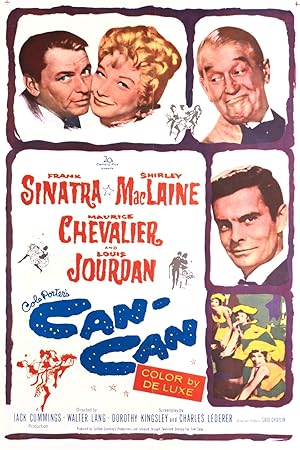
Can-Can
Montmartre, 1896: the Can-Can, the dance in which the women lift their skirts, is forbidden. Nevertheless, Simone has it performed every day in her nightclub. Her employees use their female charms to let the representatives of law enforcement look the other way - and even attend the shows. Then the young ambitious judge Philippe Forrestier decides to bring this to an end. Will Simone manage to twist him round her little finger too? Her boyfriend, Francois, certainly doesn't like to watch her trying.
Working with a modest budget of $5.0M, the film achieved a respectable showing with $8.4M in global revenue (+68% profit margin).


Plot Structure
Story beats plotted across runtime


Narrative Arc
Emotional journey through the story's key moments
Story Circle
Blueprint 15-beat structure
Arcplot Score Breakdown
Weighted: Precision (70%) + Arc (15%) + Theme (15%)
Can-Can (1960) reveals deliberately positioned dramatic framework, characteristic of Walter Lang's storytelling approach. This structural analysis examines how the film's 15-point plot structure maps to proven narrative frameworks across 2 hours and 22 minutes. With an Arcplot score of 6.9, the film balances conventional beats with creative variation.
Characters
Cast & narrative archetypes

Simone Pistache
François Durnais
Paul Barriere
Claudine
Philippe Forrestier
Main Cast & Characters
Simone Pistache
Played by Shirley MacLaine
A vivacious Parisian nightclub owner who runs a dance hall featuring the scandalous can-can, fighting to preserve her business and lifestyle.
François Durnais
Played by Frank Sinatra
A moralistic lawyer initially tasked with shutting down Simone's establishment who becomes romantically entangled with her.
Paul Barriere
Played by Maurice Chevalier
A sophisticated judge and François's mentor who also falls for Simone, creating a romantic triangle.
Claudine
Played by Juliet Prowse
A spirited can-can dancer at Simone's establishment who becomes romantically involved with François.
Philippe Forrestier
Played by Louis Jourdan
A wealthy art critic and Simone's former lover who remains in her social circle.
Structural Analysis
The Status Quo at 1 minutes (1% through the runtime) establishes Simone Pistache runs her lively Montmartre dance hall where the scandalous can-can is performed, defying Paris morality laws with charm and audacity.. Notably, this early placement immediately immerses viewers in the story world.
The inciting incident occurs at 16 minutes when Judge Philipe Forrestier is assigned to investigate and prosecute Simone's establishment for performing the illegal can-can, threatening to shut down her livelihood.. At 11% through the film, this Disruption aligns precisely with traditional story structure. This beat shifts the emotional landscape, launching the protagonist into the central conflict.
The First Threshold at 33 minutes marks the transition into Act II, occurring at 23% of the runtime. This indicates the protagonist's commitment to Simone decides to personally meet Judge Forrestier and charm him into understanding the artistic merit of the can-can, actively choosing seduction over legal defense., moving from reaction to action.
At 71 minutes, the Midpoint arrives at 50% of the runtime—precisely centered, creating perfect narrative symmetry. Of particular interest, this crucial beat False victory: Philipe falls deeply in love with Simone and seems willing to abandon his moral crusade, suggesting everything will work out through romance., fundamentally raising what's at risk. The emotional intensity shifts, dividing the narrative into clear before-and-after phases.
The Collapse moment at 104 minutes (73% through) represents the emotional nadir. Here, Philipe must prosecute Simone in court despite his love for her, forcing her to stand trial. Her freedom and livelihood face death; their relationship appears doomed., illustrates the protagonist at their lowest point. This beat's placement in the final quarter sets up the climactic reversal.
The Second Threshold at 112 minutes initiates the final act resolution at 79% of the runtime. Simone realizes she must demonstrate the can-can's artistic merit directly in court, synthesizing her passion for art with the need for social acceptance and legal vindication., demonstrating the transformation achieved throughout the journey.
Emotional Journey
Can-Can's emotional architecture traces a deliberate progression across 15 carefully calibrated beats.
Narrative Framework
This structural analysis employs a 15-point narrative structure framework that maps key story moments. By mapping Can-Can against these established plot points, we can identify how Walter Lang utilizes or subverts traditional narrative conventions. The plot point approach reveals not only adherence to structural principles but also creative choices that distinguish Can-Can within the comedy genre.
Walter Lang's Structural Approach
Among the 3 Walter Lang films analyzed on Arcplot, the average structural score is 7.1, reflecting strong command of classical structure. Can-Can takes a more unconventional approach compared to the director's typical style. For comparative analysis, explore the complete Walter Lang filmography.
Comparative Analysis
Additional comedy films include The Bad Guys, Ella Enchanted and The Evening Star. For more Walter Lang analyses, see The King and I, There's No Business Like Show Business.
Plot Points by Act
Act I
SetupStatus Quo
Simone Pistache runs her lively Montmartre dance hall where the scandalous can-can is performed, defying Paris morality laws with charm and audacity.
Theme
Paul Barriere, an elderly judge, observes that true art and freedom cannot be suppressed by outdated laws - foreshadowing the film's central conflict between propriety and authenticity.
Worldbuilding
Establishing the world of Montmartre nightlife: Simone's independent spirit, her relationship with lawyer François Durnais, the vibrant can-can performances, and the tension with Paris authorities.
Disruption
Judge Philipe Forrestier is assigned to investigate and prosecute Simone's establishment for performing the illegal can-can, threatening to shut down her livelihood.
Resistance
François attempts to protect Simone by getting close to the judge. Simone debates how to handle the investigation - through legal means, charm, or defiance. The judge proves incorruptible.
Act II
ConfrontationFirst Threshold
Simone decides to personally meet Judge Forrestier and charm him into understanding the artistic merit of the can-can, actively choosing seduction over legal defense.
Mirror World
The romantic relationship between Simone and Philipe begins to develop, representing the thematic tension between duty/propriety and passion/freedom.
Premise
The fun of the premise: Simone navigates a romantic quadrangle with Philipe, François, and artist Boris, while continuing to run her establishment under the judge's nose with elaborate musical numbers.
Midpoint
False victory: Philipe falls deeply in love with Simone and seems willing to abandon his moral crusade, suggesting everything will work out through romance.
Opposition
Complications intensify: jealousies flare among the romantic rivals, Philipe's professional duty conflicts with his personal feelings, and pressure mounts from authorities to enforce the law.
Collapse
Philipe must prosecute Simone in court despite his love for her, forcing her to stand trial. Her freedom and livelihood face death; their relationship appears doomed.
Crisis
Dark night: Simone faces the reality that she may lose everything - her business, her art form, and the man she loves - all because she refused to compromise her authentic self.
Act III
ResolutionSecond Threshold
Simone realizes she must demonstrate the can-can's artistic merit directly in court, synthesizing her passion for art with the need for social acceptance and legal vindication.
Synthesis
The trial becomes a showcase: Simone and her dancers perform the can-can in court, winning over the jury and public opinion. Philipe reconciles duty with heart, and romantic entanglements resolve.
Transformation
Final image mirrors the opening: Simone's dance hall thrives, now legitimized and celebrated, with her personal freedom intact and true love secured - authenticity has triumphed over repression.