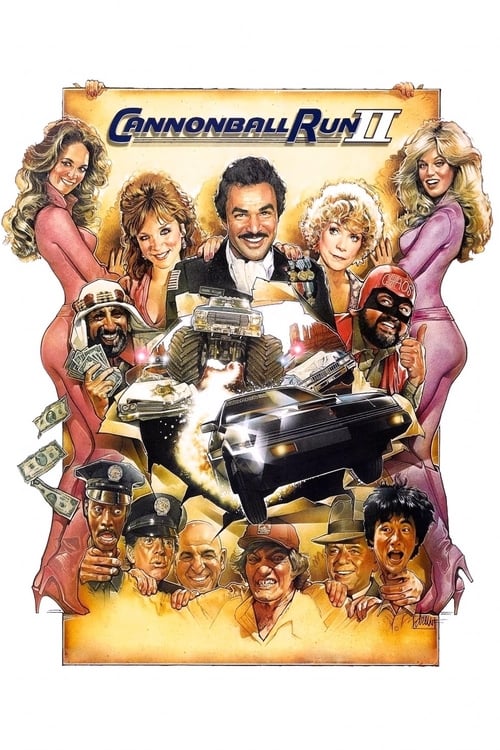
Cannonball Run II
When a wealthy sheikh puts up $1 million in prize money for a cross-country car race, there is one person crazy enough to hit the road hard with wheels spinning fast. Legendary driver J.J. McClure enters the competition along with his friend Victor and together they set off across the American landscape in a madcap action-adventure destined to test their wits and automobile skills.
Despite a moderate budget of $20.0M, Cannonball Run II became a commercial success, earning $56.3M worldwide—a 181% return.
1 win & 8 nominations


Plot Structure
Story beats plotted across runtime


Narrative Arc
Emotional journey through the story's key moments
Story Circle
Blueprint 15-beat structure
Arcplot Score Breakdown
Weighted: Precision (70%) + Arc (15%) + Theme (15%)
Cannonball Run II (1984) exemplifies strategically placed story structure, characteristic of Hal Needham's storytelling approach. This structural analysis examines how the film's 15-point plot structure maps to proven narrative frameworks across 1 hour and 48 minutes. With an Arcplot score of 7.7, the film showcases strong structural fundamentals.
Characters
Cast & narrative archetypes

J.J. McClure
Victor Prinzim / Captain Chaos
Sheik Abdul ben Falafel
Blake
Jill Rivers
Marcie
King
Don
Veronica
Betty
Main Cast & Characters
J.J. McClure
Played by Burt Reynolds
Race car driver and team captain who leads his crew in the cross-country race.
Victor Prinzim / Captain Chaos
Played by Dom DeLuise
J.J.'s sidekick who transforms into the superhero persona Captain Chaos.
Sheik Abdul ben Falafel
Played by Dean Martin
Wealthy Middle Eastern sheik who sponsors the race and joins the adventure.
Blake
Played by Sammy Davis Jr.
The Sheik's partner and fellow racer in the competition.
Jill Rivers
Played by Telly Savalas
Beautiful woman who teams up with Marcie for the race.
Marcie
Played by Shirley MacLaine
Jill's racing partner and fellow competitor in the Cannonball Run.
King
Played by Jamie Farr
Don's partner, together they form a competitive racing duo.
Don
Played by Richard Kiel
King's racing partner in the cross-country competition.
Veronica
Played by Susan Anton
Attractive woman who joins the race with her partner Betty.
Betty
Played by Catherine Bach
Veronica's racing partner and fellow attractive competitor.
Structural Analysis
The Status Quo at 2 minutes (2% through the runtime) establishes Opening montage establishes the returning Cannonball racers in their ordinary lives - J.J. McClure and Victor working as stunt drivers, the Sheik in his palace, Fenderbaum at his practice - all successful but restless after their previous race victory.. Structural examination shows that this early placement immediately immerses viewers in the story world.
The inciting incident occurs at 12 minutes when The Sheik's family contacts J.J. And the other racers, revealing the kidnapping. They demand the racers organize another Cannonball Run, which King Abdul will enter, betting that if he wins, he keeps the Sheik and his fortune.. At 12% through the film, this Disruption aligns precisely with traditional story structure. This beat shifts the emotional landscape, launching the protagonist into the central conflict.
The First Threshold at 26 minutes marks the transition into Act II, occurring at 24% of the runtime. This shows the protagonist's commitment to The race officially begins in Connecticut. All teams make the active choice to enter this dangerous competition to save their friend, crossing from their normal lives into the chaos of the cross-country race., moving from reaction to action.
At 54 minutes, the Midpoint arrives at 50% of the runtime—precisely centered, creating perfect narrative symmetry. The analysis reveals that this crucial beat False defeat: King Abdul's team takes a commanding lead through cheating and sabotage. Simultaneously, massive police roadblocks are set up across multiple states. The stakes raise dramatically as both the competition and the law close in., fundamentally raising what's at risk. The emotional intensity shifts, dividing the narrative into clear before-and-after phases.
The Collapse moment at 82 minutes (76% through) represents the emotional nadir. Here, J.J.'s vehicle breaks down catastrophically. With King Abdul near victory, it appears they've lost both the race and the Sheik's life. The dream of saving their friend dies as they sit stranded, defeated., shows the protagonist at their lowest point. This beat's placement in the final quarter sets up the climactic reversal.
The Second Threshold at 87 minutes initiates the final act resolution at 81% of the runtime. The other racers arrive and band together. They realize that by working as a team and combining their resources rather than competing, they can still stop King Abdul. J.J. Synthesizes the film's theme: together they're stronger than apart., demonstrating the transformation achieved throughout the journey.
Emotional Journey
Cannonball Run II's emotional architecture traces a deliberate progression across 15 carefully calibrated beats.
Narrative Framework
This structural analysis employs structural analysis methodology used to understand storytelling architecture. By mapping Cannonball Run II against these established plot points, we can identify how Hal Needham utilizes or subverts traditional narrative conventions. The plot point approach reveals not only adherence to structural principles but also creative choices that distinguish Cannonball Run II within the action genre.
Hal Needham's Structural Approach
Among the 5 Hal Needham films analyzed on Arcplot, the average structural score is 7.5, reflecting strong command of classical structure. Cannonball Run II represents one of the director's most structurally precise works. For comparative analysis, explore the complete Hal Needham filmography.
Comparative Analysis
Additional action films include The Bad Guys, Puss in Boots and Venom: The Last Dance. For more Hal Needham analyses, see Hooper, Smokey and the Bandit and Smokey and the Bandit II.
Plot Points by Act
Act I
SetupStatus Quo
Opening montage establishes the returning Cannonball racers in their ordinary lives - J.J. McClure and Victor working as stunt drivers, the Sheik in his palace, Fenderbaum at his practice - all successful but restless after their previous race victory.
Theme
Victor tells J.J., "It's not about winning, it's about the ride" - establishing the film's theme that the adventure and camaraderie matter more than the destination.
Worldbuilding
Introduction of the ensemble cast and their relationships. We meet returning racers and learn about their dynamics. The Sheik is kidnapped by King Abdul ben Falafel, who wants revenge for losing the first race.
Disruption
The Sheik's family contacts J.J. and the other racers, revealing the kidnapping. They demand the racers organize another Cannonball Run, which King Abdul will enter, betting that if he wins, he keeps the Sheik and his fortune.
Resistance
J.J. and Victor debate whether to risk another illegal cross-country race. They reluctantly contact all the previous racers to recruit them. Some resist, citing the danger and illegality, but friendship and loyalty to the Sheik convince them. Preparation and team assembly montage.
Act II
ConfrontationFirst Threshold
The race officially begins in Connecticut. All teams make the active choice to enter this dangerous competition to save their friend, crossing from their normal lives into the chaos of the cross-country race.
Mirror World
Introduction of Blake and Fenderbaum's relationship subplot. Their bickering partnership mirrors the theme that relationships and teamwork matter more than individual glory in this competition.
Premise
The promise of the premise - wild cross-country racing with outrageous vehicles and costumes. Teams use disguises, tricks, and schemes to gain advantage. Comic encounters with law enforcement, traffic, and each other. The Sheik's captor King Abdul races with his incompetent henchmen.
Midpoint
False defeat: King Abdul's team takes a commanding lead through cheating and sabotage. Simultaneously, massive police roadblocks are set up across multiple states. The stakes raise dramatically as both the competition and the law close in.
Opposition
Teams face increasing obstacles: mechanical failures, police encounters intensify, King Abdul's sabotage escalates. Internal conflicts emerge as stress builds. The military gets involved. J.J.'s team falls further behind while trying to help other racers in trouble.
Collapse
J.J.'s vehicle breaks down catastrophically. With King Abdul near victory, it appears they've lost both the race and the Sheik's life. The dream of saving their friend dies as they sit stranded, defeated.
Crisis
J.J. and the team process their failure in darkness. They reflect on what the race meant - not winning, but the friendships. This moment of introspection helps them realize what they need to do.
Act III
ResolutionSecond Threshold
The other racers arrive and band together. They realize that by working as a team and combining their resources rather than competing, they can still stop King Abdul. J.J. synthesizes the film's theme: together they're stronger than apart.
Synthesis
Finale: All the racers work together in an elaborate plan to stop King Abdul before he crosses the finish line. Multiple teams coordinate in a climactic chase and confrontation. They rescue the Sheik and defeat the villain through teamwork, not individual victory.
Transformation
Closing image: All the racers together celebrating not a race victory, but the rescue of their friend. They laugh and toast each other. Unlike the opening where they were separate and restless, they're now united and fulfilled by friendship over competition.