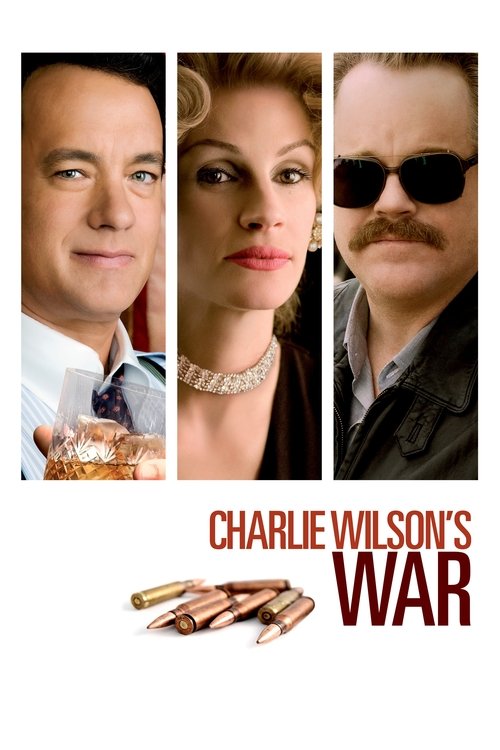
Charlie Wilson's War
A Texas congressman sets a series of events in motion when he conspires with a CIA operative to aid Afghan mujahideen rebels fighting the Soviets.
Working with a considerable budget of $75.0M, the film achieved a respectable showing with $119.5M in global revenue (+59% profit margin).
Nominated for 1 Oscar. 5 wins & 24 nominations


Plot Structure
Story beats plotted across runtime


Narrative Arc
Emotional journey through the story's key moments
Story Circle
Blueprint 15-beat structure
Arcplot Score Breakdown
Weighted: Precision (70%) + Arc (15%) + Theme (15%)
Charlie Wilson's War (2007) showcases strategically placed story structure, characteristic of Mike Nichols's storytelling approach. This structural analysis examines how the film's 15-point plot structure maps to proven narrative frameworks across 1 hour and 42 minutes. With an Arcplot score of 7.2, the film balances conventional beats with creative variation.
Characters
Cast & narrative archetypes

Charlie Wilson
Joanne Herring
Gust Avrakotos
Bonnie Bach
Main Cast & Characters
Charlie Wilson
Played by Tom Hanks
A charismatic Texas congressman who orchestrates covert funding for Afghan mujahideen against the Soviets while living a hedonistic lifestyle.
Joanne Herring
Played by Julia Roberts
A wealthy, conservative Houston socialite and political activist who inspires Charlie to support the Afghan cause.
Gust Avrakotos
Played by Philip Seymour Hoffman
A gruff, no-nonsense CIA operative who becomes Charlie's partner in expanding the covert operation in Afghanistan.
Bonnie Bach
Played by Amy Adams
Charlie Wilson's fiercely loyal and competent congressional aide who helps manage his office and personal affairs.
Structural Analysis
The Status Quo at 1 minutes (1% through the runtime) establishes Charlie Wilson relaxes in a Las Vegas hot tub surrounded by strippers and cocaine, being interviewed about his supposed corruption investigation. This establishes him as a charming, hedonistic Texas congressman who lives large and plays by his own rules.. Significantly, this early placement immediately immerses viewers in the story world.
The inciting incident occurs at 12 minutes when Charlie watches Dan Rather's news report showing footage of Afghan refugees and Soviet helicopter attacks. A refugee woman tells of watching her son die. This is the event that pierces Charlie's bubble of indulgence and makes Afghanistan real to him.. At 11% through the film, this Disruption aligns precisely with traditional story structure. This beat shifts the emotional landscape, launching the protagonist into the central conflict.
The First Threshold at 25 minutes marks the transition into Act II, occurring at 25% of the runtime. This shows the protagonist's commitment to Charlie boards a plane to Pakistan, making the active choice to leave his comfortable world and see the refugee camps firsthand. This is his decision to enter the world of covert operations and geopolitical warfare., moving from reaction to action.
At 52 minutes, the Midpoint arrives at 51% of the runtime—precisely centered, creating perfect narrative symmetry. Of particular interest, this crucial beat False victory: Charlie successfully increases covert funding to $500 million, then to $1 billion. The Soviets are being defeated. Gust shows Charlie reports of Soviet helicopters being destroyed. They've won - or so it seems. Stakes raise as success brings new complications., fundamentally raising what's at risk. The emotional intensity shifts, dividing the narrative into clear before-and-after phases.
The Collapse moment at 76 minutes (74% through) represents the emotional nadir. Here, Charlie's request for $1 million to build schools in Afghanistan is rejected by Congress. After spending billions on weapons, America won't invest a million in peace. The dream of a rebuilt Afghanistan dies. This is the "whiff of death" - not literal, but the death of hope for a better outcome., illustrates the protagonist at their lowest point. This beat's placement in the final quarter sets up the climactic reversal.
The Second Threshold at 84 minutes initiates the final act resolution at 82% of the runtime. Gust tells Charlie the Zen master story: a boy gets a horse, and after each event the master says "We'll see." Charlie finally understands that consequences ripple forward in ways we cannot predict. This wisdom allows him to accept the complexity of what they've done., demonstrating the transformation achieved throughout the journey.
Emotional Journey
Charlie Wilson's War's emotional architecture traces a deliberate progression across 15 carefully calibrated beats.
Narrative Framework
This structural analysis employs systematic plot point analysis that identifies crucial turning points. By mapping Charlie Wilson's War against these established plot points, we can identify how Mike Nichols utilizes or subverts traditional narrative conventions. The plot point approach reveals not only adherence to structural principles but also creative choices that distinguish Charlie Wilson's War within the comedy genre.
Mike Nichols's Structural Approach
Among the 16 Mike Nichols films analyzed on Arcplot, the average structural score is 7.0, demonstrating varied approaches to story architecture. Charlie Wilson's War represents one of the director's most structurally precise works. For comparative analysis, explore the complete Mike Nichols filmography.
Comparative Analysis
Additional comedy films include The Bad Guys, Ella Enchanted and The Evening Star. For more Mike Nichols analyses, see Closer, Primary Colors and The Birdcage.
Plot Points by Act
Act I
SetupStatus Quo
Charlie Wilson relaxes in a Las Vegas hot tub surrounded by strippers and cocaine, being interviewed about his supposed corruption investigation. This establishes him as a charming, hedonistic Texas congressman who lives large and plays by his own rules.
Theme
Joanne Herring tells Charlie at her party: "There's a little boy in Pakistan who'll be a man someday. The choices you make now will determine whether he grows up to be a doctor or a terrorist." This states the film's theme about consequences of American foreign policy decisions.
Worldbuilding
We meet Charlie in his world: a powerful congressman on the Defense Appropriations Committee, beloved in his Texas district, living a life of parties and women. His staff includes the beautiful women he hires. He has influence but uses it mostly for personal pleasure.
Disruption
Charlie watches Dan Rather's news report showing footage of Afghan refugees and Soviet helicopter attacks. A refugee woman tells of watching her son die. This is the event that pierces Charlie's bubble of indulgence and makes Afghanistan real to him.
Resistance
Charlie debates whether to get involved. Joanne Herring becomes his mentor, educating him about the Soviet threat and the Afghan resistance. She arranges for him to visit Pakistan. He resists at first, but she appeals to his ego and sense of legacy.
Act II
ConfrontationFirst Threshold
Charlie boards a plane to Pakistan, making the active choice to leave his comfortable world and see the refugee camps firsthand. This is his decision to enter the world of covert operations and geopolitical warfare.
Mirror World
Charlie meets Gust Avrakotos, the CIA operative who will become his partner. Gust is everything Charlie isn't: gruff, working-class, cynical about politics. Their relationship will carry the thematic tension between idealism and pragmatism.
Premise
The fun of the premise: Charlie and Gust work together to funnel millions, then billions, in covert aid to the mujahideen. Charlie uses his charm and committee position to manipulate budgets. They travel the world building unlikely alliances. The war effort succeeds beyond imagination.
Midpoint
False victory: Charlie successfully increases covert funding to $500 million, then to $1 billion. The Soviets are being defeated. Gust shows Charlie reports of Soviet helicopters being destroyed. They've won - or so it seems. Stakes raise as success brings new complications.
Opposition
The darker side emerges. Charlie faces ethics investigations. The operation's success creates new problems: who will govern Afghanistan after the Soviets leave? Charlie tries to secure funding for schools and infrastructure but meets resistance. The victory starts to feel hollow.
Collapse
Charlie's request for $1 million to build schools in Afghanistan is rejected by Congress. After spending billions on weapons, America won't invest a million in peace. The dream of a rebuilt Afghanistan dies. This is the "whiff of death" - not literal, but the death of hope for a better outcome.
Crisis
Charlie processes the implications of their success. They won the war but lost the peace. The mujahideen they armed could become tomorrow's enemies. He sits in dark contemplation of what they've created and what they've failed to do.
Act III
ResolutionSecond Threshold
Gust tells Charlie the Zen master story: a boy gets a horse, and after each event the master says "We'll see." Charlie finally understands that consequences ripple forward in ways we cannot predict. This wisdom allows him to accept the complexity of what they've done.
Synthesis
The finale shows Charlie being honored for his service. He's cleared of ethics charges. He accepts recognition knowing the full truth: they achieved a great victory and potentially planted seeds of future conflict. He owns both the triumph and the uncertainty.
Transformation
Charlie receives an award at a ceremony. Unlike the opening hot tub scene, he's sober and reflective. He's still the same charming man, but now carries the weight of understanding consequences. The final titles reveal the future: the Taliban and 9/11, proving the theme devastatingly correct.