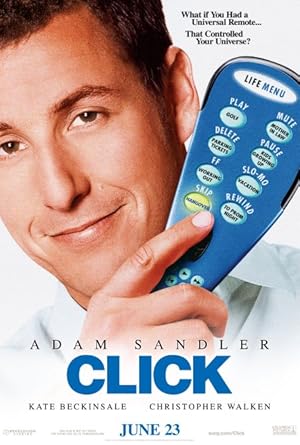
Click
Michael Newman (Sandler) is a hard working family man, who must please his boss (Hasselhoff), in order to get promoted. Problem is he gets less time with his family, and wishes for a remote in which he can control his life. This soon comes true for Newman, when he meets Morty (Walken), a crazy sales clerk, who has the ultimate remote. A remote in which he can do anything, including muting, skipping and dubbing his life. He finds this to be the opportunity in which he can not only skip every argument, but also skip to his promotion. He sees this as a good idea, until the remote goes horribly wrong.
Despite a considerable budget of $82.5M, Click became a solid performer, earning $240.7M worldwide—a 192% return.
Nominated for 1 Oscar. 3 wins & 12 nominations


Plot Structure
Story beats plotted across runtime


Narrative Arc
Emotional journey through the story's key moments
Story Circle
Blueprint 15-beat structure
Arcplot Score Breakdown
Weighted: Precision (70%) + Arc (15%) + Theme (15%)
Click (2006) showcases strategically placed plot construction, characteristic of Frank Coraci's storytelling approach. This structural analysis examines how the film's 15-point plot structure maps to proven narrative frameworks across 1 hour and 47 minutes. With an Arcplot score of 7.1, the film balances conventional beats with creative variation.
Characters
Cast & narrative archetypes

Michael Newman
Donna Newman
Morty
Mr. Ammer
Ben Newman
Samantha Newman
Ted Newman
Main Cast & Characters
Michael Newman
Played by Adam Sandler
A workaholic architect who sacrifices family time for career advancement, then receives a universal remote that controls his life.
Donna Newman
Played by Kate Beckinsale
Michael's loving wife who struggles with her husband's obsessive work habits and desires quality family time.
Morty
Played by Christopher Walken
A mysterious eccentric who works at Bed Bath & Beyond and gives Michael the universal remote with life-altering consequences.
Mr. Ammer
Played by David Hasselhoff
Michael's demanding boss who constantly dangles promotions and partnership while exploiting his dedication.
Ben Newman
Played by Joseph Castanon
Michael's young son who idolizes his father but suffers from his absence and repeats his workaholic patterns.
Samantha Newman
Played by Tatum McCann
Michael's young daughter who loves swimming and seeks her father's attention and approval.
Ted Newman
Played by Henry Winkler
Michael's father, a former swimming coach who represents traditional values and work-life balance.
Structural Analysis
The Status Quo at 2 minutes (2% through the runtime) establishes Michael Newman, overworked architect, struggles with his chaotic home life - broken universal remote, demanding kids, and constant work interruptions. His life is out of balance, prioritizing career over family.. The analysis reveals that this early placement immediately immerses viewers in the story world.
The inciting incident occurs at 12 minutes when Frustrated with his malfunctioning remotes, Michael goes to Bed Bath & Beyond seeking a universal remote. He encounters Morty, a mysterious employee who offers him a "universal" remote that controls far more than electronics.. At 12% through the film, this Disruption aligns precisely with traditional story structure. This beat shifts the emotional landscape, launching the protagonist into the central conflict.
The First Threshold at 26 minutes marks the transition into Act II, occurring at 24% of the runtime. This shows the protagonist's commitment to Michael actively chooses to use the remote to skip past an argument with Donna and fast-forward through a cold. He decides to embrace the remote's power to control his life and eliminate inconveniences, believing he can have it all., moving from reaction to action.
At 52 minutes, the Midpoint arrives at 49% of the runtime—precisely centered, creating perfect narrative symmetry. Notably, this crucial beat Michael becomes partner at the firm - his career dream achieved. False victory: he has professional success and the remote seems like the best thing ever. But the remote has been auto-skipping increasingly larger chunks of time without his explicit consent, and he's noticeably aged. Stakes raise dramatically., fundamentally raising what's at risk. The emotional intensity shifts, dividing the narrative into clear before-and-after phases.
The Collapse moment at 78 minutes (73% through) represents the emotional nadir. Here, Michael fast-forwards to his last day as CEO and discovers he's ancient, alone, and about to die. His son Ben is making the same mistakes - prioritizing work over family. Michael has a heart attack in the rain outside the office. The "whiff of death" is literal - he's dying, having wasted his entire life., reveals the protagonist at their lowest point. This beat's placement in the final quarter sets up the climactic reversal.
The Second Threshold at 83 minutes initiates the final act resolution at 78% of the runtime. Michael wakes up in Bed Bath & Beyond - it was all a vision/warning from Morty (the Angel of Death). He's been given a second chance. Armed with knowledge of what matters, Michael has clarity: he must choose family over career advancement. The synthesis of his ambition with his family values., demonstrating the transformation achieved throughout the journey.
Emotional Journey
Click's emotional architecture traces a deliberate progression across 15 carefully calibrated beats.
Narrative Framework
This structural analysis employs structural analysis methodology used to understand storytelling architecture. By mapping Click against these established plot points, we can identify how Frank Coraci utilizes or subverts traditional narrative conventions. The plot point approach reveals not only adherence to structural principles but also creative choices that distinguish Click within the comedy genre.
Frank Coraci's Structural Approach
Among the 5 Frank Coraci films analyzed on Arcplot, the average structural score is 6.9, demonstrating varied approaches to story architecture. Click represents one of the director's most structurally precise works. For comparative analysis, explore the complete Frank Coraci filmography.
Comparative Analysis
Additional comedy films include The Bad Guys, Ella Enchanted and The Evening Star. For more Frank Coraci analyses, see The Waterboy, Zookeeper and Here Comes the Boom.
Plot Points by Act
Act I
SetupStatus Quo
Michael Newman, overworked architect, struggles with his chaotic home life - broken universal remote, demanding kids, and constant work interruptions. His life is out of balance, prioritizing career over family.
Theme
Michael's father Ted tells him "Family comes first" during a visit, warning that work will consume him if he lets it. Michael dismisses this advice, insisting he needs to focus on his career to provide for his family.
Worldbuilding
Establishment of Michael's world: demanding boss Ammer, loving wife Donna, two children (Ben and Samantha), constant work-life conflict. Michael promises family time but repeatedly breaks promises due to work. His inability to control even his TV remote symbolizes his lack of control over his life.
Disruption
Frustrated with his malfunctioning remotes, Michael goes to Bed Bath & Beyond seeking a universal remote. He encounters Morty, a mysterious employee who offers him a "universal" remote that controls far more than electronics.
Resistance
Morty explains the remote's capabilities in his workshop. Michael is skeptical but intrigued. The remote can control time itself - pause, fast-forward, rewind his life. Morty warns there are consequences but Michael doesn't fully listen. Michael debates whether this is real or if he's dreaming.
Act II
ConfrontationFirst Threshold
Michael actively chooses to use the remote to skip past an argument with Donna and fast-forward through a cold. He decides to embrace the remote's power to control his life and eliminate inconveniences, believing he can have it all.
Mirror World
Michael uses the remote to pause time and have a heartfelt moment with his children, seeing their frozen smiles. This represents the life he could have if he were present - the relationship that will teach him what truly matters.
Premise
The "fun and games" of having a universal remote. Michael fast-forwards through arguments, illness, traffic, and tedious work moments. He gets his promotion by skipping ahead. The remote learns his preferences and starts auto-piloting, but Michael doesn't notice the warning signs that he's missing important moments with his family.
Midpoint
Michael becomes partner at the firm - his career dream achieved. False victory: he has professional success and the remote seems like the best thing ever. But the remote has been auto-skipping increasingly larger chunks of time without his explicit consent, and he's noticeably aged. Stakes raise dramatically.
Opposition
Michael discovers he's missed years of his life - his kids are grown, he's divorced from Donna (who has remarried), his father died (he auto-skipped the funeral), and he's morbidly obese. He tries to regain control but the remote has taken over. Every attempt to fix things makes them worse. He's become exactly what he feared - successful but alone.
Collapse
Michael fast-forwards to his last day as CEO and discovers he's ancient, alone, and about to die. His son Ben is making the same mistakes - prioritizing work over family. Michael has a heart attack in the rain outside the office. The "whiff of death" is literal - he's dying, having wasted his entire life.
Crisis
In the hospital, Michael is dying and processes his wasted life. He uses his last strength to drag himself to warn Ben not to make his mistakes. His emotional breakdown as he tells Ben "family comes first" - the same words his father told him - represents his complete understanding of what he's lost.
Act III
ResolutionSecond Threshold
Michael wakes up in Bed Bath & Beyond - it was all a vision/warning from Morty (the Angel of Death). He's been given a second chance. Armed with knowledge of what matters, Michael has clarity: he must choose family over career advancement. The synthesis of his ambition with his family values.
Synthesis
Michael rushes home and chooses his family. He tells Ammer he won't prioritize work over family anymore, risking his career. He kisses Donna in the rain (reversing the heart attack scene). He's present with his children. He throws away the remote, rejecting the temptation to control time.
Transformation
Michael wakes up with his family on the couch, a note reading "Good guys need a break" from Morty. The broken universal remote sits nearby - symbolic that he no longer needs to control everything. He's transformed from a workaholic into a present father and husband, having learned family comes first.