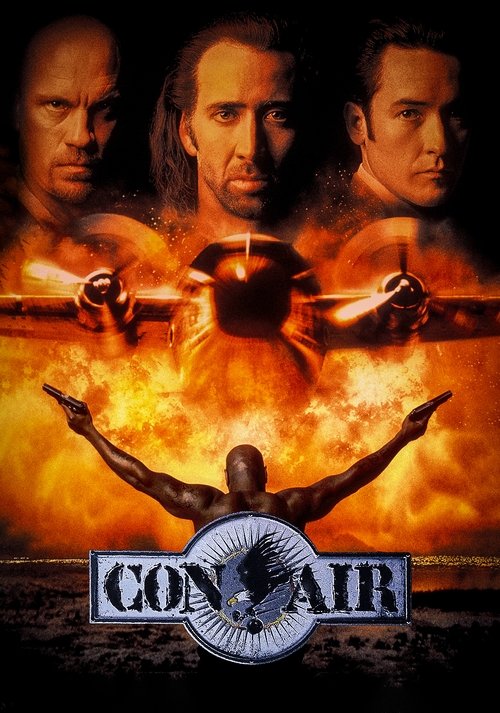
Con Air
Newly-paroled former US Army ranger Cameron Poe is headed back to his wife, but must fly home aboard a prison transport flight dubbed "Jailbird" taking the “worst of the worst” prisoners, a group described as “pure predators”, to a new super-prison. Poe faces impossible odds when the transport plane is skyjacked mid-flight by the most vicious criminals in the country led by the mastermind — genius serial killer Cyrus "The Virus" Grissom, and backed by black militant Diamond Dog and psychopath Billy Bedlam.
Despite a significant budget of $75.0M, Con Air became a commercial success, earning $224.0M worldwide—a 199% return.
Nominated for 2 Oscars. 7 wins & 11 nominations


Plot Structure
Story beats plotted across runtime


Narrative Arc
Emotional journey through the story's key moments
Story Circle
Blueprint 15-beat structure
Arcplot Score Breakdown
Weighted: Precision (70%) + Arc (15%) + Theme (15%)
Con Air (1997) showcases deliberately positioned narrative architecture, characteristic of Simon West's storytelling approach. This structural analysis examines how the film's 15-point plot structure maps to proven narrative frameworks across 1 hour and 56 minutes. With an Arcplot score of 7.5, the film showcases strong structural fundamentals.
Characters
Cast & narrative archetypes

Cameron Poe
Cyrus "The Virus" Grissom
Vince Larkin
Nathan "Diamond Dog" Jones
Garland Greene
Joe "Pinball" Parker
Duncan Malloy
William "Billy Bedlam" Bedford
Main Cast & Characters
Cameron Poe
Played by Nicolas Cage
Former Army Ranger wrongly imprisoned, protecting innocents during prison transport hijacking while trying to get home to his daughter.
Cyrus "The Virus" Grissom
Played by John Malkovich
Brilliant and ruthless criminal mastermind who orchestrates the hijacking of the prison transport plane.
Vince Larkin
Played by John Cusack
U.S. Marshal who believes in Poe's innocence and works to resolve the hijacking situation without unnecessary casualties.
Nathan "Diamond Dog" Jones
Played by Ving Rhames
Massive black militant criminal who becomes Cyrus's enforcer and second-in-command during the hijacking.
Garland Greene
Played by Steve Buscemi
Insane serial killer known as the Marietta Mangler, unpredictable and terrifying even to other criminals.
Joe "Pinball" Parker
Played by Dave Chappelle
Diabetic prisoner and friend to Poe who needs medical attention, representing the innocent caught in violence.
Duncan Malloy
Played by Colm Meaney
DEA agent in charge who takes a ruthless, shoot-first approach to ending the hijacking situation.
William "Billy Bedlam" Bedford
Played by Nick Chinlund
Psychotic criminal who works with Cyrus and demonstrates explosive violent tendencies.
Structural Analysis
The Status Quo at 1 minutes (1% through the runtime) establishes Cameron Poe, Army Ranger in dress uniform, arrives home on leave to surprise his pregnant wife Tricia. They dance together, establishing him as a loving husband and soon-to-be father with everything to live for.. Significantly, this early placement immediately immerses viewers in the story world.
The inciting incident occurs at 13 minutes when Eight years later: Poe has served his time and receives parole. He reads a letter from his daughter Casey (whom he's never met) and prepares to board the Jailbird transport plane home. Today is her birthday, and today he finally goes free.. At 11% through the film, this Disruption aligns precisely with traditional story structure. This beat shifts the emotional landscape, launching the protagonist into the central conflict.
The First Threshold at 27 minutes marks the transition into Act II, occurring at 24% of the runtime. This indicates the protagonist's commitment to Cyrus Grissom and his accomplices execute their escape plan, taking over the plane mid-flight. Poe witnesses guards being murdered but chooses to stay aboard rather than expose himself—he could escape, but Baby-O is injured and needs his insulin. Poe decides to play along as a convict to stay alive and help., moving from reaction to action.
At 58 minutes, the Midpoint arrives at 50% of the runtime—precisely centered, creating perfect narrative symmetry. Of particular interest, this crucial beat At the desert airfield refueling stop, Poe's attempt to get Baby-O medical help fails when Baby-O dies. Simultaneously, Larkin discovers Poe is actually a parolee, not a conspirator. The stakes raise: Poe has lost his innocent friend, his cover is thinner, and Cyrus now plans to pick up the worst criminal of all—his mentor., fundamentally raising what's at risk. The emotional intensity shifts, dividing the narrative into clear before-and-after phases.
The Collapse moment at 86 minutes (75% through) represents the emotional nadir. Here, Poe's cover is blown. Cyrus discovers he's a parolee and condemns him to death. Poe is beaten and about to be thrown from the plane. He put himself at risk to save others, and now he'll die without ever meeting his daughter. The "whiff of death" is literal—execution by fellow inmates., shows the protagonist at their lowest point. This beat's placement in the final quarter sets up the climactic reversal.
The Second Threshold at 92 minutes initiates the final act resolution at 79% of the runtime. Poe and Larkin make contact and coordinate a plan. Information is shared: Poe learns the plane will be shot down over Las Vegas; Larkin learns Poe is protecting a guard still aboard. Poe synthesizes his Ranger skills with his hard-won prison survival instincts—no more hiding. It's time to act., demonstrating the transformation achieved throughout the journey.
Emotional Journey
Con Air's emotional architecture traces a deliberate progression across 15 carefully calibrated beats.
Narrative Framework
This structural analysis employs structural analysis methodology used to understand storytelling architecture. By mapping Con Air against these established plot points, we can identify how Simon West utilizes or subverts traditional narrative conventions. The plot point approach reveals not only adherence to structural principles but also creative choices that distinguish Con Air within the action genre.
Simon West's Structural Approach
Among the 9 Simon West films analyzed on Arcplot, the average structural score is 7.4, reflecting strong command of classical structure. Con Air represents one of the director's most structurally precise works. For comparative analysis, explore the complete Simon West filmography.
Comparative Analysis
Additional action films include The Bad Guys, Puss in Boots and Venom: The Last Dance. For more Simon West analyses, see The Mechanic, The General's Daughter and Old Guy.
Plot Points by Act
Act I
SetupStatus Quo
Cameron Poe, Army Ranger in dress uniform, arrives home on leave to surprise his pregnant wife Tricia. They dance together, establishing him as a loving husband and soon-to-be father with everything to live for.
Theme
During the bar confrontation, one of the attackers mocks Poe's attempt to walk away: "What's wrong, soldier boy? Too good for us?" The theme emerges: when does a good man's strength become a liability? When should he fight, and when should he show restraint?
Worldbuilding
Poe's joyful homecoming is cut short when drunk locals attack him and Tricia outside a bar. Using his Ranger training, Poe defends them but accidentally kills one attacker. Despite self-defense, his military skills are deemed "lethal weapons" and he's sentenced to 7-10 years for manslaughter.
Disruption
Eight years later: Poe has served his time and receives parole. He reads a letter from his daughter Casey (whom he's never met) and prepares to board the Jailbird transport plane home. Today is her birthday, and today he finally goes free.
Resistance
Poe boards the C-123 transport with hardened criminals including Cyrus "The Virus" Grissom, Diamond Dog, and Johnny 23. U.S. Marshal Vince Larkin briefs the transfer operation. Poe befriends diabetic guard Baby-O and tries to stay invisible, but the plane is a powder keg of dangerous convicts.
Act II
ConfrontationFirst Threshold
Cyrus Grissom and his accomplices execute their escape plan, taking over the plane mid-flight. Poe witnesses guards being murdered but chooses to stay aboard rather than expose himself—he could escape, but Baby-O is injured and needs his insulin. Poe decides to play along as a convict to stay alive and help.
Mirror World
Marshal Vince Larkin is introduced as the thematic mirror—a by-the-book lawman who believes in rules and procedure, contrasting with Poe's improvisational survival. Larkin begins tracking the hijacked plane and clashes with DEA agent Malloy, who wants to destroy the plane with all aboard.
Premise
The "promise of the premise": convicts running wild on a hijacked plane. Poe navigates deadly inmates, secretly helps guard Baby-O, hides his parolee status, and attempts to signal authorities during a fuel stop in Lerner Airfield. Each convict's personality creates chaos: Johnny 23 assaults the female guard, Diamond Dog philosophizes, Garland Greene terrifies everyone.
Midpoint
At the desert airfield refueling stop, Poe's attempt to get Baby-O medical help fails when Baby-O dies. Simultaneously, Larkin discovers Poe is actually a parolee, not a conspirator. The stakes raise: Poe has lost his innocent friend, his cover is thinner, and Cyrus now plans to pick up the worst criminal of all—his mentor.
Opposition
Everything intensifies. The plane picks up Cyrus's associate. Poe is suspected by both sides—convicts doubt his loyalty, authorities think he's complicit. Johnny 23 threatens the female guard; Poe must intervene without blowing his cover. Garland Greene disappears into a casino. DEA agent Malloy pushes to shoot the plane down, regardless of Poe or surviving guards.
Collapse
Poe's cover is blown. Cyrus discovers he's a parolee and condemns him to death. Poe is beaten and about to be thrown from the plane. He put himself at risk to save others, and now he'll die without ever meeting his daughter. The "whiff of death" is literal—execution by fellow inmates.
Crisis
Poe narrowly escapes death when an explosion rocks the plane (Larkin's intervention). He processes his failure—Baby-O dead, his cover blown, his family unreachable. But he finds new resolve: he still has the female guard to protect, and Larkin on the ground is his unlikely ally. He can still fight.
Act III
ResolutionSecond Threshold
Poe and Larkin make contact and coordinate a plan. Information is shared: Poe learns the plane will be shot down over Las Vegas; Larkin learns Poe is protecting a guard still aboard. Poe synthesizes his Ranger skills with his hard-won prison survival instincts—no more hiding. It's time to act.
Synthesis
The finale erupts across Las Vegas. The plane crash-lands on the Strip in spectacular fashion. Poe fights Cyrus hand-to-hand while protecting the guard. Larkin pursues on the ground, taking down convicts and standing up to Malloy. The action culminates with Cyrus killed by machinery and Poe finally free—proven a hero, not a criminal.
Transformation
Poe, battered and bloodied, arrives at his home carrying the stuffed bunny he's protected throughout the ordeal. His daughter Casey runs to him—"Are you my daddy?"—and he meets her for the first time. Where the opening showed a man dancing with his wife, the closing shows a father embracing the daughter he fought to reach. He's transformed from soldier to convict to father.