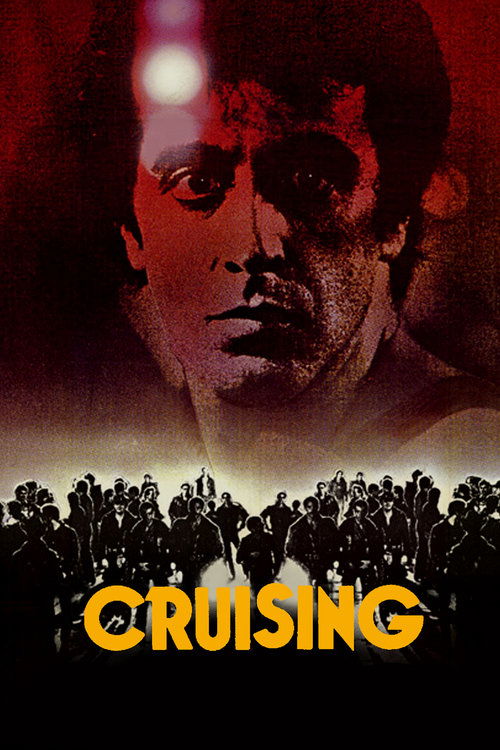
Cruising
When New York is caught in the grip of a sadistic serial killer who preys on patrons of the city's underground bars, young rookie Steve Burns infiltrates the S&M subculture to try and lure him out of the shadows.
Working with a modest budget of $11.0M, the film achieved a modest success with $19.8M in global revenue (+80% profit margin).


Plot Structure
Story beats plotted across runtime


Narrative Arc
Emotional journey through the story's key moments
Story Circle
Blueprint 15-beat structure
Arcplot Score Breakdown
Weighted: Precision (70%) + Arc (15%) + Theme (15%)
Cruising (1980) showcases meticulously timed story structure, characteristic of William Friedkin's storytelling approach. This structural analysis examines how the film's 15-point plot structure maps to proven narrative frameworks across 1 hour and 42 minutes. With an Arcplot score of 7.1, the film balances conventional beats with creative variation.
Characters
Cast & narrative archetypes

Steve Burns
Captain Edelson
Nancy Burns
Ted Bailey
Skip Lee
Stuart Richards
Main Cast & Characters
Steve Burns
Played by Al Pacino
A young NYPD officer who goes undercover in the gay S&M subculture to catch a serial killer targeting gay men.
Captain Edelson
Played by Paul Sorvino
Steve's police captain who assigns him to the undercover operation and monitors his progress.
Nancy Burns
Played by Karen Allen
Steve's girlfriend who becomes increasingly concerned and suspicious about his undercover work and emotional distance.
Ted Bailey
Played by Don Scardino
A Columbia University student and aspiring playwright who becomes a suspect and connects with Steve in the underground scene.
Skip Lee
Played by Jay Acovone
A leather-clad denizen of the gay nightlife who befriends Steve and helps him navigate the subculture.
Stuart Richards
Played by Richard Cox
A wealthy gay man who lives in the Village and becomes romantically interested in Steve during the investigation.
Structural Analysis
The Status Quo at 1 minutes (1% through the runtime) establishes Steve Burns lives a quiet life with his girlfriend Nancy in a modest apartment, working as a beat cop. He represents conventional heterosexual masculinity and stability before his world is disrupted.. Significantly, this early placement immediately immerses viewers in the story world.
The inciting incident occurs at 12 minutes when Burns is specifically recruited by his superiors to go undercover in the gay leather subculture to catch the killer. This assignment threatens both his relationship and his sense of self.. At 12% through the film, this Disruption aligns precisely with traditional story structure. This beat shifts the emotional landscape, launching the protagonist into the central conflict.
The First Threshold at 25 minutes marks the transition into Act II, occurring at 25% of the runtime. This shows the protagonist's commitment to Burns fully commits to the undercover operation, moving into a new apartment in the Village and beginning his immersion into the gay leather bar scene as a patrolling presence., moving from reaction to action.
At 51 minutes, the Midpoint arrives at 50% of the runtime—precisely centered, creating perfect narrative symmetry. Significantly, this crucial beat Burns witnesses a murder attempt in Morningside Park and pursues a suspect. This raises the stakes dramatically and blurs the line between his real identity and his undercover persona as he becomes personally involved., fundamentally raising what's at risk. The emotional intensity shifts, dividing the narrative into clear before-and-after phases.
The Collapse moment at 75 minutes (73% through) represents the emotional nadir. Here, Stuart Richards, Burns's neighbor and friend, is found murdered in Burns's apartment building. This death represents the collapse of the boundary between Burns's investigation and his personal life—the violence has touched him directly., demonstrates the protagonist at their lowest point. This beat's placement in the final quarter sets up the climactic reversal.
The Second Threshold at 81 minutes initiates the final act resolution at 80% of the runtime. Burns identifies Stuart's killer, Skip Lee, through evidence and confronts him. The arrest appears to resolve the case, allowing Burns to synthesize his experience and attempt to return to his former life., demonstrating the transformation achieved throughout the journey.
Emotional Journey
Cruising's emotional architecture traces a deliberate progression across 15 carefully calibrated beats.
Narrative Framework
This structural analysis employs a 15-point narrative structure framework that maps key story moments. By mapping Cruising against these established plot points, we can identify how William Friedkin utilizes or subverts traditional narrative conventions. The plot point approach reveals not only adherence to structural principles but also creative choices that distinguish Cruising within the crime genre.
William Friedkin's Structural Approach
Among the 10 William Friedkin films analyzed on Arcplot, the average structural score is 7.2, reflecting strong command of classical structure. Cruising takes a more unconventional approach compared to the director's typical style. For comparative analysis, explore the complete William Friedkin filmography.
Comparative Analysis
Additional crime films include The Bad Guys, Rustom and The Whole Ten Yards. For more William Friedkin analyses, see Sorcerer, Jade and Blue Chips.
Plot Points by Act
Act I
SetupStatus Quo
Steve Burns lives a quiet life with his girlfriend Nancy in a modest apartment, working as a beat cop. He represents conventional heterosexual masculinity and stability before his world is disrupted.
Theme
Captain Edelson tells Burns: "You don't have to be homosexual to do this job, but it helps." The film's central question is posed: Can one assume an identity without being consumed by it?
Worldbuilding
Burns is introduced to the NYPD investigation of serial murders in the gay leather bar scene. We see his ordinary life, his relationship with Nancy, and learn about the brutal killings targeting gay men in Greenwich Village.
Disruption
Burns is specifically recruited by his superiors to go undercover in the gay leather subculture to catch the killer. This assignment threatens both his relationship and his sense of self.
Resistance
Burns hesitates and debates taking the assignment. He receives guidance from fellow officers and begins his preparation, learning about the subculture he must infiltrate. Nancy expresses concern about the assignment's impact on their relationship.
Act II
ConfrontationFirst Threshold
Burns fully commits to the undercover operation, moving into a new apartment in the Village and beginning his immersion into the gay leather bar scene as a patrolling presence.
Mirror World
Burns meets Stuart Richards, a Columbia University student who becomes his neighbor and friendly guide to the gay community. Stuart represents an alternative identity and serves as a thematic mirror to Burns's investigation.
Premise
Burns fully inhabits his undercover persona, frequenting leather bars, observing the subculture, and encountering various suspects. He becomes increasingly absorbed in this world while the killer continues to strike.
Midpoint
Burns witnesses a murder attempt in Morningside Park and pursues a suspect. This raises the stakes dramatically and blurs the line between his real identity and his undercover persona as he becomes personally involved.
Opposition
Burns's relationship with Nancy deteriorates as he becomes more deeply embedded in the undercover world. The investigation intensifies, suspects emerge including Skip and Ted, and Burns's identity becomes increasingly fractured.
Collapse
Stuart Richards, Burns's neighbor and friend, is found murdered in Burns's apartment building. This death represents the collapse of the boundary between Burns's investigation and his personal life—the violence has touched him directly.
Crisis
Burns spirals in the aftermath of Stuart's death. He processes the horror of the killing and questions his role in the investigation. His identity crisis deepens as the lines between investigator and participant blur completely.
Act III
ResolutionSecond Threshold
Burns identifies Stuart's killer, Skip Lee, through evidence and confronts him. The arrest appears to resolve the case, allowing Burns to synthesize his experience and attempt to return to his former life.
Synthesis
Burns testifies at Skip's trial and the case concludes. He attempts to reintegrate into his relationship with Nancy and his previous life, but the experience has fundamentally altered him in ambiguous ways.
Transformation
In the apartment with Nancy, Burns looks at himself in the mirror wearing sunglasses from his undercover persona while Nancy disappears into another room. The ambiguous ending suggests Burns's identity has been irrevocably changed—he may have become what he was hunting.