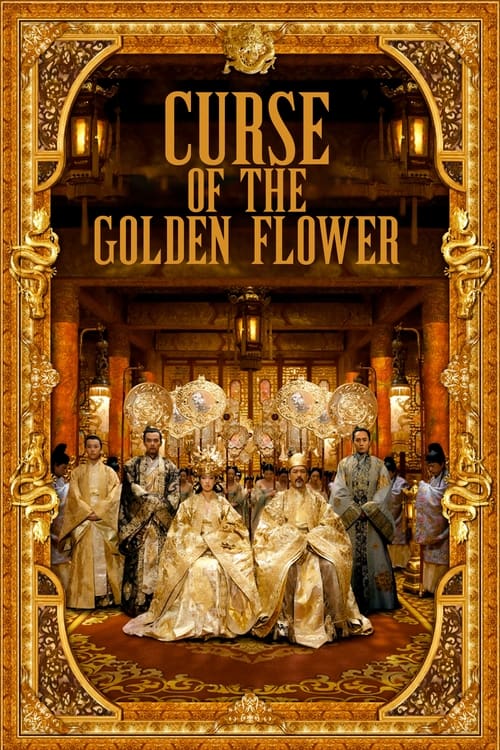
Curse of the Golden Flower
During China's Tang dynasty the emperor has taken the princess of a neighboring province as his wife. She has borne him two sons and raised his eldest. Now his control over his dominion is complete, including the royal family itself.
Working with a respectable budget of $45.0M, the film achieved a respectable showing with $78.6M in global revenue (+75% profit margin).
Nominated for 1 Oscar. 19 wins & 35 nominations


Plot Structure
Story beats plotted across runtime


Narrative Arc
Emotional journey through the story's key moments
Story Circle
Blueprint 15-beat structure
Arcplot Score Breakdown
Weighted: Precision (70%) + Arc (15%) + Theme (15%)
Curse of the Golden Flower (2006) demonstrates strategically placed narrative architecture, characteristic of Zhang Yimou's storytelling approach. This structural analysis examines how the film's 15-point plot structure maps to proven narrative frameworks across 1 hour and 54 minutes. With an Arcplot score of 7.0, the film balances conventional beats with creative variation.
Characters
Cast & narrative archetypes

Empress Phoenix
Emperor Ping
Crown Prince Wan
Prince Jai
Prince Yu
Imperial Doctor Jiang
Jiang Chan
Main Cast & Characters
Empress Phoenix
Played by Gong Li
The Emperor's second wife who plots rebellion after discovering she's been slowly poisoned by her husband for years.
Emperor Ping
Played by Chow Yun-fat
The ruthless Tang Dynasty ruler who maintains absolute control through manipulation, poison, and political machination.
Crown Prince Wan
Played by Liu Ye
The eldest prince and heir apparent who harbors an incestuous relationship with his stepmother and becomes embroiled in palace intrigue.
Prince Jai
Played by Jay Chou
The second prince, a skilled warrior returning from military campaigns who becomes caught between loyalty to family and moral conviction.
Prince Yu
Played by Qin Junjie
The youngest prince, a gentle soul overlooked by his father who ultimately becomes a tragic pawn in the palace conspiracy.
Imperial Doctor Jiang
Played by Ni Dahong
The Empress's loyal physician and secret lover who aids her rebellion and becomes the architect of the attempted coup.
Jiang Chan
Played by Li Man
Doctor Jiang's daughter and Prince Jai's love interest, torn between family loyalty and her forbidden feelings.
Structural Analysis
The Status Quo at 1 minutes (1% through the runtime) establishes The imperial palace prepares for the Chong Yang Festival. Servants methodically dress Empress Phoenix in elaborate golden robes, establishing the rigid hierarchy and ornate spectacle of palace life. The Empress appears outwardly compliant but her eyes reveal hidden anguish.. Of particular interest, this early placement immediately immerses viewers in the story world.
The inciting incident occurs at 13 minutes when Prince Jai reveals to his mother the Empress that her daily medicine contains black fungus poison - the Emperor has been slowly poisoning her for years. This revelation destroys the Empress's illusion of her marriage and confirms the Emperor's murderous intentions.. At 12% through the film, this Disruption aligns precisely with traditional story structure. This beat shifts the emotional landscape, launching the protagonist into the central conflict.
The First Threshold at 28 minutes marks the transition into Act II, occurring at 24% of the runtime. This demonstrates the protagonist's commitment to The Empress makes the irrevocable choice to move forward with armed rebellion against the Emperor. She sends word to her father to mobilize troops. There is no turning back from treason - she crosses from victim to active conspirator., moving from reaction to action.
At 58 minutes, the Midpoint arrives at 50% of the runtime—precisely centered, creating perfect narrative symmetry. Of particular interest, this crucial beat The Emperor reveals he has known about the conspiracy all along. In a devastating confrontation, he exposes that Prince Jai is actually his son with the Empress from before she married him - their incestuous relationship is the true secret. This false defeat reveals the Emperor holds all the cards., fundamentally raising what's at risk. The emotional intensity shifts, dividing the narrative into clear before-and-after phases.
The Collapse moment at 85 minutes (75% through) represents the emotional nadir. Here, The Empress learns that Crown Prince Wan has successfully blocked her father's troops - they will not arrive in time. Her conspiracy has failed. Prince Yu discovers Chan is actually his half-sister (the Emperor's daughter), destroying their love. All hope collapses as the Emperor's complete control is revealed., reveals the protagonist at their lowest point. This beat's placement in the final quarter sets up the climactic reversal.
The Second Threshold at 93 minutes initiates the final act resolution at 82% of the runtime. The Empress decides to launch the rebellion anyway, not for victory but for defiance. She dons her golden armor and mobilizes her golden-clad forces. She chooses visible resistance over silent death - synthesizing her maternal love and royal pride into one final act of will., demonstrating the transformation achieved throughout the journey.
Emotional Journey
Curse of the Golden Flower's emotional architecture traces a deliberate progression across 15 carefully calibrated beats.
Narrative Framework
This structural analysis employs proven narrative structure principles that track dramatic progression. By mapping Curse of the Golden Flower against these established plot points, we can identify how Zhang Yimou utilizes or subverts traditional narrative conventions. The plot point approach reveals not only adherence to structural principles but also creative choices that distinguish Curse of the Golden Flower within the action genre.
Zhang Yimou's Structural Approach
Among the 11 Zhang Yimou films analyzed on Arcplot, the average structural score is 6.8, demonstrating varied approaches to story architecture. Curse of the Golden Flower represents one of the director's most structurally precise works. For comparative analysis, explore the complete Zhang Yimou filmography.
Comparative Analysis
Additional action films include The Bad Guys, Puss in Boots and Venom: The Last Dance. For more Zhang Yimou analyses, see Full River Red, Cliff Walkers and The Flowers of War.
Plot Points by Act
Act I
SetupStatus Quo
The imperial palace prepares for the Chong Yang Festival. Servants methodically dress Empress Phoenix in elaborate golden robes, establishing the rigid hierarchy and ornate spectacle of palace life. The Empress appears outwardly compliant but her eyes reveal hidden anguish.
Theme
Prince Jai tells the Empress: "In this palace, everyone wears a mask." This encapsulates the central theme: the destructive nature of power, secrecy, and forbidden desire masked behind ceremonial beauty and familial duty.
Worldbuilding
Establishes the palace's elaborate protocols, the relationships between Emperor, Empress, and three princes. We learn the Empress takes medicine daily administered by the Imperial Doctor. The Emperor returns from campaign. Prince Yu secretly loves Chan, the Imperial Doctor's daughter. Layered tensions simmer beneath ceremonial formality.
Disruption
Prince Jai reveals to his mother the Empress that her daily medicine contains black fungus poison - the Emperor has been slowly poisoning her for years. This revelation destroys the Empress's illusion of her marriage and confirms the Emperor's murderous intentions.
Resistance
The Empress debates whether to resist or accept her fate. She enlists Prince Jai in a conspiracy to overthrow the Emperor during the festival. They recruit the Empress's father, the General, to march troops into the capital. The Empress continues taking the poison to avoid suspicion while secretly planning rebellion.
Act II
ConfrontationFirst Threshold
The Empress makes the irrevocable choice to move forward with armed rebellion against the Emperor. She sends word to her father to mobilize troops. There is no turning back from treason - she crosses from victim to active conspirator.
Mirror World
Prince Yu's forbidden romance with Chan (the Imperial Doctor's daughter) deepens. Their genuine love contrasts with the Empress's twisted relationship with the Emperor, showing what love without power games could be - yet they too are trapped by palace hierarchy.
Premise
The palace becomes a chessboard of hidden moves. The Empress prepares her golden-armored forces. Prince Jai struggles with filial duty versus loyalty to his mother. The Emperor seems oblivious but makes subtle counter-moves. Chrysanthemums bloom everywhere for the festival, beautiful but symbolizing death. Secret alliances form and fracture.
Midpoint
The Emperor reveals he has known about the conspiracy all along. In a devastating confrontation, he exposes that Prince Jai is actually his son with the Empress from before she married him - their incestuous relationship is the true secret. This false defeat reveals the Emperor holds all the cards.
Opposition
The Emperor systematically dismantles the conspiracy. He sends Crown Prince Wan to intercept the Empress's father's troops. He manipulates Prince Jai's loyalty. The Empress realizes she is surrounded. The Emperor tightens control while maintaining the ceremonial facade of the festival. The palace becomes a beautiful prison closing in.
Collapse
The Empress learns that Crown Prince Wan has successfully blocked her father's troops - they will not arrive in time. Her conspiracy has failed. Prince Yu discovers Chan is actually his half-sister (the Emperor's daughter), destroying their love. All hope collapses as the Emperor's complete control is revealed.
Crisis
The Empress faces the darkness of her complete defeat. Prince Yu grieves his impossible love. The festival preparations continue mockingly around them. The Empress must choose: submit to death or fight anyway. In her darkest moment, she finds desperate resolve - if she cannot win, she will make her rebellion visible.
Act III
ResolutionSecond Threshold
The Empress decides to launch the rebellion anyway, not for victory but for defiance. She dons her golden armor and mobilizes her golden-clad forces. She chooses visible resistance over silent death - synthesizing her maternal love and royal pride into one final act of will.
Synthesis
The Chong Yang Festival erupts into spectacular warfare. Golden-armored troops battle silver-armored Imperial forces in the palace courtyard. Chrysanthemums are trampled in torrents of blood. Prince Jai fights for his mother. The Emperor watches coldly from above. The rebellion is crushed ruthlessly. Bodies pile in golden heaps. Beauty and death merge completely.
Transformation
The palace is restored to pristine order as if nothing happened. The Emperor sits on his throne. The Empress, now completely broken and docile, is again dressed in golden robes and continues taking her poison. The youngest prince serves them in silence. The mask of imperial perfection has been restored - power has crushed all rebellion and love, leaving only beautiful, deadly order.