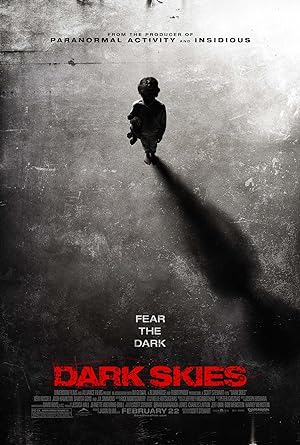
Dark Skies
The Barrett family-mother Lacy, father Daniel, older son Jesse, and younger son Sammy-reside on a quiet suburban street in an unnamed American city. Daniel is currently unemployed, placing the burden of supporting the family on Lacy, who works as a real estate agent. Their two sons enjoy a happy relationship and communicate with each other from their beds via walk-talkie. A number of strange occurrences befall the family. During the night, the contents of the kitchen are rearranged in bizarre configurations. The house alarm is set off when it detects that all entry points were breached simultaneously. Sammy suffers a fit while playing soccer and Lacy is shocked when hundreds of birds suddenly crash into the house. One night, Lacy is awakened by a sound from Sammy's room. When she goes to check on him, through the darkness she sees a figure standing over his bed. She turns on the light to find an empty room. Sammy is found walking away from the house but cannot remember leaving. Lacy, Daniel and Jesse each suffer catatonic episodes and regain consciousness with no memory of their experiences.
Despite its small-scale budget of $3.5M, Dark Skies became a commercial juggernaut, earning $27.9M worldwide—a remarkable 696% return. The film's compelling narrative found its audience, showing that strong storytelling can transcend budget limitations.


Plot Structure
Story beats plotted across runtime


Narrative Arc
Emotional journey through the story's key moments
Story Circle
Blueprint 15-beat structure
Arcplot Score Breakdown
Weighted: Precision (70%) + Arc (15%) + Theme (15%)
Dark Skies (2013) exemplifies deliberately positioned story structure, characteristic of Scott Stewart's storytelling approach. This structural analysis examines how the film's 15-point plot structure maps to proven narrative frameworks across 1 hour and 37 minutes. With an Arcplot score of 7.0, the film balances conventional beats with creative variation.
Characters
Cast & narrative archetypes

Lacy Barrett
Daniel Barrett
Jesse Barrett
Sammy Barrett
Edwin Pollard
Main Cast & Characters
Lacy Barrett
Played by Keri Russell
A working mother struggling to hold her family together while experiencing increasingly disturbing paranormal phenomena in their suburban home.
Daniel Barrett
Played by Josh Hamilton
An unemployed architect and father who initially dismisses the strange occurrences until undeniable evidence forces him to confront the threat to his family.
Jesse Barrett
Played by Dakota Goyo
The 13-year-old eldest son who becomes a primary target of the alien entities and experiences disturbing visitations.
Sammy Barrett
Played by Kadan Rockett
The younger Barrett son who exhibits signs of alien contact including night terrors and unexplained injuries.
Edwin Pollard
Played by J.K. Simmons
A paranormal expert and alien abduction specialist who provides the Barretts with crucial information about the extraterrestrial threat they face.
Structural Analysis
The Status Quo at 1 minutes (1% through the runtime) establishes The Barrett family appears normal in their suburban home. Daniel is unemployed but hiding it, Lacy works as a realtor. Their two sons Jesse and Sammy play in the yard. Surface normalcy masks underlying financial stress.. Structural examination shows that this early placement immediately immerses viewers in the story world.
The inciting incident occurs at 12 minutes when First inexplicable incident: The family wakes to find their kitchen ransacked with food arranged in bizarre geometric patterns. No signs of break-in. Security seems violated but there's no rational explanation - something impossible has invaded their home.. At 12% through the film, this Disruption aligns precisely with traditional story structure. This beat shifts the emotional landscape, launching the protagonist into the central conflict.
The First Threshold at 24 minutes marks the transition into Act II, occurring at 25% of the runtime. This shows the protagonist's commitment to Lacy witnesses impossible phenomenon: she finds Sammy standing catatonic in the yard at 3 AM, then watches on video as he talks to an invisible presence. She can no longer deny something paranormal is happening. She chooses to actively investigate rather than dismiss it., moving from reaction to action.
At 47 minutes, the Midpoint arrives at 49% of the runtime—precisely centered, creating perfect narrative symmetry. Structural examination shows that this crucial beat False victory collapses: Police arrive responding to alarm, but the family appears crazy - Daniel has inexplicably trashed his own house during a blackout. What they thought was gathering evidence now makes them look unstable. Their credibility is destroyed and they're more isolated than ever., fundamentally raising what's at risk. The emotional intensity shifts, dividing the narrative into clear before-and-after phases.
The Collapse moment at 72 minutes (74% through) represents the emotional nadir. Here, Pollard reveals the devastating truth: once you're chosen, there's no escape. One family member will be taken. The hope of protection dies. Pollard himself is a broken man, still tormented by the Greys. Their fight has been futile - they cannot win, only choose who to sacrifice., demonstrates the protagonist at their lowest point. This beat's placement in the final quarter sets up the climactic reversal.
The Second Threshold at 77 minutes initiates the final act resolution at 79% of the runtime. Synthesis of knowledge: The parents arm themselves with all their research and surveillance equipment. They decide to fight despite futility - not because they can win, but because protecting their children is what defines them. They combine Pollard's warnings with their own documented patterns., demonstrating the transformation achieved throughout the journey.
Emotional Journey
Dark Skies's emotional architecture traces a deliberate progression across 15 carefully calibrated beats.
Narrative Framework
This structural analysis employs structural analysis methodology used to understand storytelling architecture. By mapping Dark Skies against these established plot points, we can identify how Scott Stewart utilizes or subverts traditional narrative conventions. The plot point approach reveals not only adherence to structural principles but also creative choices that distinguish Dark Skies within the horror genre.
Scott Stewart's Structural Approach
Among the 3 Scott Stewart films analyzed on Arcplot, the average structural score is 6.8, demonstrating varied approaches to story architecture. Dark Skies represents one of the director's most structurally precise works. For comparative analysis, explore the complete Scott Stewart filmography.
Comparative Analysis
Additional horror films include Thinner, A Nightmare on Elm Street and Mary Reilly. For more Scott Stewart analyses, see Priest, Legion.
Plot Points by Act
Act I
SetupStatus Quo
The Barrett family appears normal in their suburban home. Daniel is unemployed but hiding it, Lacy works as a realtor. Their two sons Jesse and Sammy play in the yard. Surface normalcy masks underlying financial stress.
Theme
During a family dinner conversation, someone mentions "Things aren't always what they seem" - foreshadowing the hidden reality that will shatter their ordinary world and the inability to trust their perceptions.
Worldbuilding
Establishing the Barrett family dynamics: Daniel's job search frustration, Lacy's career pressures, Jesse's teenage rebelliousness with neighbor Ratner, young Sammy's innocence. Financial strain threatens their middle-class stability. Normal suburban life with underlying tension.
Disruption
First inexplicable incident: The family wakes to find their kitchen ransacked with food arranged in bizarre geometric patterns. No signs of break-in. Security seems violated but there's no rational explanation - something impossible has invaded their home.
Resistance
The family debates explanations: Daniel suspects neighborhood kids, Lacy worries about Sammy sleepwalking. They install alarm system and cameras. Strange incidents escalate - birds kamikaze into house, photos show marks on Sammy. They resist supernatural explanations, clinging to rational answers.
Act II
ConfrontationFirst Threshold
Lacy witnesses impossible phenomenon: she finds Sammy standing catatonic in the yard at 3 AM, then watches on video as he talks to an invisible presence. She can no longer deny something paranormal is happening. She chooses to actively investigate rather than dismiss it.
Mirror World
Lacy begins researching online, finding forums and accounts of similar experiences. This community of believers and experiencers represents an alternative worldview - those who've abandoned rationality for acceptance of the unexplainable. They offer knowledge but no comfort.
Premise
Full paranormal horror: mysterious nosebleeds, lost time, implanted memories, violent outbursts. Both sons show signs of alien contact. The family experiences the terror promised by the premise - suburban home invasion by unknowable entities. They document evidence, consult doctors who find unexplainable symptoms.
Midpoint
False victory collapses: Police arrive responding to alarm, but the family appears crazy - Daniel has inexplicably trashed his own house during a blackout. What they thought was gathering evidence now makes them look unstable. Their credibility is destroyed and they're more isolated than ever.
Opposition
The antagonistic forces close in: CPS investigates them as unfit parents, neighbors shun them, their children are terrorized nightly. Lacy finds expert Edwin Pollard who confirms "The Greys" are targeting them for abduction. The family fortifies the house but phenomena intensify - they're losing ground against an unstoppable force.
Collapse
Pollard reveals the devastating truth: once you're chosen, there's no escape. One family member will be taken. The hope of protection dies. Pollard himself is a broken man, still tormented by the Greys. Their fight has been futile - they cannot win, only choose who to sacrifice.
Crisis
Dark night of despair: The family grapples with the impossible choice. Lacy and Daniel prepare for the final night, knowing they'll lose a son. They hold each other in the darkness, facing the annihilation of their family unit with no solutions, only resignation and desperate love.
Act III
ResolutionSecond Threshold
Synthesis of knowledge: The parents arm themselves with all their research and surveillance equipment. They decide to fight despite futility - not because they can win, but because protecting their children is what defines them. They combine Pollard's warnings with their own documented patterns.
Synthesis
Final night siege: July 4th fireworks mask the coming. The family locks down together in one room, armed and watching. The Greys manifest - technology fails, reality distorts. In the chaos of the abduction attempt, the parents fight desperately. Jesse is taken despite everything. The invasion succeeds.
Transformation
Three months later: Missing person posters for Jesse cover Sammy's wall. The family endures, broken but together, waiting for a son who may never return. They've transformed from naive suburbanites to haunted believers - the opposite of the opening normalcy, forever marked by forces beyond human comprehension.