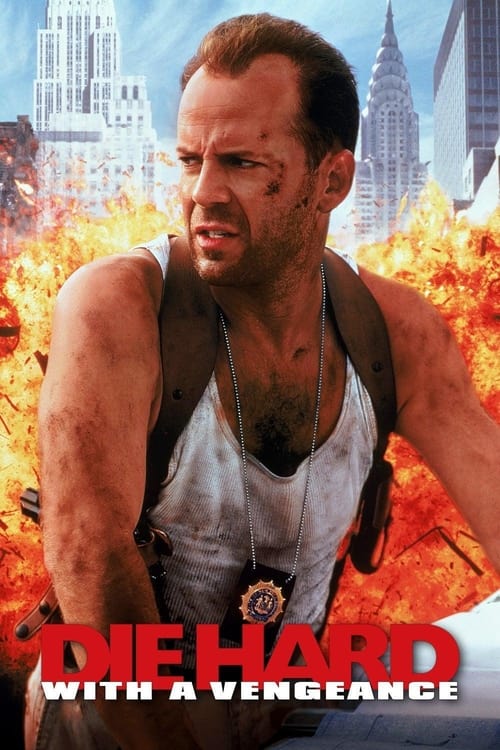
Die Hard: With a Vengeance
John McClane is forced out of suspension to play a game of "Simon Says" by a terrorist who has planted bombs all around New York City and will detonate them if McClane doesn't do what he says.
Despite a substantial budget of $90.0M, Die Hard: With a Vengeance became a financial success, earning $366.1M worldwide—a 307% return.
2 wins & 3 nominations


Plot Structure
Story beats plotted across runtime


Narrative Arc
Emotional journey through the story's key moments
Story Circle
Blueprint 15-beat structure
Characters
Cast & narrative archetypes

John McClane
Zeus Carver
Simon Gruber
Inspector Walter Cobb
Katya
Main Cast & Characters
John McClane
Played by Bruce Willis
A suspended NYPD detective forced to play a deadly game across New York City to prevent bombings orchestrated by a terrorist with a personal vendetta.
Zeus Carver
Played by Samuel L. Jackson
A Harlem electrician reluctantly dragged into McClane's crisis, becoming his unlikely partner in the deadly scavenger hunt across the city.
Simon Gruber
Played by Jeremy Irons
A brilliant, vengeful terrorist orchestrating an elaborate scheme involving riddles and bombs while secretly planning a massive gold heist at the Federal Reserve.
Inspector Walter Cobb
Played by Larry Bryggman
The NYPD inspector coordinating the response to Simon's terrorist threats and managing the chaos across New York City.
Katya
Played by Sam Phillips
Simon's cold, professional accomplice and lover who assists in the elaborate heist and terrorist plot.
Structural Analysis
The Status Quo at 2 minutes (2% through the runtime) establishes John McClane is revealed as a suspended, hungover wreck nursing a brutal hangover in his apartment. He's estranged from Holly, his career is in shambles, and he's hitting rock bottom - a far cry from the hero of Nakatomi Plaza.. Significantly, this early placement immediately immerses viewers in the story world.
The inciting incident occurs at 3 minutes when A massive bomb destroys the Bonwit Teller department store. Simon calls the police demanding John McClane - and only McClane - play his twisted game of "Simon Says," or more bombs will detonate across New York City.. At 2% through the film, this Disruption arrives earlier than typical, accelerating the narrative momentum. This beat shifts the emotional landscape, launching the protagonist into the central conflict.
The First Threshold at 31 minutes marks the transition into Act II, occurring at 24% of the runtime. This illustrates the protagonist's commitment to After the subway bomb threat, McClane and Zeus actively choose to work together as a team. Zeus commits to staying in the game despite having every reason to walk away. McClane accepts help - something the lone wolf hero struggles with. They cross into Act 2 as reluctant partners., moving from reaction to action.
At 63 minutes, the Midpoint arrives at 50% of the runtime—precisely centered, creating perfect narrative symmetry. Of particular interest, this crucial beat McClane discovers Simon is actually Simon Peter Gruber - brother of Hans Gruber, the terrorist he killed at Nakatomi Plaza. This isn't random terrorism; it's deeply personal revenge. The stakes shift from puzzle-solving to survival as McClane realizes he's been the target all along. False defeat: the game was rigged from the start., fundamentally raising what's at risk. The emotional intensity shifts, dividing the narrative into clear before-and-after phases.
The Collapse moment at 94 minutes (74% through) represents the emotional nadir. Here, Simon captures McClane and Zeus, handcuffing them to a bomb on a ship in the aqueduct. As water floods in, they face drowning while Simon escapes with the gold. McClane has failed - the villain has won, the gold is gone, and death seems certain. The whiff of death is literal as water rises around them., reveals the protagonist at their lowest point. This beat's placement in the final quarter sets up the climactic reversal.
The Second Threshold at 101 minutes initiates the final act resolution at 79% of the runtime. McClane pieces together the clues: an aspirin bottle from the truck reveals Simon's destination in Canada. The realization hits - they can still stop him. McClane and Zeus, now true partners forged through near-death, choose to pursue Simon across the border. They synthesize street smarts with detective work for the final confrontation., demonstrating the transformation achieved throughout the journey.
Emotional Journey
Die Hard: With a Vengeance's emotional architecture traces a deliberate progression across 15 carefully calibrated beats.
Narrative Framework
This structural analysis employs proven narrative structure principles that track dramatic progression. By mapping Die Hard: With a Vengeance against these established plot points, we can identify how John McTiernan utilizes or subverts traditional narrative conventions. The plot point approach reveals not only adherence to structural principles but also creative choices that distinguish Die Hard: With a Vengeance within the action genre.
John McTiernan's Structural Approach
Among the 11 John McTiernan films analyzed on Arcplot, the average structural score is 7.0, reflecting strong command of classical structure. Die Hard: With a Vengeance exemplifies the director's characteristic narrative technique. For comparative analysis, explore the complete John McTiernan filmography.
Comparative Analysis
Additional action films include The Bad Guys, Puss in Boots and Venom: The Last Dance. For more John McTiernan analyses, see Die Hard, Medicine Man and Basic.
Plot Points by Act
Act I
SetupStatus Quo
John McClane is revealed as a suspended, hungover wreck nursing a brutal hangover in his apartment. He's estranged from Holly, his career is in shambles, and he's hitting rock bottom - a far cry from the hero of Nakatomi Plaza.
Theme
Zeus Carver confronts McClane in Harlem, asking "Are you a racist?" This challenges the film's core theme: trust must be built across divides, and partnership requires seeing past surface judgments to recognize shared humanity.
Worldbuilding
The setup establishes McClane's fallen state, introduces the NYPD team including Inspector Cobb, and shows New York City as the vulnerable playground. Simon's first call comes in, demanding McClane play his deadly game or watch the city burn.
Disruption
A massive bomb destroys the Bonwit Teller department store. Simon calls the police demanding John McClane - and only McClane - play his twisted game of "Simon Says," or more bombs will detonate across New York City.
Resistance
McClane is forced to wear a racist sign in Harlem, where Zeus saves him from an angry crowd. The two are thrust together as Simon's games escalate. McClane resists partnership while Zeus questions why he's involved. Inspector Cobb coordinates from HQ as they debate how to handle the terrorist.
Act II
ConfrontationFirst Threshold
After the subway bomb threat, McClane and Zeus actively choose to work together as a team. Zeus commits to staying in the game despite having every reason to walk away. McClane accepts help - something the lone wolf hero struggles with. They cross into Act 2 as reluctant partners.
Mirror World
Zeus Carver fully emerges as McClane's thematic mirror. An electrician and community figure from Harlem, Zeus represents everything McClane isn't - rooted, principled, distrustful of cops. Their forced partnership will teach McClane that trust and teamwork are his path to redemption.
Premise
The "fun and games" of Simon Says: McClane and Zeus race across NYC solving riddles under time pressure. Water jug puzzle at the fountain, phone booth bombs, wall street chaos. The buddy-cop dynamic develops through bickering and reluctant respect as they narrowly survive each challenge.
Midpoint
McClane discovers Simon is actually Simon Peter Gruber - brother of Hans Gruber, the terrorist he killed at Nakatomi Plaza. This isn't random terrorism; it's deeply personal revenge. The stakes shift from puzzle-solving to survival as McClane realizes he's been the target all along. False defeat: the game was rigged from the start.
Opposition
Everything accelerates against our heroes. Simon's true plan emerges: the games were a diversion while his team robbed the Federal Reserve of $140 billion in gold. McClane and Zeus pursue leads while the NYPD scrambles. Simon's men are everywhere, the body count rises, and every move McClane makes seems anticipated.
Collapse
Simon captures McClane and Zeus, handcuffing them to a bomb on a ship in the aqueduct. As water floods in, they face drowning while Simon escapes with the gold. McClane has failed - the villain has won, the gold is gone, and death seems certain. The whiff of death is literal as water rises around them.
Crisis
Trapped and drowning, McClane and Zeus must work together to survive. In the dark night of the soul, they confront their mortality and their distrust of each other. Through desperate cooperation, they shoot their chains free and escape the flooding aqueduct - partnership literally saves their lives.
Act III
ResolutionSecond Threshold
McClane pieces together the clues: an aspirin bottle from the truck reveals Simon's destination in Canada. The realization hits - they can still stop him. McClane and Zeus, now true partners forged through near-death, choose to pursue Simon across the border. They synthesize street smarts with detective work for the final confrontation.
Synthesis
The finale unfolds as McClane and Zeus race to catch Simon at the Canadian border. McClane confronts Simon and his helicopter in a climactic showdown, using power lines to bring down the aircraft. Simon and his crew are killed, justice is served, and the gold is recovered. McClane's redemption is complete through partnership and perseverance.
Transformation
McClane and Zeus stand together amid the wreckage, exhausted but victorious. The man who started the film as a burned-out, isolated alcoholic has been redeemed through unlikely partnership. Zeus - who wanted nothing to do with cops - has found a friend. Trust across divides has saved them both. McClane is whole again.