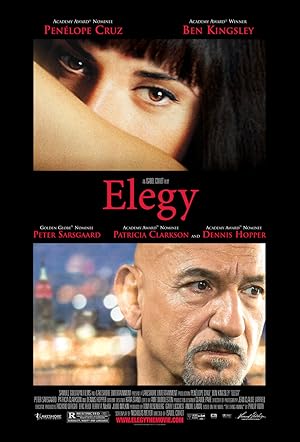
Elegy
David Kepesh is growing old. He's a professor of literature, a student of American hedonism, and an amateur musician and photographer. When he finds a student attractive, Consuela, a 24-year-old Cuban, he sets out to seduce her. Along the way, he swims in deeper feelings, maybe he's drowning. She presses him to sort out what he wants from her, and a relationship develops. They talk of traveling. He confides in his friend, George, a poet long-married, who advises David to grow up and grow old. She invites him to meet her family. His own son, from a long-ended marriage, confronts him. Is the elegy for lost relationships, lost possibilities, beauty and time passing, or failure of nerve?
Working with a small-scale budget of $13.0M, the film achieved a modest success with $14.9M in global revenue (+15% profit margin).
3 wins & 5 nominations


Plot Structure
Story beats plotted across runtime


Narrative Arc
Emotional journey through the story's key moments
Story Circle
Blueprint 15-beat structure
Arcplot Score Breakdown
Weighted: Precision (70%) + Arc (15%) + Theme (15%)
Elegy (2008) exhibits deliberately positioned dramatic framework, characteristic of Isabel Coixet's storytelling approach. This structural analysis examines how the film's 15-point plot structure maps to proven narrative frameworks across 1 hour and 52 minutes. With an Arcplot score of 6.7, the film balances conventional beats with creative variation.
Characters
Cast & narrative archetypes

David Kepesh
Consuela Castillo
George O'Hearn
Carolyn
Kenneth Kepesh
Main Cast & Characters
David Kepesh
Played by Ben Kingsley
A renowned cultural critic and professor who fears intimacy and aging, confronted by his deepest vulnerabilities when he falls for a younger student.
Consuela Castillo
Played by Penélope Cruz
A beautiful, intelligent graduate student who enters into a passionate relationship with her professor, challenging his emotional defenses.
George O'Hearn
Played by Dennis Hopper
David's poet friend and confidant who provides wisdom and perspective on love, mortality, and living authentically.
Carolyn
Played by Patricia Clarkson
David's long-term casual lover who accepts their arrangement but ultimately seeks something more meaningful.
Kenneth Kepesh
Played by Peter Sarsgaard
David's estranged son who harbors resentment toward his father's lifestyle choices and emotional unavailability.
Structural Analysis
The Status Quo at 1 minutes (1% through the runtime) establishes David Kepesh, a cultural critic and professor, is established in his comfortable routine of superficial affairs and intellectual detachment, living without emotional vulnerability.. Notably, this early placement immediately immerses viewers in the story world.
The inciting incident occurs at 14 minutes when Consuela Castillo enters David's classroom and he is immediately captivated by her extraordinary beauty, disrupting his usual emotional detachment.. At 12% through the film, this Disruption aligns precisely with traditional story structure. This beat shifts the emotional landscape, launching the protagonist into the central conflict.
The First Threshold at 28 minutes marks the transition into Act II, occurring at 25% of the runtime. This shows the protagonist's commitment to David and Consuela begin their affair. He makes the conscious choice to enter into this relationship despite knowing it threatens his carefully constructed emotional defenses., moving from reaction to action.
At 55 minutes, the Midpoint arrives at 49% of the runtime—precisely centered, creating perfect narrative symmetry. Of particular interest, this crucial beat David's jealousy erupts when Consuela invites him to a family gathering. His fear of commitment and inability to meet her emotionally causes a rift. False defeat: the relationship seems to be slipping away due to his inability to be vulnerable., fundamentally raising what's at risk. The emotional intensity shifts, dividing the narrative into clear before-and-after phases.
The Collapse moment at 83 minutes (74% through) represents the emotional nadir. Here, Consuela calls David after a year of silence to tell him she has breast cancer and needs him. The "whiff of death" is literal. David is confronted with the ultimate consequence of his emotional absence., reveals the protagonist at their lowest point. This beat's placement in the final quarter sets up the climactic reversal.
The Second Threshold at 89 minutes initiates the final act resolution at 80% of the runtime. David decides to go to Consuela. He chooses, finally, to be emotionally present and vulnerable, synthesizing what she tried to teach him about real intimacy with his capacity for devotion., demonstrating the transformation achieved throughout the journey.
Emotional Journey
Elegy's emotional architecture traces a deliberate progression across 15 carefully calibrated beats.
Narrative Framework
This structural analysis employs systematic plot point analysis that identifies crucial turning points. By mapping Elegy against these established plot points, we can identify how Isabel Coixet utilizes or subverts traditional narrative conventions. The plot point approach reveals not only adherence to structural principles but also creative choices that distinguish Elegy within the drama genre.
Isabel Coixet's Structural Approach
Among the 3 Isabel Coixet films analyzed on Arcplot, the average structural score is 6.8, demonstrating varied approaches to story architecture. Elegy takes a more unconventional approach compared to the director's typical style. For comparative analysis, explore the complete Isabel Coixet filmography.
Comparative Analysis
Additional drama films include After Thomas, South Pacific and Dirty Dancing: Havana Nights. For more Isabel Coixet analyses, see The Bookshop, My Life Without Me.
Plot Points by Act
Act I
SetupStatus Quo
David Kepesh, a cultural critic and professor, is established in his comfortable routine of superficial affairs and intellectual detachment, living without emotional vulnerability.
Theme
George tells David, "The only obsession everyone wants: 'love.' People think that in falling in love they make themselves whole. The Platonic union of souls. I think otherwise." The film's exploration of whether true intimacy is possible.
Worldbuilding
Introduction to David's world: his lectures, his friendship with poet George O'Hearn, his relationship with his son Kenny, and his comfortable pattern of detached sexual relationships with students.
Disruption
Consuela Castillo enters David's classroom and he is immediately captivated by her extraordinary beauty, disrupting his usual emotional detachment.
Resistance
David debates whether to pursue Consuela, consulting with George about his feelings. He struggles between his desire and his fear of vulnerability, eventually inviting her to a graduation party.
Act II
ConfrontationFirst Threshold
David and Consuela begin their affair. He makes the conscious choice to enter into this relationship despite knowing it threatens his carefully constructed emotional defenses.
Mirror World
Consuela represents everything David has avoided: youth, genuine emotion, vulnerability, and the possibility of real love. Their relationship becomes the mirror showing him what he's been missing.
Premise
The affair flourishes. David photographs Consuela obsessively, they share intimate moments, but his possessiveness and jealousy begin to emerge. The "fun and games" of their romance plays out.
Midpoint
David's jealousy erupts when Consuela invites him to a family gathering. His fear of commitment and inability to meet her emotionally causes a rift. False defeat: the relationship seems to be slipping away due to his inability to be vulnerable.
Opposition
David's internal antagonist (his fear of aging and emotional intimacy) intensifies. They break up. He attempts other relationships but finds them hollow. His son confronts him about his emotional cowardice. David spirals as he realizes what he's lost.
Collapse
Consuela calls David after a year of silence to tell him she has breast cancer and needs him. The "whiff of death" is literal. David is confronted with the ultimate consequence of his emotional absence.
Crisis
David sits with the devastating news, processing his failure to love her when he had the chance. He faces his darkest fear: that his emotional cowardice has cost him the only real love of his life.
Act III
ResolutionSecond Threshold
David decides to go to Consuela. He chooses, finally, to be emotionally present and vulnerable, synthesizing what she tried to teach him about real intimacy with his capacity for devotion.
Synthesis
David goes to Consuela in the hospital. He sees her mastectomy scar and finally offers her unconditional love and acceptance. He stays with her, offering genuine emotional support without his usual defenses or fear.
Transformation
David sits beside Consuela, finally capable of the vulnerability and presence he was incapable of before. The man who feared intimacy has become someone who can truly love, though it comes with the specter of loss.