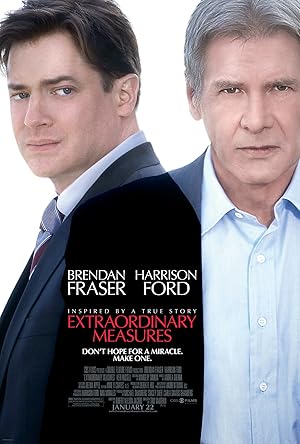
Extraordinary Measures
A Portland couple have two children with Pompe disease, a genetic anomaly that kills most before a child's tenth birthday. The husband, John, an advertising executive, contacts Robert Stonehill, a researcher in Nebraska who has done innovative research for an enzyme treatment. He has little money to fund his laboratory, and a thorny personality that drives away colleagues and funders. John and his wife Aileen raise money to help Stonehill's research and the required clinical trials. John takes on the task full time, working with venture capitalists and then rival teams of researchers. Time is running short, Stonehill's angry outburst hinder the company's faith in him, and the profit motive may upend John's hopes. The researchers race against time for the children who have the disease.
The film financial setback against its respectable budget of $31.0M, earning $15.1M globally (-51% loss). While initial box office returns were modest, the film has gained appreciation for its innovative storytelling within the drama genre.


Plot Structure
Story beats plotted across runtime


Narrative Arc
Emotional journey through the story's key moments
Story Circle
Blueprint 15-beat structure
Arcplot Score Breakdown
Weighted: Precision (70%) + Arc (15%) + Theme (15%)
Extraordinary Measures (2010) exhibits carefully calibrated dramatic framework, characteristic of Tom Vaughan's storytelling approach. This structural analysis examines how the film's 15-point plot structure maps to proven narrative frameworks across 1 hour and 46 minutes. With an Arcplot score of 6.8, the film balances conventional beats with creative variation.
Characters
Cast & narrative archetypes

John Crowley
Dr. Robert Stonehill
Aileen Crowley
Megan Crowley
Patrick Crowley
Marcus Temple
Main Cast & Characters
John Crowley
Played by Brendan Fraser
Father of two children with Pompe disease who races against time to find a cure by partnering with an unconventional scientist.
Dr. Robert Stonehill
Played by Harrison Ford
Brilliant but abrasive researcher whose groundbreaking theories on Pompe disease offer hope but require corporate partnership to realize.
Aileen Crowley
Played by Keri Russell
Dedicated mother who supports her husband's mission while managing the daily care of their sick children and maintaining family stability.
Megan Crowley
Played by Meredith Droeger
Eight-year-old daughter with Pompe disease who demonstrates remarkable courage and resilience despite her deteriorating condition.
Patrick Crowley
Played by Diego Velazquez
Six-year-old son with Pompe disease whose declining health drives his father's desperate search for treatment.
Marcus Temple
Played by Alan Ruck
Venture capitalist who provides crucial funding for the research but brings corporate pressures and timeline demands.
Structural Analysis
The Status Quo at 1 minutes (1% through the runtime) establishes John Crowley's seemingly normal family life in Portland - corporate executive with three children, two of whom have Pompe disease, a fatal genetic disorder.. Notably, this early placement immediately immerses viewers in the story world.
The inciting incident occurs at 13 minutes when John discovers Dr. Robert Stonehill's research on Pompe disease at the University of Nebraska. He realizes there might be a treatment, but it's unfunded and years from completion.. At 13% through the film, this Disruption is delayed, allowing extended setup of the story world. This beat shifts the emotional landscape, launching the protagonist into the central conflict.
The First Threshold at 27 minutes marks the transition into Act II, occurring at 25% of the runtime. This demonstrates the protagonist's commitment to John quits his job and commits to starting a biotech company with Stonehill. The family moves to Nebraska to be near the research facility., moving from reaction to action.
At 54 minutes, the Midpoint arrives at 51% of the runtime—precisely centered, creating perfect narrative symmetry. Of particular interest, this crucial beat The company secures a major partnership with a pharmaceutical corporation, providing needed funding and resources. False victory - they have money but are losing control of the research., fundamentally raising what's at risk. The emotional intensity shifts, dividing the narrative into clear before-and-after phases.
The Collapse moment at 80 minutes (76% through) represents the emotional nadir. Here, Megan has a medical crisis and is hospitalized. John faces the devastating reality that the drug may be ready but unavailable to his children, and time is running out., illustrates the protagonist at their lowest point. This beat's placement in the final quarter sets up the climactic reversal.
The Second Threshold at 85 minutes initiates the final act resolution at 80% of the runtime. John decides to fight the FDA and corporate bureaucracy. He finds a legal pathway through compassionate use protocols and rallies support from the Pompe community., demonstrating the transformation achieved throughout the journey.
Emotional Journey
Extraordinary Measures's emotional architecture traces a deliberate progression across 15 carefully calibrated beats.
Narrative Framework
This structural analysis employs structural analysis methodology used to understand storytelling architecture. By mapping Extraordinary Measures against these established plot points, we can identify how Tom Vaughan utilizes or subverts traditional narrative conventions. The plot point approach reveals not only adherence to structural principles but also creative choices that distinguish Extraordinary Measures within the drama genre.
Tom Vaughan's Structural Approach
Among the 2 Tom Vaughan films analyzed on Arcplot, the average structural score is 6.8, demonstrating varied approaches to story architecture. Extraordinary Measures exemplifies the director's characteristic narrative technique. For comparative analysis, explore the complete Tom Vaughan filmography.
Comparative Analysis
Additional drama films include After Thomas, South Pacific and Dirty Dancing: Havana Nights. For more Tom Vaughan analyses, see What Happens in Vegas.
Plot Points by Act
Act I
SetupStatus Quo
John Crowley's seemingly normal family life in Portland - corporate executive with three children, two of whom have Pompe disease, a fatal genetic disorder.
Theme
A doctor tells the Crowleys that their children likely won't live past age nine. The unspoken theme: how far would you go to save the ones you love?
Worldbuilding
Establishment of the Crowley family dynamics, John's corporate job, the daily medical routines for Megan and Patrick, and the ticking clock of their limited life expectancy.
Disruption
John discovers Dr. Robert Stonehill's research on Pompe disease at the University of Nebraska. He realizes there might be a treatment, but it's unfunded and years from completion.
Resistance
John debates leaving his lucrative career to pursue the risky venture of starting a biotech company. He meets the abrasive Dr. Stonehill and attempts to convince him to partner.
Act II
ConfrontationFirst Threshold
John quits his job and commits to starting a biotech company with Stonehill. The family moves to Nebraska to be near the research facility.
Mirror World
John and Stonehill's partnership begins - two opposite personalities forced to work together. Stonehill represents the scientific purity vs. John's desperate pragmatism.
Premise
The "promise of the premise" - watching a desperate father and brilliant scientist navigate the biotech startup world, fundraising, research setbacks, and small victories in their race against time.
Midpoint
The company secures a major partnership with a pharmaceutical corporation, providing needed funding and resources. False victory - they have money but are losing control of the research.
Opposition
Corporate pressures mount. The pharmaceutical company wants to delay trials, Stonehill chafes under corporate oversight, and John realizes he may lose access to the drug for his own children due to FDA conflict of interest rules.
Collapse
Megan has a medical crisis and is hospitalized. John faces the devastating reality that the drug may be ready but unavailable to his children, and time is running out.
Crisis
John confronts the dark irony: he helped create a treatment that may save thousands, but not his own children. He and Aileen face the possibility of losing their kids despite everything.
Act III
ResolutionSecond Threshold
John decides to fight the FDA and corporate bureaucracy. He finds a legal pathway through compassionate use protocols and rallies support from the Pompe community.
Synthesis
The clinical trial begins. Megan and Patrick receive the experimental treatment. The team monitors results while navigating final regulatory hurdles. John synthesizes his corporate skills with his father's heart.
Transformation
The children show improvement. John watches them play with renewed energy. The closing image mirrors the opening but transformed - the same family, now with hope and a future.