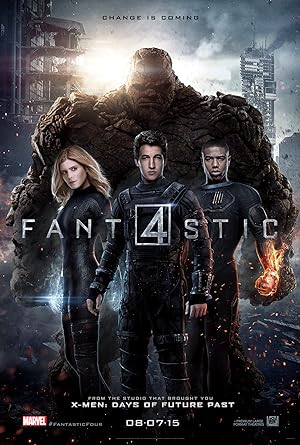
Fantastic Four
FANTASTIC FOUR, a contemporary re-imagining of Marvel's original and longest-running superhero team, centers on four young outsiders who teleport to an alternate and dangerous universe, which alters their physical form in shocking ways. Their lives irrevocably upended, the team must learn to harness their daunting new abilities and work together to save Earth from a former friend turned enemy.
Working with a significant budget of $120.0M, the film achieved a respectable showing with $168.0M in global revenue (+40% profit margin).
8 wins & 4 nominations


Plot Structure
Story beats plotted across runtime


Narrative Arc
Emotional journey through the story's key moments
Story Circle
Blueprint 15-beat structure
Arcplot Score Breakdown
Weighted: Precision (70%) + Arc (15%) + Theme (15%)
Fantastic Four (2015) demonstrates strategically placed story structure, characteristic of Josh Trank's storytelling approach. This structural analysis examines how the film's 15-point plot structure maps to proven narrative frameworks across 1 hour and 40 minutes. With an Arcplot score of 7.4, the film balances conventional beats with creative variation.
Characters
Cast & narrative archetypes

Reed Richards
Johnny Storm
Sue Storm
Ben Grimm
Victor von Doom
Dr. Franklin Storm
Main Cast & Characters
Reed Richards
Played by Miles Teller
A brilliant but socially awkward scientist who leads the dimensional travel project and becomes Mr. Fantastic with elasticity powers.
Johnny Storm
Played by Michael B. Jordan
Sue's reckless and impulsive younger brother who gains pyrokinetic abilities and becomes the Human Torch.
Sue Storm
Played by Kate Mara
A brilliant scientist and pattern recognition specialist who develops invisibility and force field powers.
Ben Grimm
Played by Jamie Bell
Reed's loyal childhood friend who becomes the rock-skinned Thing after exposure to the dimensional energy.
Victor von Doom
Played by Toby Kebbell
A brilliant but troubled scientist whose exposure to the other dimension transforms him into the powerful villain Doctor Doom.
Dr. Franklin Storm
Played by Reg E. Cathey
Sue and Johnny's father, a scientist who mentors Reed and directs the Baxter Foundation research program.
Structural Analysis
The Status Quo at 1 minutes (1% through the runtime) establishes Young Reed Richards works on his teleportation experiment in his garage, establishing him as a brilliant but isolated child with dreams of scientific discovery.. Significantly, this early placement immediately immerses viewers in the story world.
The inciting incident occurs at 12 minutes when Reed is recruited by Dr. Storm to join the Baxter Foundation and work on a full-scale quantum gate - his dream is suddenly within reach but requires leaving his old life behind.. At 12% through the film, this Disruption aligns precisely with traditional story structure. This beat shifts the emotional landscape, launching the protagonist into the central conflict.
The First Threshold at 26 minutes marks the transition into Act II, occurring at 26% of the runtime. This indicates the protagonist's commitment to After learning the military will control their discovery, Reed, Johnny, Victor, and Ben decide to take the unauthorized trip to Planet Zero themselves - a reckless choice driven by ego and fear of losing their achievement., moving from reaction to action.
At 49 minutes, the Midpoint arrives at 49% of the runtime—precisely centered, creating perfect narrative symmetry. Of particular interest, this crucial beat Ben (now The Thing) is deployed as a military weapon against his will. Reed witnesses this betrayal and realizes the government will exploit them. False defeat - they're prisoners, not heroes., fundamentally raising what's at risk. The emotional intensity shifts, dividing the narrative into clear before-and-after phases.
The Collapse moment at 74 minutes (74% through) represents the emotional nadir. Here, Victor returns and kills multiple scientists, destroys the facility, and begins opening a portal to destroy Earth. Dr. Storm is killed trying to stop him - literal death of the father figure/mentor., indicates the protagonist at their lowest point. This beat's placement in the final quarter sets up the climactic reversal.
The Second Threshold at 80 minutes initiates the final act resolution at 80% of the runtime. The team chooses to go through the portal together to stop Victor on Planet Zero - synthesizing the lesson that they're stronger together, accepting their powers instead of fighting them., demonstrating the transformation achieved throughout the journey.
Emotional Journey
Fantastic Four's emotional architecture traces a deliberate progression across 15 carefully calibrated beats.
Narrative Framework
This structural analysis employs a 15-point narrative structure framework that maps key story moments. By mapping Fantastic Four against these established plot points, we can identify how Josh Trank utilizes or subverts traditional narrative conventions. The plot point approach reveals not only adherence to structural principles but also creative choices that distinguish Fantastic Four within the action genre.
Josh Trank's Structural Approach
Among the 2 Josh Trank films analyzed on Arcplot, the average structural score is 7.1, reflecting strong command of classical structure. Fantastic Four represents one of the director's most structurally precise works. For comparative analysis, explore the complete Josh Trank filmography.
Comparative Analysis
Additional action films include The Bad Guys, Puss in Boots and Venom: The Last Dance. For more Josh Trank analyses, see Chronicle.
Plot Points by Act
Act I
SetupStatus Quo
Young Reed Richards works on his teleportation experiment in his garage, establishing him as a brilliant but isolated child with dreams of scientific discovery.
Theme
Ben Grimm tells Reed "You're not alone anymore" when they become friends - the theme about collaboration versus isolation, and how greatness requires connection to others.
Worldbuilding
Jump to teenage Reed and Ben perfecting the teleporter. They demonstrate it at the science fair where Dr. Franklin Storm and Sue Storm recognize Reed's genius and recruit him to the Baxter Foundation.
Disruption
Reed is recruited by Dr. Storm to join the Baxter Foundation and work on a full-scale quantum gate - his dream is suddenly within reach but requires leaving his old life behind.
Resistance
Reed integrates into the Baxter team, meeting Johnny Storm and Victor Von Doom. They work together to complete the quantum gate. Tension builds as Victor is possessive of the project and dismissive of government oversight.
Act II
ConfrontationFirst Threshold
After learning the military will control their discovery, Reed, Johnny, Victor, and Ben decide to take the unauthorized trip to Planet Zero themselves - a reckless choice driven by ego and fear of losing their achievement.
Mirror World
The team arrives on Planet Zero, experiencing wonder and achievement together - this moment of collaboration and discovery represents what they could accomplish as a unified team.
Premise
The Planet Zero disaster occurs. Victor is lost, the others gain powers. The team is separated and studied by the military. Each struggles alone with their transformation - the opposite of the collaboration theme.
Midpoint
Ben (now The Thing) is deployed as a military weapon against his will. Reed witnesses this betrayal and realizes the government will exploit them. False defeat - they're prisoners, not heroes.
Opposition
Reed escapes and goes into hiding for one year, trying to cure himself alone. The team remains fractured. Government pressure intensifies. They reopen the quantum gate and discover Victor is alive but transformed and hostile.
Collapse
Victor returns and kills multiple scientists, destroys the facility, and begins opening a portal to destroy Earth. Dr. Storm is killed trying to stop him - literal death of the father figure/mentor.
Crisis
The team confronts the reality that they must work together to stop Victor. Reed returns and they reunite, processing their trauma and Dr. Storm's death. They must become a team or the world ends.
Act III
ResolutionSecond Threshold
The team chooses to go through the portal together to stop Victor on Planet Zero - synthesizing the lesson that they're stronger together, accepting their powers instead of fighting them.
Synthesis
The team battles Victor on Planet Zero, using their powers in coordination. They defeat him by working together, each contributing their unique abilities. They return to Earth as a unified team.
Transformation
The team stands together in their new Baxter Foundation facility, no longer isolated or exploited. They name themselves the Fantastic Four - transformed from isolated individuals into a collaborative team of heroes.