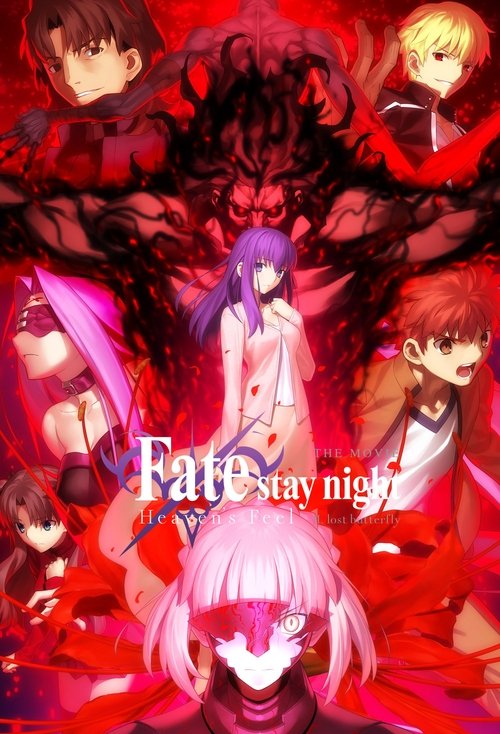
Fate/stay night: Heaven's Feel II. Lost Butterfly
Shirou has lost his Servant, Saber, and is no longer a Master in the Holy Grail War. Despite this, he refuses to leave the battle, determined to protect Sakura. Meanwhile, a mysterious shadow engulfs the city, killing Masters and Servants one by one. As Shirou faces new dangers, Sakura is drawn deeper into her own destiny as a mage.
The film earned $19.8M at the global box office.







Plot Structure
Story beats plotted across runtime


Narrative Arc
Emotional journey through the story's key moments
Story Circle
Blueprint 15-beat structure
Arcplot Score Breakdown
Weighted: Precision (70%) + Arc (15%) + Theme (15%)
Fate/stay night: Heaven's Feel II. Lost Butterfly (2019) reveals carefully calibrated plot construction, characteristic of Tomonori Sudo's storytelling approach. This structural analysis examines how the film's 12-point plot structure maps to proven narrative frameworks across 1 hour and 57 minutes. With an Arcplot score of 6.7, the film balances conventional beats with creative variation.
Structural Analysis
The Status Quo at 1 minutes (1% through the runtime) establishes Sakura wakes from a nightmare of shadow consumption, establishing her fractured mental state and the dark forces growing within her as the corrupted Holy Grail vessel.. Significantly, this early placement immediately immerses viewers in the story world.
The inciting incident occurs at 14 minutes when Shirou discovers Sakura unconscious and feverish after another shadow attack, with marks on her body suggesting her connection to the killings, forcing him to confront the truth.. At 12% through the film, this Disruption aligns precisely with traditional story structure. This beat shifts the emotional landscape, launching the protagonist into the central conflict.
At 58 minutes, the Midpoint arrives at 50% of the runtime—precisely centered, creating perfect narrative symmetry. The analysis reveals that this crucial beat Saber is consumed and corrupted by the shadow, becoming Saber Alter under Sakura's control - a false defeat showing the cost of Sakura's darkness and raising the stakes catastrophically., fundamentally raising what's at risk. The emotional intensity shifts, dividing the narrative into clear before-and-after phases.
The Collapse moment at 88 minutes (75% through) represents the emotional nadir. Here, Berserker is consumed by the shadow while protecting Illya, a literal death of the guardian figure, as Sakura fully transforms into Dark Sakura, the monster she feared becoming., reveals the protagonist at their lowest point. This beat's placement in the final quarter sets up the climactic reversal.
The Synthesis at 94 minutes initiates the final act resolution at 81% of the runtime. Shirou battles Saber Alter using Archer's arm despite his body breaking down; Rin fights to save her sister; Sakura struggles with her dark nature; threads converge toward final resolution., demonstrating the transformation achieved throughout the journey.
Emotional Journey
Fate/stay night: Heaven's Feel II. Lost Butterfly's emotional architecture traces a deliberate progression across 12 carefully calibrated beats.
Narrative Framework
This structural analysis employs proven narrative structure principles that track dramatic progression. By mapping Fate/stay night: Heaven's Feel II. Lost Butterfly against these established plot points, we can identify how Tomonori Sudo utilizes or subverts traditional narrative conventions. The plot point approach reveals not only adherence to structural principles but also creative choices that distinguish Fate/stay night: Heaven's Feel II. Lost Butterfly within the animation genre.
Tomonori Sudo's Structural Approach
Among the 3 Tomonori Sudo films analyzed on Arcplot, the average structural score is 6.6, demonstrating varied approaches to story architecture. Fate/stay night: Heaven's Feel II. Lost Butterfly represents one of the director's most structurally precise works. For comparative analysis, explore the complete Tomonori Sudo filmography.
Comparative Analysis
Additional animation films include The Bad Guys, The Quintessential Quintuplets Movie. For more Tomonori Sudo analyses, see Fate/stay night: Heaven's Feel I. Presage Flower, Fate/stay night: Heaven's Feel III. Spring Song.
Plot Points by Act
Act I
SetupStatus Quo
Sakura wakes from a nightmare of shadow consumption, establishing her fractured mental state and the dark forces growing within her as the corrupted Holy Grail vessel.
Theme
Rider tells Sakura that wanting to protect someone isn't wrong, foreshadowing the central question: can love justify protecting someone even when they become monstrous?
Worldbuilding
Establishes Shirou and Sakura's domestic routine, the ongoing Holy Grail War, Shirou's deteriorating connection with Saber, and the mysterious shadow killing Masters and Servants.
Disruption
Shirou discovers Sakura unconscious and feverish after another shadow attack, with marks on her body suggesting her connection to the killings, forcing him to confront the truth.
Resistance
Shirou debates whether to pursue the truth about Sakura while Zouken reveals himself, Kirei provides cryptic guidance, and Shirou learns more about the shadow's nature and Sakura's past suffering.
Act II
ConfrontationPremise
Shirou navigates protecting Sakura while battling other Servants; Rin investigates the shadow; the film explores the premise of choosing personal love over abstract ideals in a war.
Midpoint
Saber is consumed and corrupted by the shadow, becoming Saber Alter under Sakura's control - a false defeat showing the cost of Sakura's darkness and raising the stakes catastrophically.
Opposition
Shirou faces Saber Alter in brutal combat while losing his arm; Sakura's corruption accelerates; Rin discovers Sakura is her sister; Illya and Berserker battle the shadow; pressure intensifies from all sides.
Collapse
Berserker is consumed by the shadow while protecting Illya, a literal death of the guardian figure, as Sakura fully transforms into Dark Sakura, the monster she feared becoming.
Crisis
Shirou processes the loss and the revelation of Sakura's complete transformation; he confronts whether he can still protect someone who has become the very evil he swore to fight.
Act III
ResolutionSynthesis
Shirou battles Saber Alter using Archer's arm despite his body breaking down; Rin fights to save her sister; Sakura struggles with her dark nature; threads converge toward final resolution.
Transformation
Shirou lies broken and dying after defeating Saber Alter, having sacrificed everything for his choice, while Dark Sakura stands over him - the cost of love over idealism fully realized.